A note about links: If we include links to retail sites like Amazon or Bass Pro Shops, it's because they're relevant to the topic and, as anglers ourselves, we believe they're worth checking out. As an Amazon Associate we earn from qualifying purchases.
What it is
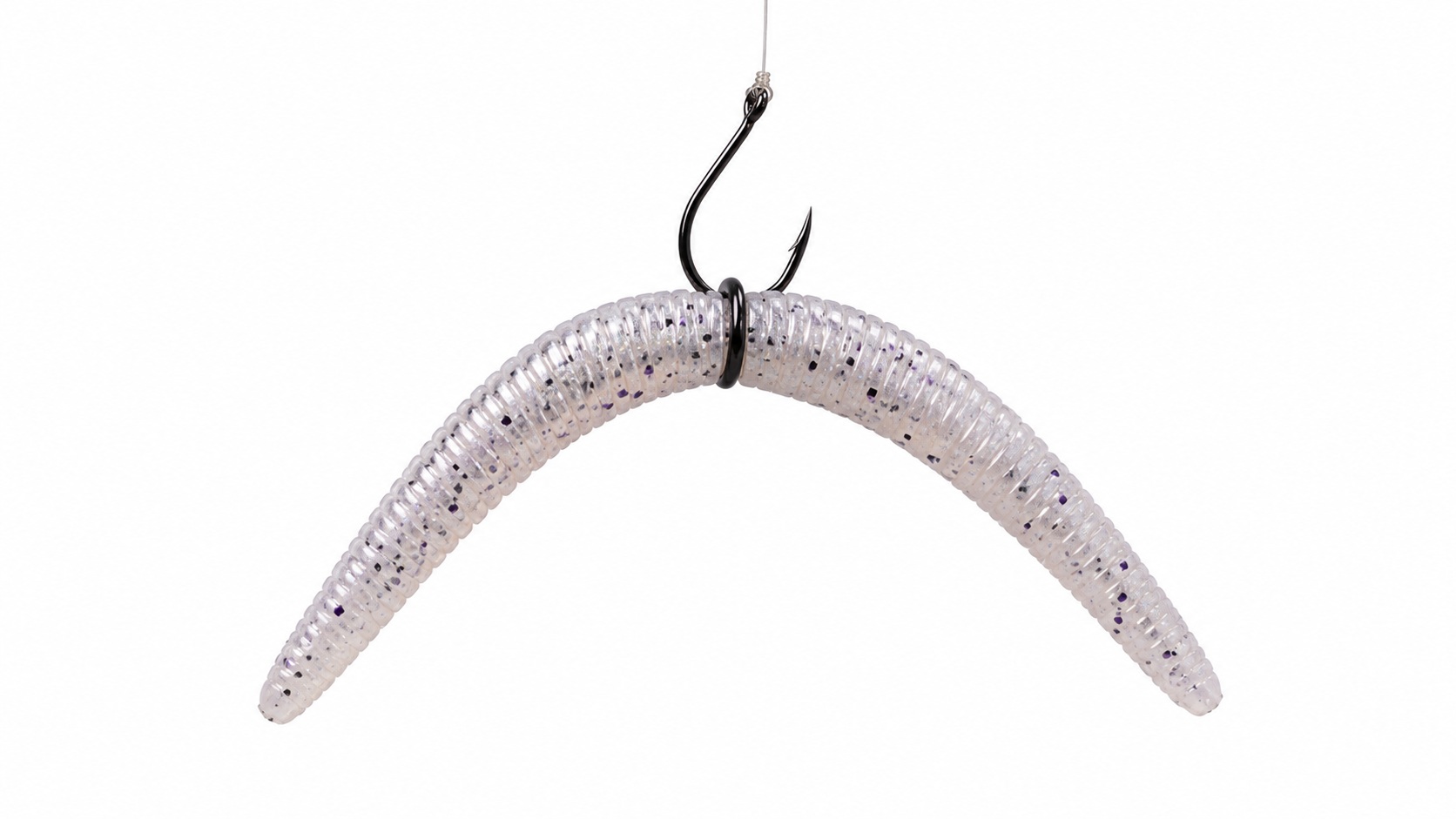
The wacky rig is about as simple as bass fishing gets. You hook a soft stick worm through the middle of its body — not the head, not the tail, but right in the center — and fish it weightless. Both ends hang free, and on the fall they wobble and undulate in a way that is nearly impossible for bass to ignore.
That action is what makes this rig work. There is nothing artificial-looking about it. A largemouth bass or smallmouth bass holding under a dock or along a shaded bank sees something that looks alive and sinking right toward it. Most strikes come on the fall before you ever move the bait.
The wacky rig earns its keep on pressured water. When fish have seen every crankbait and spinnerbait in the box, a slow-falling stick worm that barely asks anything of the angler often gets bit when nothing else will.
How to rig it
You need three things: a stick worm (a Yamamoto Senko or similar), a wacky-style hook, and ideally an o-ring tool.
O-ring first. Slipping a small silicone o-ring around the worm at its midpoint before you hook it changes the economics of this rig entirely. Without an o-ring, a single fish — or a single missed strike — tears the worm in half. With an o-ring, you hook through the rubber band rather than the plastic body, and the worm survives. Expect 15 to 30 fish per worm versus 1 or 2 without it. An inexpensive o-ring tool (a small plastic tube that slides rings onto worms in seconds) makes this effortless.
Hook selection. Use a wacky-style or drop-shot hook with a wide gap — Gamakatsu’s Wacky Hook, VMC’s Wacky Worm Hook, and Owner’s Wacky Hook are all proven options. Hook sizes in the 1/0 to 2/0 range cover most stick worms in the 4–5 inch class. The hook goes through the o-ring at the worm’s midpoint, point exposed.
Knot. Tie a non-slip loop knot directly to the hook eye. This lets the hook swing freely rather than pinning against the line, which preserves the natural wobble of the bait. A Palomar works too, but the loop knot is worth learning for this presentation.
How to fish it
Cast to your target — a dock piling, a laydown, a shaded bank edge — and let the bait fall on a semi-slack line. Watch your line. Most strikes happen during that initial drop, and you will often see the line jump or go slack before you feel anything.
If the bait reaches bottom without a bite, give it two or three small twitches with the rod tip. Let it settle again. Repeat until the bait is out of the strike zone, then pick up and cast again. This is not a fast retrieve. A single cast over a dock can take 30 seconds of slow work before you bring it back.
You can also skip the wacky rig under docks with a sidearm cast — its light, compact profile makes it one of the more skippable finesse rigs. That ability to reach shaded water a texas rig or ned rig can’t quite access is a real advantage in summer.
When to use it
The wacky rig is most productive in 1 to 10 feet of water, which puts it in play for most shallow-water bass fishing. It peaks during the spawn and post-spawn when fish are shallow and relatively easy to locate but have seen heavy pressure. Clear to lightly stained water is ideal. The bait falls slowly enough that fish have time to decide, but visibly enough that they can see it.
Spring and summer are the prime seasons. It fades somewhat in winter when fish slow down and hold deeper, though it still produces on warm days when bass move up.
Color selection
| Condition | Top Colors |
|---|---|
| Clear water | Green pumpkin, watermelon red |
| Lightly stained | Watermelon red, green pumpkin red flake |
| Stained / darker | Junebug, black blue |
| Sunny / bright | Natural shades — green pumpkin, watermelon |
Match the forage and water clarity. In very clear water, more natural colors win. When visibility drops, go darker so the fish can track the silhouette.
Gear setup
A medium-light spinning rod in the 6’10” to 7’2” range with a fast tip gives you the casting distance and sensitivity this rig needs. Spinning gear handles the light weights better than baitcasting in most situations.
Spool with 8–10 lb fluorocarbon, or use 10–15 lb braid with a 10 lb fluorocarbon leader. Fluorocarbon sinks, which keeps the bait in the strike zone on the fall. Braid is more sensitive but its buoyancy can affect the presentation in very shallow water.
Keep the drag set lighter than you think you need — hook sets on a wacky rig are mostly a matter of reeling tight and lifting, not driving an offset hook through plastic like you would on a texas rig.
Brands worth knowing
Yamamoto Senko is the benchmark. The salt-impregnated plastic gives it a slow, deliberate fall that other stick worms try to match. The 4-inch and 5-inch sizes are the standards.
Z-Man Finesse WormZ are made from ElaZtech, a tougher elastomer that holds up to strikes better than traditional soft plastic — useful if you’re burning through Senkos quickly.
Strike King KVD Finesse Worm fishes well wacky-style and comes in a wide color range at an accessible price point.
For hooks, Gamakatsu’s Wacky Hook and VMC’s Wacky Worm Hook are both sharp out of the package and hold up to repeated use. Owner’s Wacky Hook is a step up in wire gauge for fish over three pounds in heavier cover.
Pick up an o-ring tool in the same order as your hooks. It costs almost nothing and will pay for itself on the first outing.