A note about links: If we include links to retail sites like Amazon or Bass Pro Shops, it's because they're relevant to the topic and, as anglers ourselves, we believe they're worth checking out. As an Amazon Associate we earn from qualifying purchases.
What it is
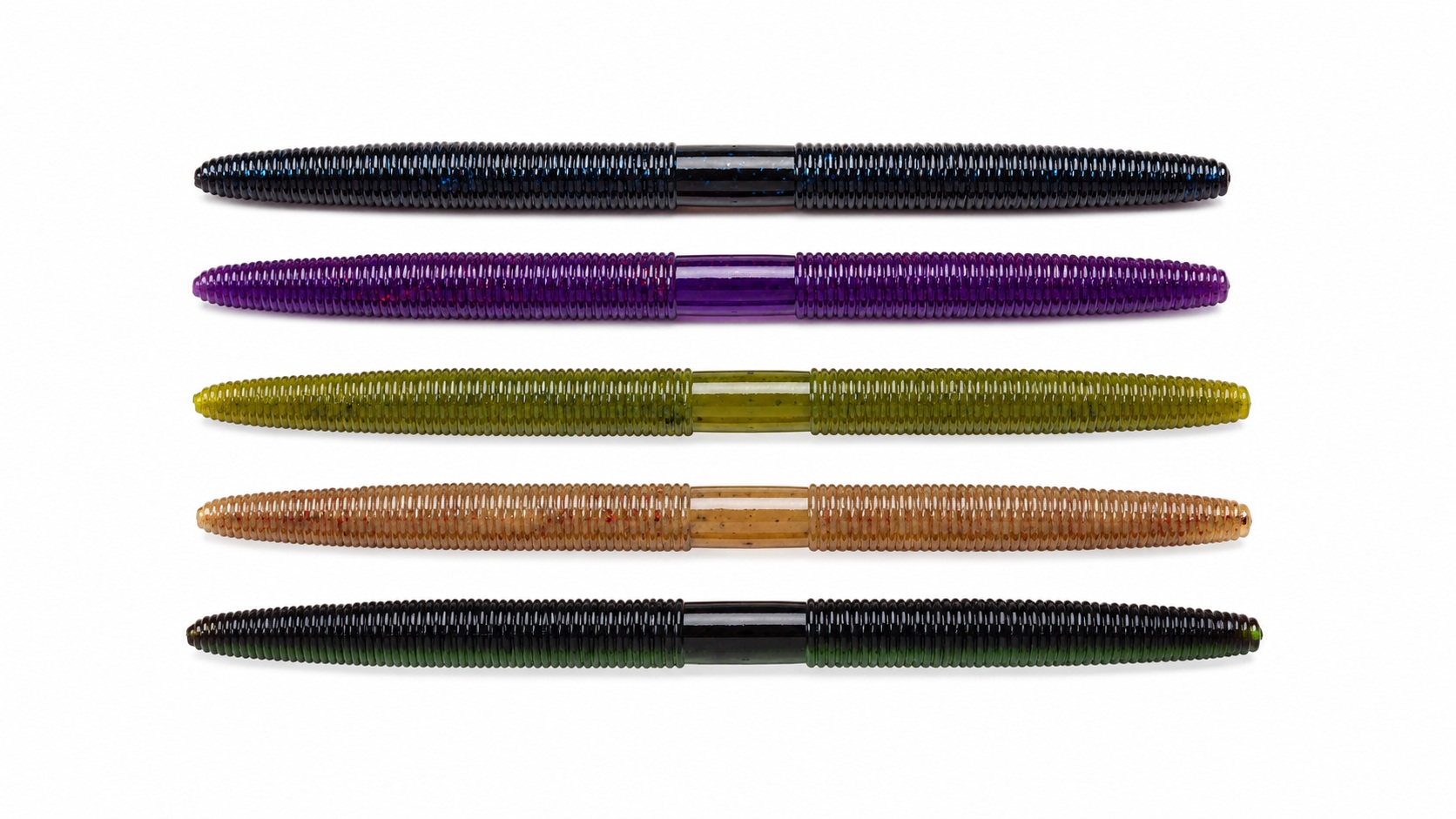
The stick worm is the most copied and most fished soft plastic in bass fishing. Its design is almost perversely simple: a thick, straight, cylindrical worm loaded with salt — no tail, no paddle, no action appendages of any kind. What it does instead is sink. Slowly, horizontally, with a subtle side-to-side shimmy driven entirely by the dense, salt-saturated plastic around the hook. That fall — and the unguarded moment when a bass inhales the bait as it hovers — is what makes the stick worm one of the most effective lures ever made.
Gary Yamamoto introduced the Senko in the 1990s. It quickly became the most-used bass bait on the tournament circuit and has held that status for over two decades. Every major soft plastic company has made a version of it.
How to rig it
The stick worm’s versatility comes from the fact that it works well on multiple rigs. Each changes the fall rate and the presentation depth.
Wacky rig (most popular)
Hook the worm through the middle of its body — straight through — with a size 1 or 1/0 weedless wacky hook (with a small wire weed guard) or a standard octopus hook for open water. The two ends hang down and wiggle in a “V” shape on the fall. This is the most visually appealing and most-fished stick worm setup. Use an O-ring (a small rubber ring placed around the worm’s middle) and hook through the ring rather than the plastic — the O-ring extends bait life significantly by keeping the hook from tearing through the plastic.
Weightless Texas rig
Skin-hook it onto an offset worm hook and fish it completely weightless. The bait sinks even slower than on the wacky rig. This is a phenomenal dock-skipping and open-water presentation. Watch your line — most bites come on the fall with no thump.
Neko rig
Push a small nail weight into the head of the worm to make one end heavier. Hook it wacky-style through the middle. The weighted nose touches bottom while the body stands up at an angle and twitches. This is a more active presentation than standard wacky rigging and works well over hard bottom.
Drop shot
Texas-rig the stick worm or use a nose hook and hang it above a drop shot weight. Effective in deeper water (10–25 feet) over main-lake structure.
Texas rig (with weight)
Standard Texas rig with a 1/8 to 3/8 oz bullet weight for fishing deeper or in wind. Loses some of the signature fall action but becomes more castable in tough conditions.
How to fish it
The stick worm is a “dead-stick” bait — the less you do, the better it usually works.
Open-water wacky rig: Cast to a target (dock, laydown, grass edge), kill all movement, and watch your line. The bait sinks 1–2 feet per second on the wacky rig. Count it down to the depth where fish are holding and then wait. Twitch gently. Wait. Most strikes come on the pause. When you feel weight or see the line move sideways, set the hook with a smooth sweep — don’t slam it, because the wacky hook is small and the plastic will tear.
Dock skipping: Skip the weightless Texas-rigged stick worm under floating docks by casting sidearm and releasing early, letting the bait skip across the surface like a flat stone. This gets the bait into the 3–4 feet of shaded water under a dock that no other presentation can reach cleanly.
Deep dock fishing: Find a dock over 6 or more feet of water. Lower the wacky-rigged bait straight down alongside each piling, count it to the bottom, and let it rest for 10–15 seconds. Often the strike happens at a specific depth — once you find it, return there on every piling.
When to use it
The stick worm is an all-seasons bait that genuinely performs year-round. Some high-percentage windows:
- Pre-spawn / spawn (late winter through spring): Wacky-rigged around spawning flats and near beds. Bass cannot ignore a bait hovering over their nest.
- Summer docks: On clear-water lakes, wacky-rigged stick worms under dock shade produce when midday heat pushes fish deep into cover.
- Post-front (tough conditions): When a cold front locks fish down and aggressive presentations get ignored, the do-nothing fall of a stick worm on light line is one of the few reliable openers.
- Clear water: The natural fall looks like nothing unnatural. In gin-clear reservoirs where fish get a long look at approaching baits, the stick worm is often the answer.
Sizes and colors
| Size | Best for |
|---|---|
| 3 inch | Finesse / small water / ultralight spinning |
| 4 inch | Finesse; slightly pressured conditions |
| 5 inch | Standard all-around; most applications |
| 6 inch | Big-bass targeting; trophy waters |
Color selection is simpler than it looks:
- Green pumpkin / watermelon: Clear to lightly stained water; imitates crawfish and baitfish
- Black / junebug: Dark or stained water; high-visibility silhouette
- Natural shad / white: Open water around baitfish; clearer conditions
- Chartreuse: High-visibility dirty water; often paired as a tail dip color
Most anglers start with green pumpkin and add black for dark/stained conditions. Those two colors cover the majority of situations.
Brands worth knowing
Yamamoto Senko is the original and the benchmark. The proprietary salt-and-plastic formula creates a density and fall rate that many copies have tried and failed to perfectly replicate. The 5-inch Senko in green pumpkin (#297) or watermelon (#208) is the standard.
Z-Man TRD TicklerZ (3.5 inch) uses ElaZtech, an elastic plastic that is nearly indestructible. It lasts far longer than standard plastics on a wacky hook — a selling point given how quickly traditional stick worms get torn up.
Strike King Shim-E-Stick is a widely available, competitively priced option that performs well on the wacky rig.
Berkley PowerBait MaxScent The General takes the stick worm concept and adds Berkley’s scent technology. The PowerBait scent compound is well-documented to increase hold time on the bait.