A note about links: If we include links to retail sites like Amazon or Bass Pro Shops, it's because they're relevant to the topic and, as anglers ourselves, we believe they're worth checking out. As an Amazon Associate we earn from qualifying purchases.
Hook into your first smallmouth bass and one thing becomes immediately clear: nothing in fresh water fights like this. The bronzeback rockets skyward, cartwheels across the surface, and keeps coming back for more long after you expect it to quit. Ounce for ounce, no freshwater species in North America matches the smallmouth’s raw aggression on the end of a line. Targeting them in a fast-moving Appalachian river or off a wave-swept Great Lakes point, feeling that first surge of power, is one of those fishing experiences that rewires what you expect from the sport.
How to identify one
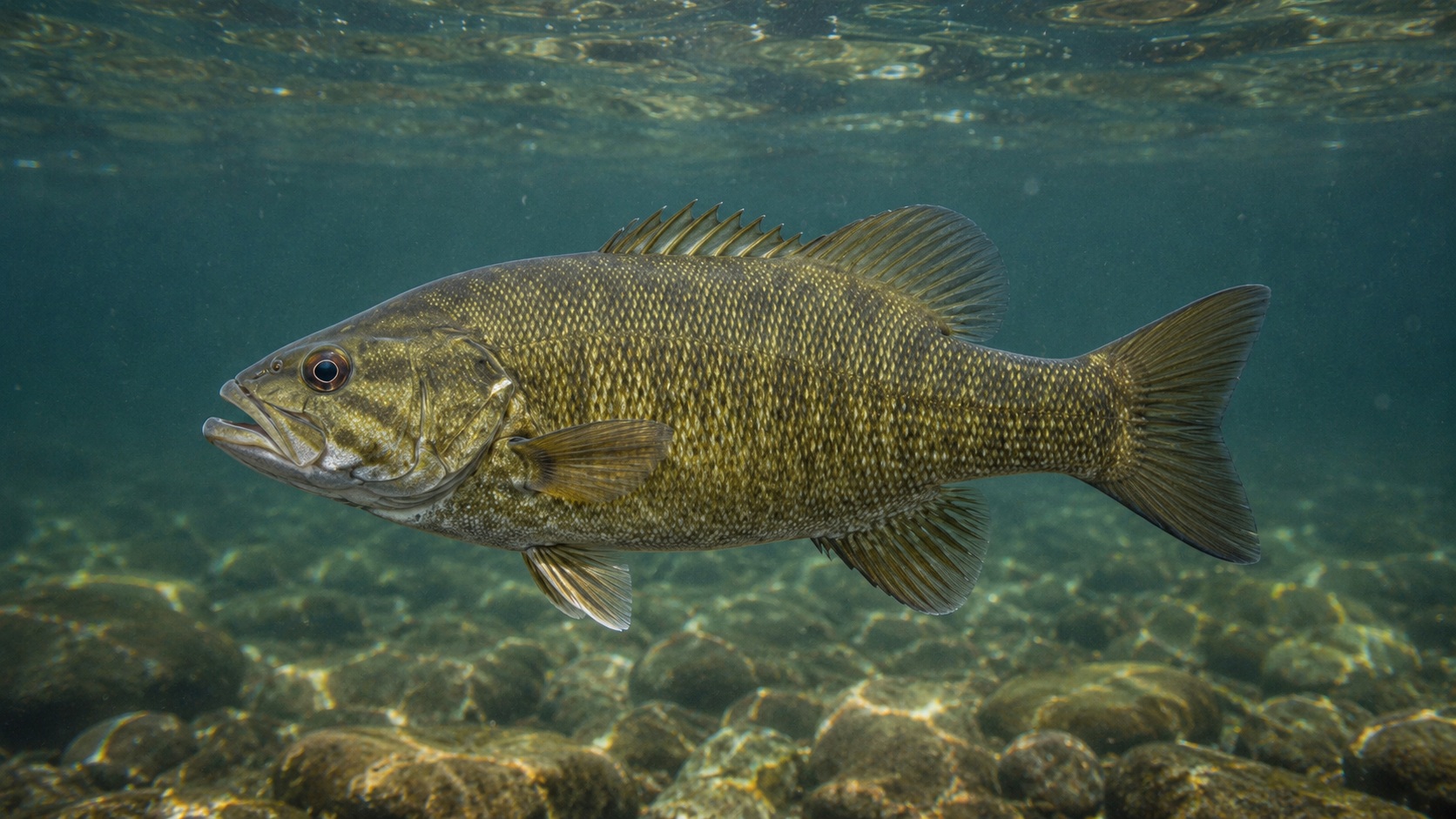
The smallmouth earns its nickname “bronzeback” honestly: the body is olive-brown to golden-bronze, often with faint vertical bars along the sides rather than the horizontal stripe pattern of its cousin the largemouth. The defining field mark is the jaw line. On a smallmouth, the upper jaw ends beneath the eye, not past it as on a largemouth. The dorsal fin has a shallow notch connecting the spiny and soft portions, and the eye is typically red or orange, another reliable marker. Young fish often show a distinct three-part tail with orange at the base fading to black and then white at the tip. In rivers, smallmouth are sometimes confused with spotted bass, but spotted bass have a more defined lateral stripe and a rough patch of teeth on the tongue.
Where to find them
Smallmouth bass are creatures of cold, clear, well-oxygenated water. In rivers, they hold in gravel and cobble runs, behind boulders and submerged ledges, and in the deep pools at the outside bends of fast stretches. In lakes and reservoirs, look for rocky points, submerged boulder fields, and windswept gravel shorelines. They avoid the warm, silty, heavily vegetated habitat that largemouth prefer.
The native stronghold runs from the St. Lawrence River and Great Lakes basin south through the Appalachians and into the upper Mississippi River system. The premier destination waters include Lake Erie and Lake Ontario, where anglers routinely catch 50 or more fish per day in peak season. The St. Lawrence River, Lake St. Clair between Michigan and Ontario, and Lake Champlain on the New York-Vermont border all hold world-class populations. In the river category, the Susquehanna in Pennsylvania and New York, the New River in Virginia and West Virginia, Tennessee’s Elk River below Tims Ford Dam, the Holston, the Hiwassee, and Dale Hollow Reservoir (home of the all-time world record) are consistently mentioned among the best in the country. Stocking programs have established productive fisheries in the Pacific Northwest, many mid-Atlantic streams, and waters well outside the native range across New England and the upper Midwest. Anglers in the South looking for smallmouth will find world-class opportunities in the rivers of Tennessee, Virginia, Georgia, and the Carolinas, where cold tailwaters and freestone mountain streams support strong populations.
When to go
Spring is the prime window. As water temperatures climb into the 55 to 65 degree Fahrenheit range, smallmouth move shallow to spawn on gravel beds and rocky flats, and pre-spawn fish are both heavily concentrated and aggressively feeding. The spawn typically runs from late April through June depending on latitude — earlier in southern Appalachian rivers, later in the Great Lakes region and New England. Post-spawn fish can be temporarily scattered and stubborn, but by midsummer they settle into predictable structure-oriented patterns in deeper, cooler water. Early morning and evening low-light periods produce best in summer heat. Fall is a close second to spring: cooling water triggers a feeding binge as smallmouth bulk up before winter, and aggressive topwater and swimbait action can be outstanding once water temperatures drop back through the 60s. Winter fishing is possible in southern rivers but slow throughout most of the range, as fish drop into deep holes and feed sparingly. In Tennessee and Virginia rivers, late September through early November is often considered the single best window for trophy-sized fish.
What to throw
Tube jigs are the foundational smallmouth bait and have been so for decades. A 3.5 to 4-inch tube in green pumpkin, smoke/pepper, or natural crayfish colors on a 3/16 to 3/8-ounce internal jighead is the workhorse. Fish it on a drag-and-hop retrieve, keeping bottom contact throughout. Short, sharp rod twitches mimic a fleeing crayfish.
Crayfish imitations of all types work because crayfish make up more than half the adult smallmouth diet. Hard-bodied craw crankbaits like the Strike King Kvad Craw or Rapala DT crawdad series worked slowly across rocky bottoms trigger reaction strikes. Soft plastic craws on a Carolina rig or Texas rig cover water efficiently.
Drop shot rigs shine in clear water and when fish are finicky. Rig a 3 to 4-inch finesse worm or small swimbait 8 to 12 inches above a 1/4-ounce tungsten drop shot weight. Shake the rod tip gently to hover the bait in place. This technique excels over deep rocky structure in summer and is one of the most consistent producers for clear-water smallmouth anywhere.
Ned rigs have earned a permanent place in the smallmouth box. A small mushroom-head jig (1/16 to 3/16 ounce) paired with a 2.75 to 3-inch Z-Man TRD or similar buoyant plastic in green pumpkin or natural brown stands the tail up off the bottom and drives smallmouth wild. Fish it with a slow drag and minimal rod action.
Topwater lures produce some of the most memorable strikes in freshwater fishing. Poppers and walking baits like the Heddon Zara Spook or Rico work best in low-light conditions over shallow rocky flats. Small swimbaits in 3 to 4-inch shad or minnow profiles on a swimbait hook are highly effective during summer and fall.
Inline spinners such as the Rooster Tail and Mepps Aglia in size 2 or 3 remain deadly in rivers, particularly when worked across current seams. For fly anglers, Clouser Minnows, crayfish patterns, and deer-hair poppers are the go-to choices.
Regulations
Smallmouth bass regulations vary significantly by state and often by individual water body. There is no uniform national standard. Many states manage smallmouth within a combined black bass aggregate limit; others regulate them separately, and some premier smallmouth rivers carry special slot or trophy limits designed to protect larger fish.
- Tennessee: Smallmouth bass are typically managed as part of a combined black bass limit; check the Tennessee Wildlife Resources Agency for current rules by specific water body at tnwildlife.org.
- Virginia: Statewide creel limit is 5 bass per day (largemouth and smallmouth combined) with no statewide minimum length; some trophy rivers have special slot limits. Check dwr.virginia.gov.
- Michigan and Great Lakes: Seasonal closures protect spawning fish; check Michigan DNR at michigan.gov/dnr or the relevant state agency for other Great Lakes states.
- New York and New England: Many waters have statewide size minimums (commonly 12 inches) and daily bag limits; some trophy fisheries carry more restrictive regulations. Check your state’s fish and wildlife agency website.
Always verify current regulations with the specific managing state agency before fishing. Rules change annually and differ by watershed, reservoir, and season. The IGFA also maintains a global record and regulation reference at igfa.org.
Handling and release
Smallmouth bass are more temperature-sensitive than largemouth and more vulnerable to stress in warm water. Keep fish in the water as much as possible, especially when water temperatures exceed 70 degrees Fahrenheit. Lip-grip the fish horizontally if you plan to photograph it, supporting the body weight rather than holding it vertically by the jaw alone. Use barbless hooks or crimp barbs when practicing catch and release on heavily pressured waters. Revive any fish that shows signs of exhaustion by holding it upright in moving current until it swims away strongly under its own power. Smallmouth are excellent table fare, with firm white flesh that many anglers consider superior to largemouth, but most serious smallmouth anglers practice catch and release given the slow growth rate of larger fish: a 5-pound smallmouth may be 10 or more years old.
On the Table
Smallmouth bass are solid table fare that many anglers enjoy keeping, though their reputation as a sport fish means a large portion are released. Those who do keep them are rewarded with clean, mild white flesh that holds up well to a variety of cooking methods.
Taste and texture: Smallmouth bass have white, firm flesh with a mild, slightly sweet flavor — cleaner and less pronounced than largemouth bass, particularly fish taken from cold, clear rivers and lakes. The texture is firm enough to hold together in a pan or on a grill without falling apart, yet flakes cleanly when cooked through. Fish from warm, stagnant, or murky water can carry a slightly earthy taste, but cold-water fish are consistently excellent.
Best preparation methods:
- Pan-frying: The firm texture makes smallmouth ideal for a simple pan-fry in butter or oil with a light seasoned flour dredge. The mild flavor lets the natural sweetness come through without heavy seasoning.
- Grilling: Fillets or whole small fish hold together well on the grill. A light brushing of olive oil and a citrus-herb finish complement the mild flesh without masking it.
- Battering and frying: The classic fish-fry treatment works beautifully — a cornmeal or seasoned breadcrumb batter adds crunch while the white flesh stays moist inside.
- Ceviche: Cold-water river smallmouth, cut into small pieces and cured in citrus juice with onion, cilantro, and peppers, makes a surprisingly clean and bright ceviche given the mild, firm flesh.
Handling for table quality: Smallmouth bass quality degrades quickly in warm weather. Kill fish promptly — a sharp rap to the head — and get them on ice immediately. Avoid letting them sit in a warm livewell for hours if you intend to eat them. Fillet soon after you return to shore rather than waiting overnight. The skin can be left on or off; skin-on fillets hold together better on the grill, but skinless fillets have a cleaner flavor in a pan or fryer. Remove the red lateral line of darker meat along the center of the fillet before cooking to eliminate any gamey undertones, especially in larger fish.
Eating caveats: Bag limits and slot regulations vary significantly by state and waterbody — check local rules before keeping fish. In heavily fished urban waters or impoundments with posted advisories, consult your state’s freshwater fish consumption guidelines for any contaminant concerns specific to that water body. No significant parasite or mercury concerns apply to smallmouth bass as a general rule.