A note about links: If we include links to retail sites like Amazon or Bass Pro Shops, it's because they're relevant to the topic and, as anglers ourselves, we believe they're worth checking out. As an Amazon Associate we earn from qualifying purchases.
What it is
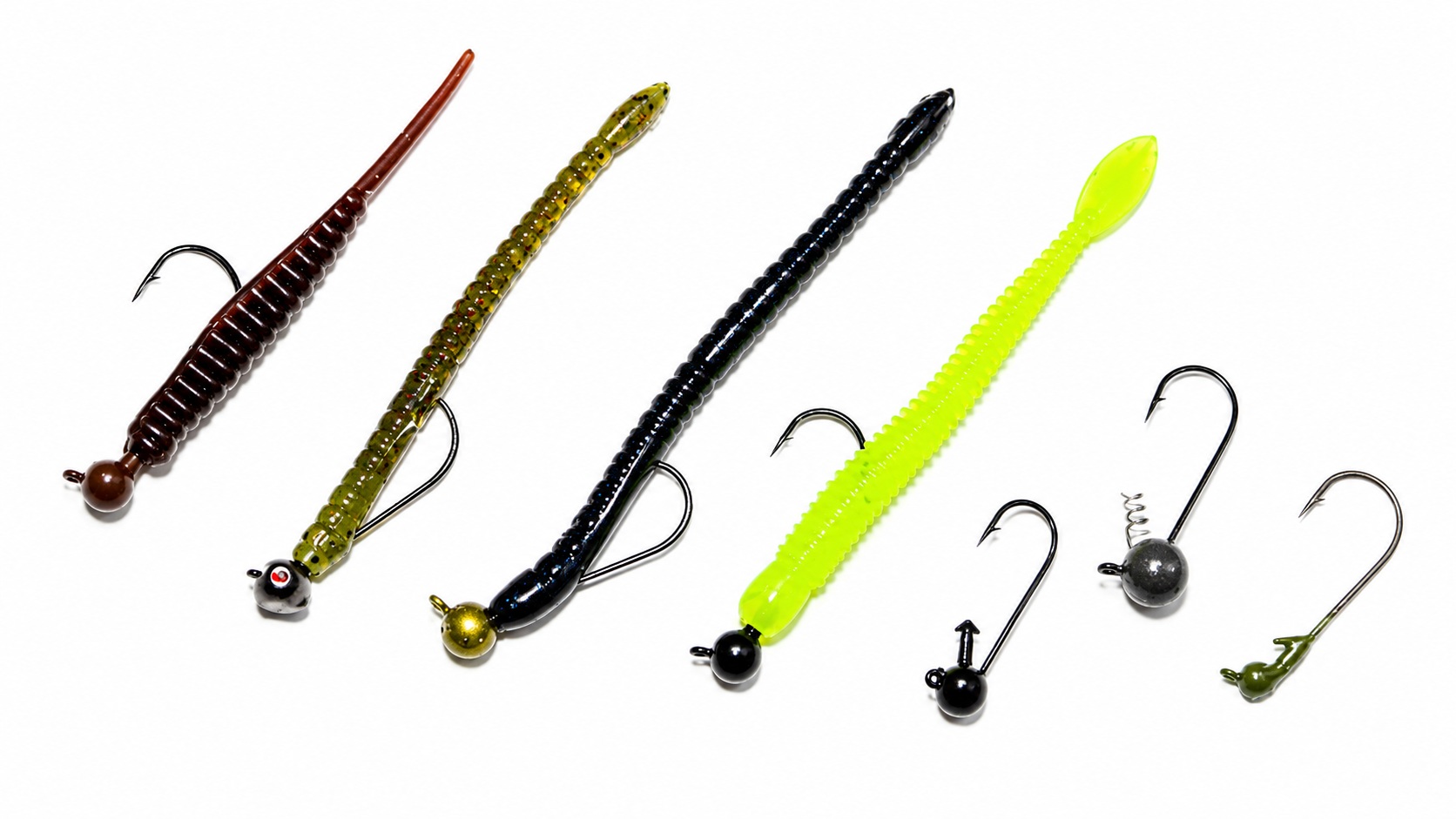
The shaky head is a finesse jig paired with a long, slender worm — and almost everything about it is designed around doing as little as possible as convincingly as possible. The jig head is narrow, sometimes called a stand-up or ball-nose head, shaped so it plants itself upright on the bottom and holds the worm in a natural, tail-up posture without any help from the angler. The worm is nose-hooked, leaving the full length of the bait to quiver and ripple on the slightest rod movement or water current.
This is not a power-fishing bait. It is not for burning water or triggering reaction strikes. The shaky head earns its reputation on pressured lakes where bass have seen every fast-moving lure in the tackle shop, and where a subtle, stationary presentation is the only thing that draws a commitment. It is one of the most reliable finesse rigs in freshwater bass fishing, and it is approachable enough that beginners can fish it effectively from the first cast.
The setup
Jig head selection:
| Weight | Use case |
|---|---|
| 1/8 oz | Shallow water (under 8 ft), calm conditions, slowest fall |
| 3/16–1/4 oz | General-purpose; 8–18 ft, light wind |
| 3/8 oz | Deeper water (18–25+ ft), wind, faster drop needed |
Hook size on the jig head should match the worm diameter — most finesse worms pair well with a 1/0 or 2/0 hook. Stand-up heads with a wider base keep the bait more vertical and are preferred over round ball heads in most situations.
Worm selection:
- 5–6 inch finesse worms (Zoom Trick Worm, Strike King Dream Shot, Berkley Powerbait Maxscent Flatworm) for standard fishing
- 7–10 inch worms when targeting larger fish or fishing in clearer water where a longer profile looks more natural
- Straight-tail or slightly tapered tails outperform paddle tails on the shaky head — you want the worm’s natural body to quiver, not a bulky tail competing with the head’s action
Rigging: Push the hook point through the nose of the worm about 1/4 inch from the tip, run it straight through the body for about an inch, then exit. Do not Texas-rig it into the body — the hook rides exposed or barely skin-hooked on a shaky head. This maximizes the tail quiver and improves hookup percentage significantly.
How to fish it
Cast to your target, let the rig sink on a semi-slack line (watch for line movement as it falls — strikes on the drop are common), and let it settle on the bottom. From there, the presentation is almost entirely in your rod tip.
The shake: Hold the rod at roughly the 10–11 o’clock position and make short, rapid twitches with the rod tip — not big sweeps, just micro-vibrations. You are shaking the rod tip, not moving the bait across the bottom. The worm stays in place while the tail quivers and dances. Hold each shake sequence for 5–10 seconds, pause completely for 3–5 seconds, then repeat. The pause often produces the bite.
Moving between spots: Every 30–45 seconds, slowly drag the bait 6–12 inches along the bottom by raising the rod, reel up slack, lower, and start shaking again. You are not covering water fast — you are working a specific area thoroughly.
Strikes: A shaky head bite often telegraphs as the line moving sideways, going slack unexpectedly, or a dull thump. Keep enough line contact to feel it but do not fish with a completely tight line — the worm needs to move freely. When you feel the bite, drop the rod tip slightly, reel up slack, and sweep into the fish with a firm but not violent hookset.
When to use it
Hard bottom: The shaky head shines on rock, gravel, chunk rock, and shell beds. These bottoms let the stand-up head plant itself in a natural posture. Muddy soft bottoms let the head sink and the presentation suffers.
8–25 feet of water: Main-lake points, channel edges, rocky drop-offs, and deep dock pilings in this depth range are the core shaky head zones. Shallow-water applications work, but the rig really separates itself in the 10–20 foot range where other finesse rigs lose efficiency.
Clear, pressured water: On highland reservoirs and clear highland lakes where bass have heavy fishing pressure, the shaky head often outproduces more aggressive presentations in summer and post-frontal conditions.
Year-round viability: Unlike many presentations that have a narrow seasonal window, the shaky head works every month of the year. In cold water, use lighter weights and fish slower. In summer, target deeper water with 3/8 oz heads. In fall and spring, 3/16–1/4 oz in transitional depths covers most situations.
Color guide
| Color | Conditions |
|---|---|
| Green pumpkin | Clear water, bright sun |
| Watermelon-red | Transitional clarity, light stain |
| Junebug | Stained or off-color water |
| Black/blue | Night fishing, heavily stained water |
When in doubt in clear water, green pumpkin is the default. It is neutral, natural-looking, and produces across the country in nearly every clear-water situation.
Gear setup
A shaky head is a spinning-gear presentation. Baitcasting tackle is too stiff and too heavy for the finesse weights involved.
- Rod: Medium power, fast or extra-fast action spinning rod, 6’10” to 7’4”. Enough sensitivity to feel the bottom composition and detect soft bites, with enough backbone to drive a hook home on a long-distance cast.
- Reel: 2500 or 3000 size spinning reel with a smooth drag.
- Line: 6–8 lb fluorocarbon mainline. Fluorocarbon sinks, has low visibility, and transmits bottom feel better than monofilament. Some anglers fish 10–15 lb braid with a 6–8 lb fluorocarbon leader when fishing around rocks — the abrasion resistance of fluorocarbon leader protects against cut-offs without sacrificing sensitivity.
Brands worth knowing
Strike King produces some of the most widely used shaky head jigs; their Shaky Head Jig in 3/16 and 1/4 oz is a tournament staple.
Z-Man makes finesse-specific heads designed for their ElaZtech plastics, which have exceptional buoyancy that enhances the stand-up posture.
Owner and Gamakatsu both produce aftermarket stand-up heads with premium hooks that upgrade any shaky head setup.
Berkley’s Powerbait Maxscent Flatworm and the Zoom Trick Worm are the two most-referenced worm choices for the rig — both are widely available, inexpensive, and proven on fisheries across the country.