A note about links: If we include links to retail sites like Amazon or Bass Pro Shops, it's because they're relevant to the topic and, as anglers ourselves, we believe they're worth checking out. As an Amazon Associate we earn from qualifying purchases.
What it is
The hard body swimbait is not a lure you pick up when you want to catch a limit. It is a lure you pick up when you want to catch the biggest fish in the lake.
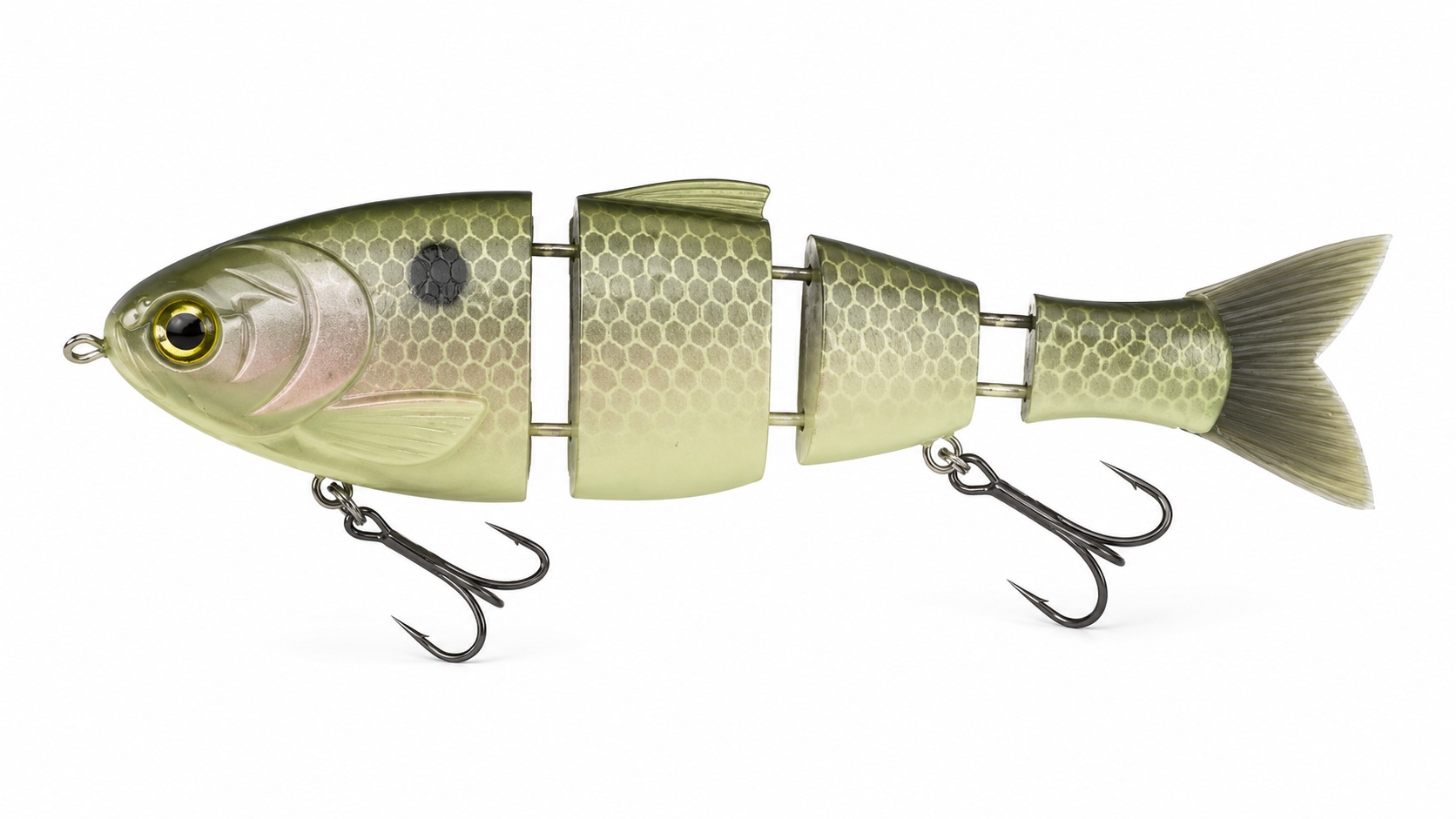
These are large, multi-segment hard plastic baits — typically 4 to 16 inches long — built to mimic forage fish with startling realism. The segments are connected by wire through-bodies or hinged joints, and as the bait swims, each section moves independently, creating a full-body wobble that closely resembles a live fish pushing through the water. They sink slowly, suspend, or rise depending on the model, and that controlled, deliberate action is what draws strikes from fish that have seen every other presentation.
There are two distinct styles that often get lumped together under the swimbait label, and it is worth knowing the difference.
A jointed swimbait has three to eight segments and produces a continuous tail-kick on a steady retrieve. The bait swims on its own as long as you are reeling. Most trout-pattern baits fall into this category — Huddelston Deluxe and Castaic soft swimbaits built for California and Pacific Northwest reservoirs where largemouth bass actively hunt stocked trout. Those fish have seen real trout their whole lives, and a 6-to-9 inch hand-painted replica swimming at the right depth triggers a predatory response that no other bait can replicate.
A glide bait is typically a two-piece bait with a wider hinge point. Instead of a continuous swim, it responds to rod inputs — pull it forward and it darts; pause and let it glide to the side in a wide, slow S-curve. The Deps Slide Swimmer and Megabass Magdraft are the benchmarks. The glide bait’s action is more intermittent and requires more angler involvement, but that pause-and-glide kills big fish in cold water and post-spawn windows when bass are not chasing aggressively.
Both styles share the same core purpose: presenting a large, convincing meal to a fish big enough to eat it.
The setup
Hard swimbaits require specialized gear. The baits are heavy (often 2 to 6 oz), the casts need to be long and accurate, and you need enough backbone to drive large hooks into heavy fish that often strike while the bait is far from the boat.
Rod: A dedicated swimbait rod, 8 to 9 feet, heavy to extra-heavy power with a moderate or moderate-fast action. The length loads the rod for casting heavy bait and gives you sweep to work a glide bait. Cheap rods will telegraph the action of the bait poorly and tire you out fast.
Reel: A large-frame, low-profile baitcaster with a high line capacity and a slower gear ratio (5.4:1 to 6.3:1). The slower retrieve is intentional — it keeps the bait in the strike zone longer and matches the pace these fish need to commit.
Line: 20 to 25 lb fluorocarbon. Fluorocarbon sinks, which helps keep the bait at depth, and its low stretch gives you sensitivity to feel the bait working and enough authority to drive hooks on a distant cast. Braid is too aggressive and kills the action on lighter glide baits.
Hooks: Most quality swimbaits come rigged with manufacturer hooks. Do not swap them for undersized hooks. Many anglers add a belly treble to jointed swimbaits to improve hookup ratios on followers that nip the tail.
How to fish it
Slow down more than you think you need to. Then slow down again.
For a jointed swimbait, the retrieve is a slow, steady wind — two to three crank handles per second at most. The bait does the work; your job is keeping it at the right depth and speed. Let it sink to your target depth before starting the retrieve, then maintain the cadence. A slow roll just above the bottom, or along the thermocline, covers most productive windows.
For a glide bait, the retrieve is pull-pause-glide. Point the rod toward the bait, sweep the rod to the side or forward, then let line go slack as the bait glides and turns. The pause is where strikes happen. Fish will follow the bait for 30 feet before deciding. If you speed up when you see a follower, you will pull it away. Hold your nerve and stay slow.
Depth control matters — get familiar with how fast your specific bait sinks (count it down) and adjust your retrieve speed to keep it in the zone.
When to use it
Post-spawn (late spring): Big females are recovering and feeding heavily. They are shallow or just coming off the beds and willing to eat a large meal. Swimbaits along points and transition edges are highly productive.
Winter slow-roll: Cold water makes bass lethargic, but it does not make them stop feeding — it makes them selective. A large swimbait moving slowly at depth triggers reaction and feeding from fish that will not chase a jig or crankbait. Swim it just above bottom structure in 10 to 25 feet of water.
Clear-water reservoirs: High-visibility water is where the realism of a hard swimbait earns its price. Fish can see conventional lures for what they are. In clear California, western, and highland reservoirs, a trout-pattern swimbait swimming through the water column looks like the thing bass eat every day.
After fronts settle: Post-front conditions slow fish down. A swimbait’s patient, non-threatening presentation is better suited to neutral fish than reaction baits.
Color and size
| Size | Best Use |
|---|---|
| 4–6 inch | Smallmouth, slot-size largemouth; good entry point for the technique |
| 6–9 inch | All-around largemouth and striper fishing; most versatile range |
| 10–16 inch | Trophy largemouth on trophy lakes; muskie and pike |
Color: Match local forage. Trout patterns (rainbow, brown trout) for reservoirs with stocked trout. Shad and bluegill colors for most other lakes. Natural finishes outperform chartreuse and solid colors in clear water. In stained water, add some contrast — a darker back and a flash belly.
Brands worth knowing
Deps Slide Swimmer (175mm and 250mm) — the glide bait standard. Japanese-made, expensive, and exceptional. The 250mm version is one of the most effective big-bass baits ever made.
Megabass Magdraft — a floating glide bait with a wide-body profile; fishes well on the surface and just below during warm months.
Huddelston Deluxe — hand-poured, hyper-realistic trout imitation. Trophy largemouth water only. Not cheap, but built for exactly one thing and does it better than anything else.
Castaic — solid trout imitator at a more accessible price point; good starting place for the technique.
Savage Gear 3D Line Thru — realistic body with a line-through rigging system that lets fish swim against the bait without leverage; available in multiple species profiles.
River2Sea Whopper Plopper / S-Waver — the S-Waver glide bait sits at a price point accessible for anglers new to the technique without sacrificing too much action.
Hard swimbaits demand patience, specialized gear, and a willingness to fish for hours without a bite. Most days you will throw them for a long time. But the fish that does commit — the 7-pound largemouth that tracked the bait from 40 feet and finally inhaled it — is the reason swimbait anglers keep showing up.