A note about links: If we include links to retail sites like Amazon or Bass Pro Shops, it's because they're relevant to the topic and, as anglers ourselves, we believe they're worth checking out. As an Amazon Associate we earn from qualifying purchases.
What it is
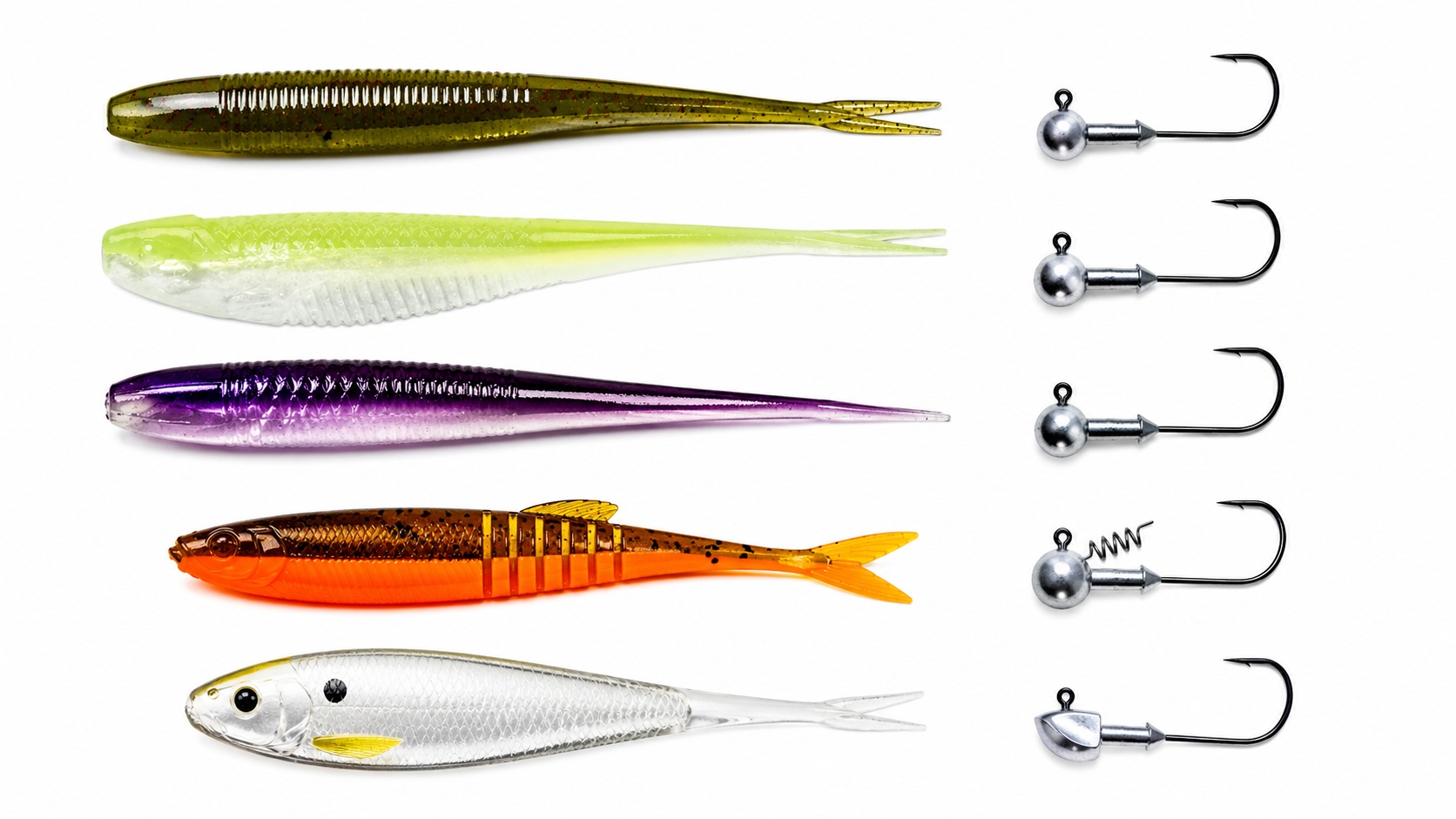
A soft jerkbait is a slender, shad-shaped soft plastic with a flat or slightly forked tail and no built-in wiggle. Unlike a paddletail swimbait, it does nothing on a straight retrieve. That is the point. Every bit of action comes from the angler — rod twitches and pauses make the bait dart sideways, stall, then glide back toward the bottom like a wounded or confused baitfish. Predators that have seen every crankbait in the box will eat a soft jerkbait on a slow, erratic presentation because it looks like something genuinely struggling.
The format works across species and ecosystems. Freshwater anglers have used them for largemouth bass, smallmouth bass, and striped bass for decades. Inshore saltwater anglers rely on the same action for spotted seatrout, redfish, common snook, and flounder. The bait reads as “injured shad” in a lake and “injured mullet” in a tidal flat — fish do not care about the label.
How to rig it
Weightless weedless (most common). Thread the hook point through the nose, bring it out about a quarter inch down, rotate the bait so the hook rides point-up, and skin-hook the point back into the body. A wide-gap hook in 3/0 to 5/0 works for most sizes. This setup sinks slowly on a slack line and produces the best side-to-side dart. It is also nearly snag-free, making it the default choice around grass, docks, and laydowns.
Light jig head (open water, schooling fish). A 1/8 to 1/4 oz round or shad-head jig gives you casting distance and a controlled sink rate. The bait still darts on rod twitches, but it returns to a predictable depth on the pause. This is useful when fish are suspended or holding at a specific depth over open flats or in the water column during a shad school.
Texas rig weedless. A texas rig with a bullet weight in the 1/16 to 3/16 oz range punches the bait through tight cover — mangrove roots, dock pilings, matted grass edges. The weight keeps it moving on the fall without the bulk of a jig head collar.
How to fish it
The core retrieve is the twitch-twitch-pause. Cast past the target, take up slack, and pop the rod tip downward two or three times with short, sharp strokes. Then stop. Let the bait glide and settle for one to three seconds. Repeat. How long you pause matters more than how hard you twitch — most strikes come on the fall, not the dart.
In saltwater, especially around mangroves and dock shadows, let the bait sink past the shadow line before starting your retrieve. Snook and redfish stage in shade and strike upward. Casting past the cover and walking the bait through it on the pause gives the fish time to commit.
When fish are visibly schooling or busting bait on the surface, switch to a faster cadence — quicker twitches, shorter pauses — and keep the bait in the strike zone. The bait’s erratic movement mimics a baitfish being chased out of the school.
When to use it
Spring and fall are peak seasons when shad and mullet migrations push baitfish through creeks, flats, and points. A soft jerkbait matches that bait size and silhouette closely. It also performs well in summer around shaded structure when fish are lethargic — the slow, gliding fall is less threatening than a fast-moving lure.
Clear water favors weightless presentation because the subtle action reads clearly to fish. Stained or dingy water calls for a jig head to keep the bait at depth and a more aggressive twitch cadence to create vibration.
Color and size selection
| Condition | Color | Notes |
|---|---|---|
| Clear water, bright sky | Pearl, white, silver flake | Matches shad; visible at distance |
| Stained water, grass flats | Root beer, watermelon, natural shad | Reads as a silhouette |
| Dark pockets, mangroves, dock shade | Chartreuse belly, white/chartreuse | High contrast under low light |
| Overcast / muddy water | Chartreuse, electric chicken | Maximum visibility |
For freshwater bass and finesse applications, 3 to 4 inch baits on lighter tackle give a subtle presentation. For inshore saltwater — seatrout, redfish, snook — 4 to 5 inch baits on heavier gear match the bait size fish are keying on.
Gear setup
For freshwater, a medium-power spinning rod in the 6’10” to 7’4” range with a fast tip gives the rod load needed to snap the bait sideways without burning out your wrist. Spool with 10 to 15 lb braided line and a 10 to 12 lb fluorocarbon leader. Braid transmits every twitch directly; fluorocarbon gives the leader near-invisibility in clear water.
For inshore saltwater, step up to a medium-heavy spinning rod, 20 to 30 lb braid, and a 20 to 25 lb fluorocarbon leader. The heavier leader handles structure abrasion near mangroves and dock pilings.
Brands worth knowing
Zoom Super Fluke is the freshwater standard — a buoyant, soft plastic that glides exceptionally well on the pause. The pearl/white and natural shad colors are go-to choices for clear water and schooling fish.
Z-Man Scented Jerk ShadZ uses Z-Man’s ElaZtech material, which is noticeably more durable than standard plastics and floats on a weightless rig. The buoyancy extends the glide and the pause, giving fish extra time to eat. A strong choice for inshore saltwater where toothy seatrout and redfish destroy conventional plastics quickly.
DOA CAL Shad has a long track record in Gulf Coast and Atlantic inshore fisheries. The salt-impregnated body and natural colorways make it a staple for spotted seatrout and flounder on shallow grass flats.
Bass Assassin Sea Shad fills a similar role at a lower price point, with a wide range of sizes and colors suited to both inshore and freshwater applications.
Berkley PowerBait Jerk Shad adds the PowerBait scent formula to the profile, which can make a difference when fish are holding short or picking up and dropping the bait.