A note about links: If we include links to retail sites like Amazon or Bass Pro Shops, it's because they're relevant to the topic and, as anglers ourselves, we believe they're worth checking out. As an Amazon Associate we earn from qualifying purchases.
If there is one fish that defines saltwater fishing on Florida’s Space Coast, it is the common snook. Linesiders grow large, fight dirty, and live in the kind of tight, structure-heavy places that demand accurate casts and quick reflexes. They use the current against you, bulldogging into dock pilings and oyster bars the moment they feel the hook. When you finally slide a big snook to the boat, gill plate flaring and lateral line catching the light, you understand why Florida anglers are obsessed with this fish. Catching your first keeper snook is a genuine rite of passage, and chasing big females in the 30-inch-plus range is a lifelong pursuit.
How to identify one
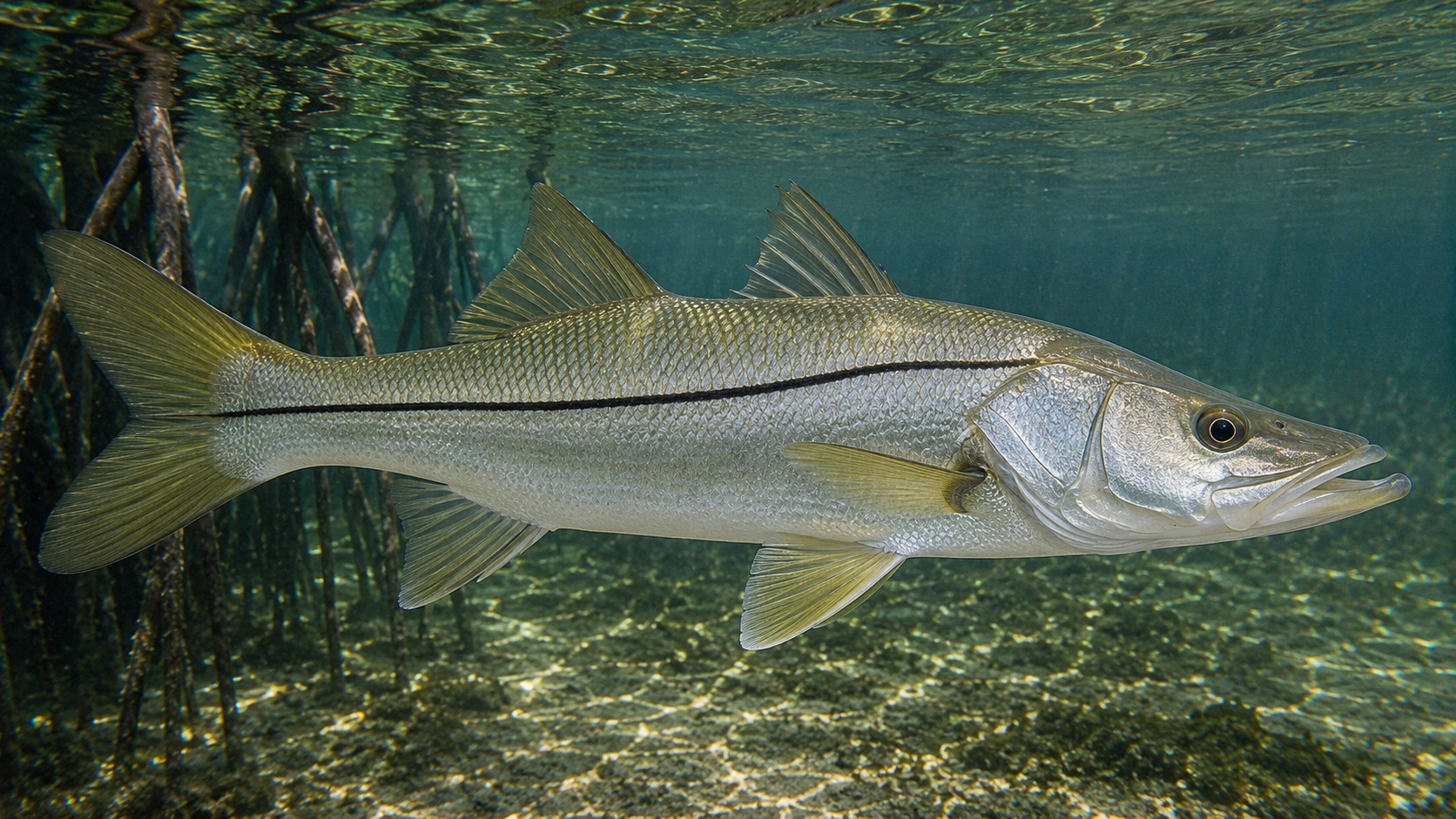
The common snook is one of the easiest fish in Florida inshore waters to identify at a glance. The defining feature is the bold black lateral line that runs from the gill plate all the way to the tail, continuing onto the caudal fin itself. That line is visible from twenty feet away, even in murky water. No other common inshore species shares it.
Beyond the lateral line, look for a sloping, almost concave forehead, a large mouth with a protruding lower jaw, and yellowish fins. The body is slender and compressed compared to a redfish or black drum, built for speed and ambush rather than brute strength. The dorsal fin is split into two sections, with a sharp forward section and a longer soft-rayed rear section.
The only lookalike confusion worth mentioning is with other snook species in Florida. Fat snook and swordspine snook share the same lateral line, but both are much smaller fish (rarely exceeding 18 inches). If you are releasing a fish over 20 inches, it is almost certainly a common snook.
Where to find them
Snook are structure fish. They do not roam open water; they hold at the edge of current breaks and wait for the water to bring food to them. If you understand that one principle, you can locate snook anywhere in their range.
On the Space Coast and the Indian River Lagoon, the top habitats are:
Sebastian Inlet is in a category of its own. The rocks, strong tidal current, and massive baitfish concentrations at the inlet create world-class snook fishing year-round. Sebastian Inlet is nationally recognized as one of the finest snook fisheries anywhere. Fish the jetty rocks on the outgoing tide, or work the deeper channels on the incoming. The structure holds fish at every stage of the tide.
Dock lights on the IRL are the summer night-fishing target. On dark nights, lit docks attract baitfish, which attract snook. The fish stack in the shadow line at the edge of the light, ambushing prey as it drifts or swims into the illuminated zone. This is visual fishing at its best.
Mangrove shorelines are snook nurseries and year-round habitat. Work the points where mangrove edges meet creek mouths or channel edges. On outgoing tide, snook stage just outside these creek mouths to intercept baitfish.
Bridge pilings and culverts funnel current, which positions snook predictably. The downcurrent side of any bridge piling is worth a cast.
Canaveral National Seashore and Mosquito Lagoon hold good populations in the backcountry creeks and spoil islands, especially during warm months.
When to go
Spring (March through May) is the best all-around season. Water temperatures are climbing into the mid-70s, snook are active and aggressive, and the fishery is open on the Atlantic coast. Fish are spread across a variety of habitats from the inlet to the lagoon.
Summer (June through August) offers outstanding fishing, especially at night around dock lights. Note that harvest is closed June 1 through August 31 on the Atlantic coast, overlapping with the spawning aggregation period. Snook school heavily near inlets to spawn during these months, creating visible concentrations, but all fish must be released.
Fall (September through November) is an underrated window. As water temperatures drop from summer highs, snook become aggressive feeders. The harvest season reopens September 1 on the Atlantic coast.
Winter is the critical vulnerability period. Snook are a tropical species at the very northern edge of their range in Central Florida. Water temperatures below approximately 50-55 degrees Fahrenheit can kill them outright, and severe cold kills have wiped out significant portions of the Space Coast population in the past. When cold fronts push through, snook seek the warmest water available: power plant discharge areas, deeper lagoon channels, and spring-fed creeks. Fish activity slows dramatically below 60 degrees.
What to throw
This is where snook fishing gets interesting. The same fish that will pounce on a live shrimp on Tuesday may refuse every live bait you throw on Wednesday. Versatility and reading conditions are as important as bait selection.
Live shrimp is the workhorse bait and the best starting point for anyone new to snook fishing. Hook a live shrimp through the horn on a 1/0 or 2/0 wide-gap hook with a light leader. Fish it on a popping cork near dock lights at night, or free-line it with no weight into current breaks. Shrimp produces fish in almost every condition and every habitat.
Live pinfish, mullet, and pilchards are the step up for bigger fish, especially near Sebastian Inlet. A lively 3-4 inch pinfish free-lined into the inlet current is hard for a large snook to resist. Near the inlet during spring and fall pilchard runs, match the size of the baitfish in the water. Small pilchards on a light jig head or free-lined are lethal.
Soft plastic jerkbaits are the most versatile artificial option. White or chartreuse paddle-tails and jerkbaits on a 1/4 to 3/8 oz jig head work in current, along mangrove edges, and under dock lights. Work them with a twitch-and-pause retrieve, keeping the bait near the bottom in current. The DOA shrimp in glow or root beer is a Space Coast classic.
Small topwater plugs at first light are a special experience. Walk-the-dog style plugs in the 3-4 inch range over shallow grass flats or along mangrove edges at dawn will draw explosive strikes. Work them slowly and pause often.
Leader and rigging: Snook have sandpaper-rough gill plates and a sharp edge on the gill cover that will saw through light line instantly when a fish shakes its head near structure. Use 30-40 lb fluorocarbon leader, minimum 18 inches. Braided main line (20-30 lb) gives you sensitivity and a thin profile for working current.
Florida regulations
Snook are one of Florida’s most carefully managed inshore species, and the regulations reflect their biological vulnerability. On the Atlantic coast, including the Indian River Lagoon and Space Coast waters, the current rules are:
Slot limit: 28 to 33 inches total length. Only fish measuring at least 28 inches but no more than 33 inches may be kept.
Bag limit: One fish per person per day.
Closed seasons: June 1 through August 31 (spawning closure) and December 15 through January 31 (cold weather/recovery closure).
Snook permit required: In addition to a saltwater fishing license, you must have a separate snook permit to harvest snook.
The slot limit has a specific biological rationale. Snook are protandric hermaphrodites, meaning fish are born male and the largest individuals transition to female as they grow. Those big 33-inch-plus fish are almost exclusively female and are the most reproductively important animals in the population. Releasing fish over 33 inches protects the spawning core of the fishery.
Always verify current regulations at myfwc.com before your trip, as FWC has modified snook rules multiple times in recent years.
Handling and release
Snook are durable fish but deserve careful handling, particularly during summer heat when water oxygen levels drop. Wet your hands before touching the fish. Avoid holding snook vertically by the lower jaw for extended periods; support the body horizontally. If the fish is to be released, keep it in the water as much as possible, revive it by holding it gently in the current until it kicks free on its own. On hot summer days, a quick release is the kindest release.
On the Table
Common snook is one of Florida’s most prized inshore table fish — firm, white, mildly sweet flesh that rivals the best eating in saltwater, provided you handle it correctly from the moment it hits the deck.
Taste and texture: The flesh is bright white, large-flaked, and firm with a delicate, mildly sweet flavor and a slight nuttiness. It lacks the “fishy” character of oilier species and sits closer to redfish or striped bass on the flavor spectrum. The texture holds its shape under heat without going rubbery, making it forgiving across multiple cooking methods.
Best preparation methods:
- Grilling: The firm, large-flake flesh holds up to direct heat without falling apart. A hot grate, a brushing of olive oil, and simple seasoning (salt, pepper, citrus) let the natural sweetness come through. Keep fillets skin-side down briefly to sear, then flip only once.
- Pan searing: High heat in a cast-iron or stainless pan creates a golden crust while the center stays moist. Sear 3-4 minutes per side; the thick fillets from slot-sized fish cook evenly without drying out.
- Ceviche: The mild, sweet flavor profile makes snook an outstanding choice for citrus cure. Dice skinless fillets into small cubes, submerge in fresh lime juice, and cure 20-30 minutes before adding onion, cilantro, and chili. The delicate flesh “cooks” quickly and absorbs the acid without becoming mushy.
- Baking with a crust: A Parmesan-breadcrumb or herb crust at 375 F for 12-15 minutes keeps the fillet moist and adds textural contrast without masking the flavor.
Handling for table quality: Ice the fish immediately after landing — do not leave snook on a stringer in warm water. Snook are best bled at the gills right at the boat before going on ice. When filleting, remove the skin completely before the fillet touches heat. The lateral line area contains a fatty layer with pronounced soapy, sour oils that penetrate the flesh on contact with heat; even a thin strip of skin left behind can spoil the flavor of an entire fillet. Old-time Florida anglers sometimes called snook “soap fish” for exactly this reason. Pin bones run along the center of each fillet; use needle-nose pliers or tweezers to pull them after filleting.
Eating caveats: Florida manages snook under strict slot limits and seasonal closures. On the Atlantic coast, the slot is 28-33 inches; on the Gulf coast, 28-32 inches. The bag limit is one fish per person per day statewide during open seasons. Seasons close during peak spawning periods (typically summer) and during winter cold events when snook are physiologically stressed. Only fish within the legal slot are eligible to keep, which means the quality of the meal is naturally standardized — slot fish are mature, well-conditioned adults at peak eating size. Always verify current FWC season dates and regional slot limits before retaining a fish, as rules differ between Atlantic and Gulf management zones and can be adjusted on short notice.