A note about links: If we include links to retail sites like Amazon or Bass Pro Shops, it's because they're relevant to the topic and, as anglers ourselves, we believe they're worth checking out. As an Amazon Associate we earn from qualifying purchases.
What it is
Power fishing is the art of doing more. Where finesse relies on small baits and patience, power fishing leans on heavy gear, big and loud presentations, and fast retrieves to cover as much water as possible. The goal is not to coax a reluctant fish into biting — it is to find the fish that are already willing, and to find them quickly. Every cast is a question, and a power angler asks that question hundreds of times an hour until the water answers.
The core idea is efficiency. On any given day, only a fraction of the fish in a body of water are actively feeding. Power fishing is a search engine for those biters. By moving fast and firing baits at likely cover, you eliminate dead water in a hurry and concentrate your time on the spots and the fish that are ready to react. A spinnerbait burned past a laydown or a lipless crankbait ripped through grass triggers a reflex strike — the fish reacts before it has time to think.
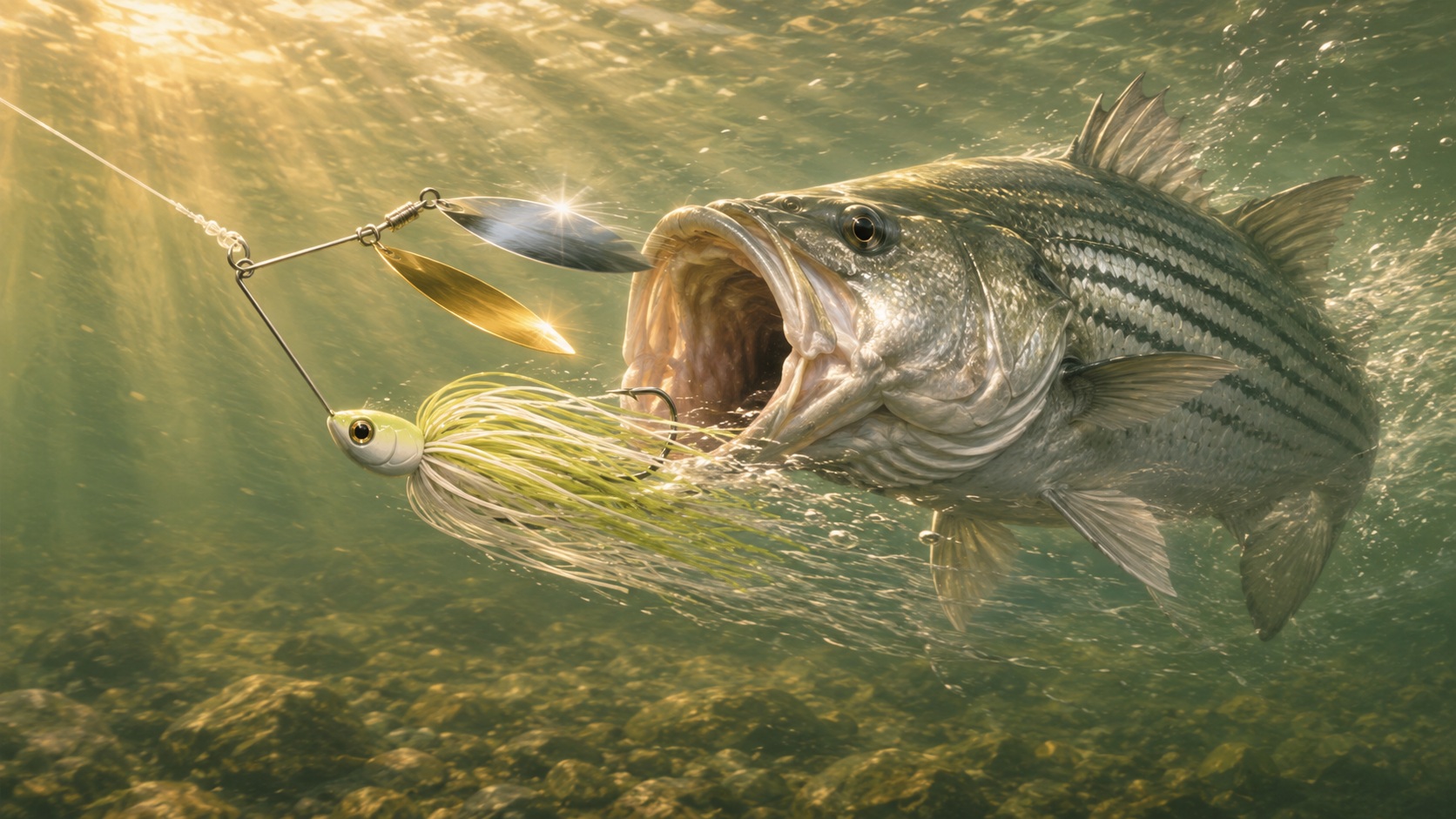
Power fishing is most associated with bass, but the philosophy crosses over to nearly anything aggressive. Northern pike and muskellunge crush big bladed baits and swimbaits worked fast. Inshore and nearshore, striped bass, snook, and bluefish chase down loud, fleeing presentations the same way. Wherever predators ambush and feed by reaction, fishing fast and big puts baits in front of more of them.
How to do it
Power fishing is built on three things: heavy gear, big and loud baits, and speed.
Beef up the gear. Power fishing demands tackle that can drive a hook home and pull fish out of cover. That means medium-heavy to heavy rods, fast or high-speed reels, and strong line — often 15 to 20 lb fluorocarbon or 30 to 65 lb braid. Heavy line lets you horse fish away from structure, withstand the abrasion of wood and rock, and fire long casts that cover more water per cast.
Throw bigger, louder baits. Power baits are made to be seen and heard. Spinnerbaits and bladed jigs flash and thump, lipless and squarebill crankbaits rattle and deflect, buzzbaits gurgle across the surface, and paddletail swimbaits push water with a heavy tail kick. The profile is meant to grab attention from a distance and provoke a reaction, not to mimic a timid meal.
Speed everything up. This is the heart of power fishing. Cast, retrieve at a steady or fast clip, reel in, and cast again. You are not working a single spot thoroughly — you are covering a stretch of bank, a grass line, or a flat as fast as you can while still triggering bites. If a spot does not produce in a few casts, you move. The discipline is in keeping the boat moving and the bait in the water.
The bite is rarely subtle. Reaction strikes are violent — a slamming thump, a rod nearly ripped from your hands, a fish hooking itself on the charge. Keep a firm grip, reel through the strike to load the rod, and let the heavy gear do its job driving the hook and turning the fish.
When to use it
Power fishing shines when fish are active and aggressive. Reach for it when:
- The water is warm. Pre-spawn and the fall feed are prime power-fishing windows — fish are feeding hard, chasing bait, and willing to run down a fast presentation.
- Light is low. Dawn, dusk, and overcast skies push predators out to roam and ambush, exactly when a loud, fast bait draws strikes.
- The water is stained. In stained or muddy water, fish hunt by vibration and flash. Loud, displacement-heavy baits let them find your lure where a subtle profile would go unnoticed.
- You need to find fish. When you are starting cold on new water, power fishing is the fastest way to locate active schools and figure out a pattern before slowing down.
The flip side: when fish are pressured, the water is clear and calm, or a cold front has shut everything down, power fishing leaves fish behind. In those windows, a slow finesse presentation tips neutral fish into biting where speed and noise only push them away. Match the approach to the mood of the fish.
Common mistakes
The number one mistake is fishing too slowly. Anglers used to finesse struggle to commit to the speed; if you are second-guessing a fast retrieve, speed it up and keep the boat moving. The second is using gear that is too light — power fishing falls apart when light line and limber rods cannot drive a big hook or pull a fish from cover. The third is staying too long in unproductive water. The whole point is efficiency: give a spot a few casts, and if it does not produce, move on and let the water tell you where the biters are.