A note about links: If we include links to retail sites like Amazon or Bass Pro Shops, it's because they're relevant to the topic and, as anglers ourselves, we believe they're worth checking out. As an Amazon Associate we earn from qualifying purchases.
What it is
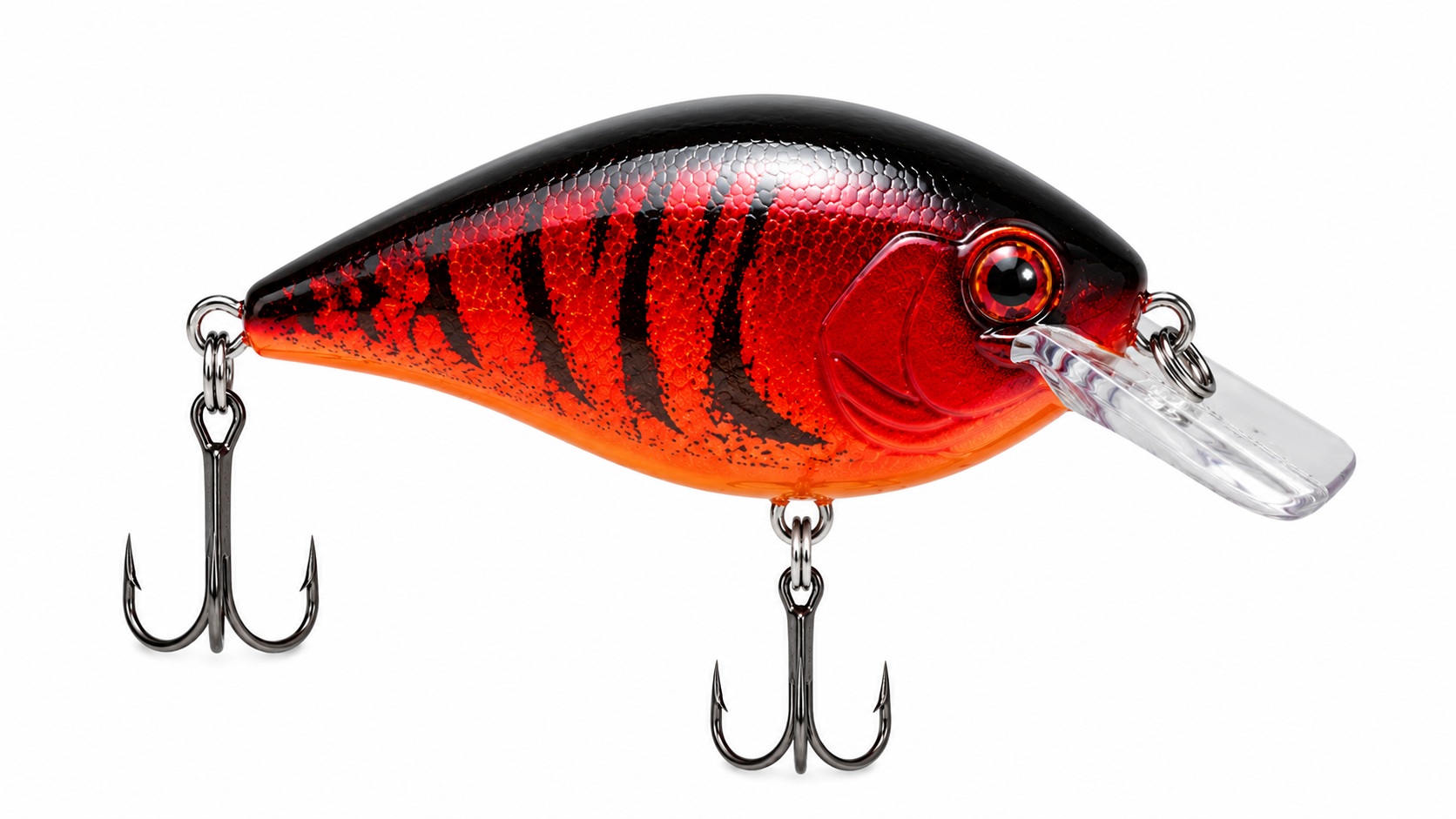
The squarebill crankbait is a hard plastic lure built for one specific job: hunting through the shallowest, snag-filled cover in the lake and coming out the other side with a bass attached. Its defining feature is the flat, square-shaped lip that deflects off hard objects — rocks, wood, stumps, dock pilings, riprap — rather than catching and hanging up like a conventional round-billed crank. Every deflection changes the bait’s direction and speed unpredictably, which triggers the instinctive reaction strikes that are the crankbait’s whole game.
Most squarebills run 2–6 feet deep depending on line diameter, rod angle, and retrieve speed. They are shallow-water tools designed for the zone where bass spend their most active feeding time.
How to fish it
The squarebill’s effectiveness comes from contact with cover. Fishing it in open water misses the point.
The standard retrieve: Cast past your target — a log, rock pile, dock piling, or riprap bank. Start reeling at a medium-fast speed. When the bait contacts something hard, it will lurch sideways or dart upward. Do not stop reeling. The change in direction on the deflection is the trigger. Many strikes come in the split-second after impact.
Vary the speed: Steady medium-fast retrieve is the default, but slowing down near the end of the retrieve or adding brief pauses after a deflection can produce when bass are following but not committing. A floating crankbait (most squarebills float at rest) that pauses and rises near a laydown gives a reluctant fish a moment to eat.
Work wood: Fallen trees, laydowns, and dock pilings are prime squarebill cover. Cast parallel to the cover so the bait runs along its entire length rather than just deflecting off it once.
Riprap: Rocky riprap banks (dam faces, bridge causeways, boat ramps) are some of the most consistent squarebill locations. Make long casts parallel to the bank and count on the bait bouncing off every rock.
When to use it
The squarebill is most productive in cool to mild water temperatures — roughly 50 to 72°F — which puts spring and fall at the top of the calendar.
Spring: Pre-spawn and spawn periods are the highest-percentage windows. Bass are shallow, aggressive, and positioned near cover. A squarebill running just above the bottom in 2–5 feet of water produces consistently from ice-out through post-spawn.
Fall: As water cools and bass shift shallow to chase baitfish, the squarebill covers water fast and finds active fish. This is the season for burning it through shad-colored flats and along the backs of pockets.
Year-round: Any time water temperatures are in the productive range and bass are positioned in shallow cover, the squarebill is a legitimate choice. In summer, shift to early morning and low-light periods when fish come up shallow.
Avoid: Very cold water (below 48°F) slows fish reaction time enough that a faster-moving crankbait loses most of its effectiveness. Slow down to a jig or soft plastic in these conditions.
Depth control
You control how deep a squarebill runs by adjusting:
- Line diameter: Thinner line (10 lb fluorocarbon) lets the bait dive deeper; heavier line (17+ lb) limits depth. This is the most practical depth tuning tool.
- Rod tip angle: Rod tip up = shallower running. Rod tip down (toward the water) = slightly deeper.
- Retrieve speed: Faster retrieve = deeper running (to a point). Slowing down lets a floating squarebill rise.
Most 1/2 oz squarebills hit their rated depth (usually 3–5 feet) on 12–14 lb monofilament or fluorocarbon with a moderate retrieve.
Gear considerations
Rod: Medium-heavy power, moderate action (not extra-fast). A softer tip absorbs the impact of deflections and — critically — keeps the hooks from pulling out during head shakes. An extra-fast action rod will throw hooks.
Line: 12–17 lb fluorocarbon is the standard. Fluorocarbon sinks (deepens the dive), has low stretch compared to mono, and is less visible than braid. Many anglers use monofilament for its stretch (acts like a shock absorber on hard strikes).
Avoid braid for squarebill fishing in most situations. Zero-stretch braid tears hooks on the headshake and can pull hooks on the initial hookset when the fish is close.
Sizes and variants
| Size | Weight | Depth range | Best for |
|---|---|---|---|
| Small (1.5–2”) | 1/4 – 3/8 oz | 1–3 feet | Finesse / cold water / small streams |
| Standard (2–2.5”) | 3/8 – 1/2 oz | 2–5 feet | All-around; most situations |
| Large (2.5–3”+) | 1/2 – 5/8 oz | 3–6 feet | Larger profile; big bass targeting |
Color selection:
- Chartreuse shad / chartreuse crawfish: Stained or murky water; high visibility
- Sexy Shad / ghost shad: Clear to lightly stained water; realistic baitfish pattern
- Craw patterns (brown/orange): Rocky bottom; crawfish-eating situations
- White / pearl: Any water around shad or shiners
Match water clarity first, then regional baitfish. In clear water, go natural. In stained water, go bright.
Brands worth knowing
Strike King KVD Square Bill (KVD 1.5 and 2.5) is the most copied tournament squarebill of the last 20 years. The 1.5 is the standard; the 2.5 runs slightly deeper. Widely available and proven.
BOOYAH Covert Series is a strong value option with good action and a wide range of color choices.
Rapala DT-Flat runs in the same depth range with Rapala’s balsa-inspired action and a wide wobble on the deflection.
Lucky Craft LC 1.5 and 2.5 are premium squarebills popular on the tournament circuit for their precise action and hook quality.