A note about links: If we include links to retail sites like Amazon or Bass Pro Shops, it's because they're relevant to the topic and, as anglers ourselves, we believe they're worth checking out. As an Amazon Associate we earn from qualifying purchases.
What it is
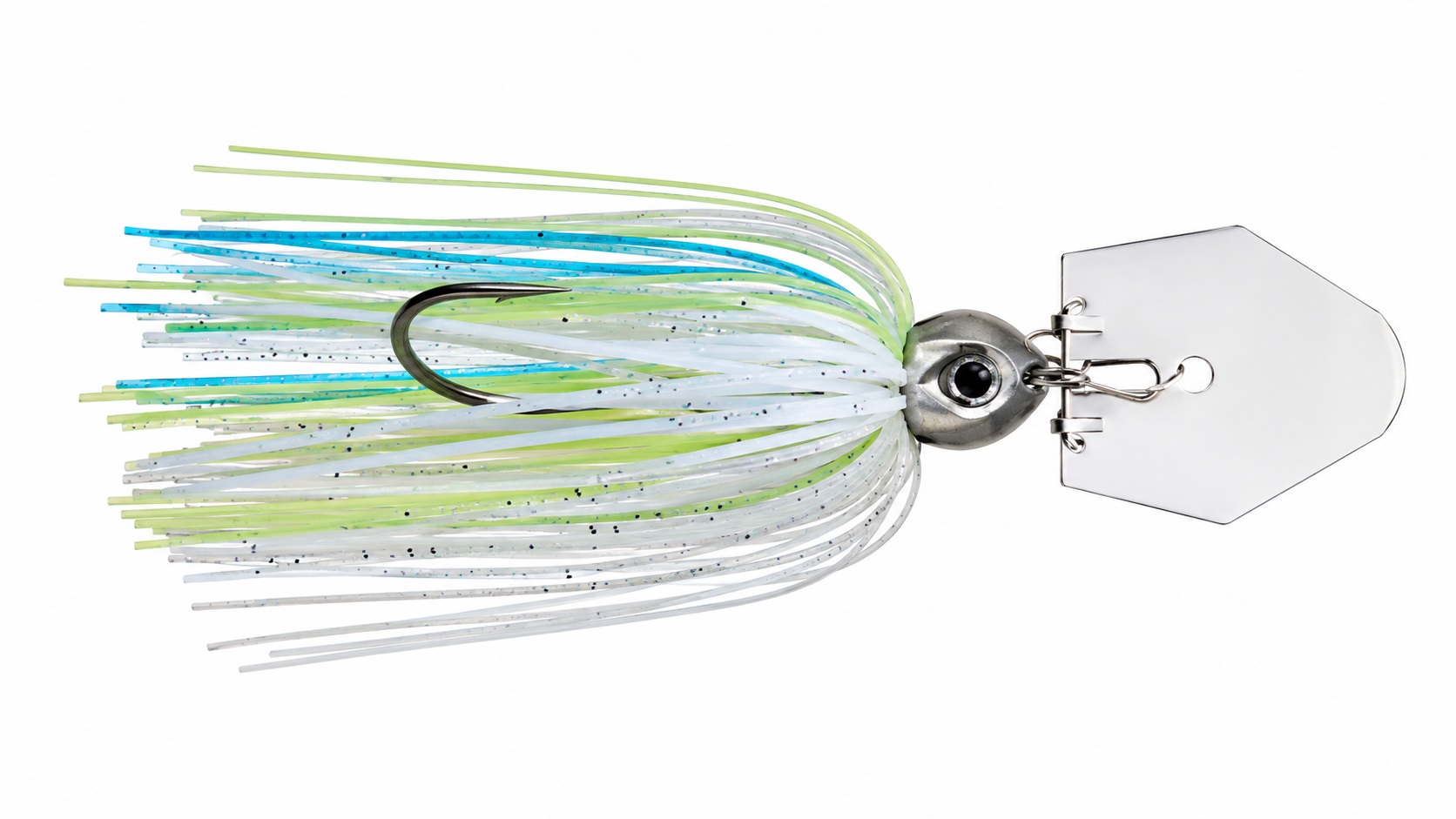
The bladed jig is a power-fishing lure built around a single design idea: attach a flat hex-shaped metal blade to the front of a jig head so it shakes the entire lure side-to-side on the retrieve. The result is something between a spinnerbait and a traditional jig — it has the depth versatility of a jig, the blade vibration of a spinnerbait, and a tight, erratic wobble that neither lure produces on its own.
Z-Man introduced the original ChatterBait in 2006 and the design quickly became one of the most imitated lures on the market. Every major tackle brand now makes a version, but the concept is the same across all of them: jig head, wire clip, hexagonal blade, and a soft plastic trailer threaded onto the hook. The blade generates low-frequency vibration and a clicking sound on the retrieve — both of which call fish in from a distance, particularly in stained or off-color water where visibility is limited.
Largemouth bass are the primary target, but walleye and northern pike also respond well to the vibration profile. If you fish lakes with healthy grass and moderate to poor water clarity, this lure belongs in your rotation.
How to rig it
Bladed jigs come pre-rigged with a hook on a molded jig head. Setup mostly means choosing and attaching the right trailer:
- Select a soft plastic trailer that complements the blade weight. A boot-tail or paddle-tail swimbait gives the lure a natural baitfish profile and adds a secondary tail kick. A craw or chunk trailer slows the fall and adds bulk — useful when fish want something bigger and slower.
- Thread the trailer straight onto the hook shank, starting from the trailer’s head. Keep the bait straight — a crooked trailer will make the lure track sideways.
- Push the hook point through so it lies flat in the body of the plastic or just barely skin-hooked. Most bladed jig hooks are wide-gap and can carry a moderate-sized trailer without fouling.
- Check the trailer length. Longer trailers increase the overall profile and slow the action slightly; shorter trailers keep the bait compact and let the blade dominate.
Trailer color should complement the head color. Matching the trailer closely to the head creates a cohesive look; contrasting the trailer tail (e.g., a green-pumpkin body with an orange-tipped tail) can add a trigger point that gets noticed.
How to fish it
The standard retrieve is a steady medium-speed wind just fast enough to keep the blade deflecting. Unlike a crankbait, you do not need to crank fast — the blade produces vibration even at moderate speeds. Let the lure determine the pace: if you feel it throbbing against the rod tip, you are in the zone.
Key retrieve variations:
- Straight retrieve: The go-to starting point. Reel at a pace that keeps the lure in the top half of the water column or just above the grass canopy. The blade deflection is constant and predictable.
- Stop and go: Kill the retrieve for one to two seconds and let the lure fall, then pick it back up. Strikes often come on the pause — the lure drops erratically and bass tracking it react instinctively.
- Burning: Speed up to a fast retrieve just below the surface. This works well in warm water when bass are in an aggressive, feeding mood.
- Countdown: Cast, count the lure down to the desired depth, then begin the retrieve. Useful when bass are suspended or holding in a specific depth band rather than right on the bottom.
In and around grass is where this lure excels. Work the edges of weed lines and let the lure clip the tops of submerged vegetation. The deflection off grass stalks triggers reaction strikes. When the grass is thick, burn it fast over the top to avoid hanging up. In sparser cover, a slower retrieve that lets the lure tick through individual stalks is more effective.
When to use it
Spring is the peak season. Pre-spawn largemouth bass push shallow into grass flats and bladed jigs match the primary forage — bluegill and shad — better than almost anything else at that time of year. The vibration is especially effective when bass are in a competitive, active feeding mode heading toward the spawn.
Summer keeps the lure productive as long as grass remains. Fish the lure along deep grass edges in the morning and push shallow as light improves. Fall is also strong — shad school up and bladed jigs running at shad speed through mid-depth water are a reliable fall pattern.
The lure loses its edge in very clear water, where fish get a long look and the blade flash can spook them. It also struggles in very cold water — below about 50°F, fish are sluggish and slower presentations like a jig or drop shot typically outperform. In stained to muddy conditions, the bladed jig is often the first choice because vibration and sound do the work that visibility cannot.
Color selection
| Water clarity | Color choice |
|---|---|
| Clear | Natural shad (white/silver), ghost patterns |
| Lightly stained | Green pumpkin, watermelon, shad white |
| Stained | Black/blue, brown/orange, chartreuse |
| Muddy / very dark | Chartreuse, white, bright orange |
Black and blue is the standard choice for cold-water periods and low-light mornings regardless of clarity. Chartreuse is a go-to when visibility drops below a foot — the blade’s vibration calls fish in and the color helps close the deal once they are close.
Gear setup
A medium-heavy rod with a fast tip is the standard pairing. The tip needs enough flex to detect the blade’s throbbing action and telegraph when the lure has fouled, but the backbone to drive the hook home on a hard strike.
- Rod: 7’ to 7’3” medium-heavy casting rod, fast action
- Reel: Baitcasting reel, 6.4:1 to 7.1:1 gear ratio; higher ratios give you more control over retrieve speed
- Line: 15–20 lb fluorocarbon is the standard choice — it sinks and stays out of the blade’s path; 30–50 lb braid with a 15–17 lb fluorocarbon leader is a good option around heavy grass where braid’s no-stretch hooksets help
Avoid monofilament as a mainline — its stretch and buoyancy can cause the line to loop up and foul the blade, killing the action on the retrieve.
Brands worth knowing
Z-Man ChatterBait: The original. Available in the standard model, the Elite (updated hook and skirt), and the Jack Hammer (designed with Brett Hite, with a reinforced wire frame and premium components). The Jack Hammer is widely considered the most refined version of the lure on the market.
Strike King Rage Blade: A well-priced option with Strike King’s proven skirt material. The blade shape produces a slightly different frequency than the ChatterBait — worth having both on a day when fish are showing a preference.
Booyah Melee: Competitive price point, solid components, and available in a wide color range. A good entry point if you are fishing the lure for the first time.
Megabass Spark Shad: A Japanese-engineered take on the bladed jig with a finesse blade profile. Effective in clearer water where a subtler presentation outperforms the standard models.
Daiwa Prorex Chatterbait: Built with a tight-gap hook designed for trailer retention — a practical detail that matters when fishing around thick cover where trailers tend to ride up or twist.