A note about links: If we include links to retail sites like Amazon or Bass Pro Shops, it's because they're relevant to the topic and, as anglers ourselves, we believe they're worth checking out. As an Amazon Associate we earn from qualifying purchases.
Bluegill may be the most democratic fish in North America. They live in farm ponds in Iowa, reservoir coves in Tennessee, Great Lakes bays in Michigan, and roadside ditches in the Deep South. Virtually anyone with a rod, a hook, and a piece of worm can catch one. They bite when other species will not, and on light tackle they fight with an energy that is completely out of proportion to their size. A 10-inch bluegill on 6-pound line and a light spinning rod does not give up easily. It pulls in tight circles, bends the rod, and makes you work for it in a way that keeps the whole thing genuinely fun. Add in the fact that they are absolutely table quality, and you have a fish that earns its reputation as the backbone of freshwater fishing across the eastern half of the country.
How to identify one
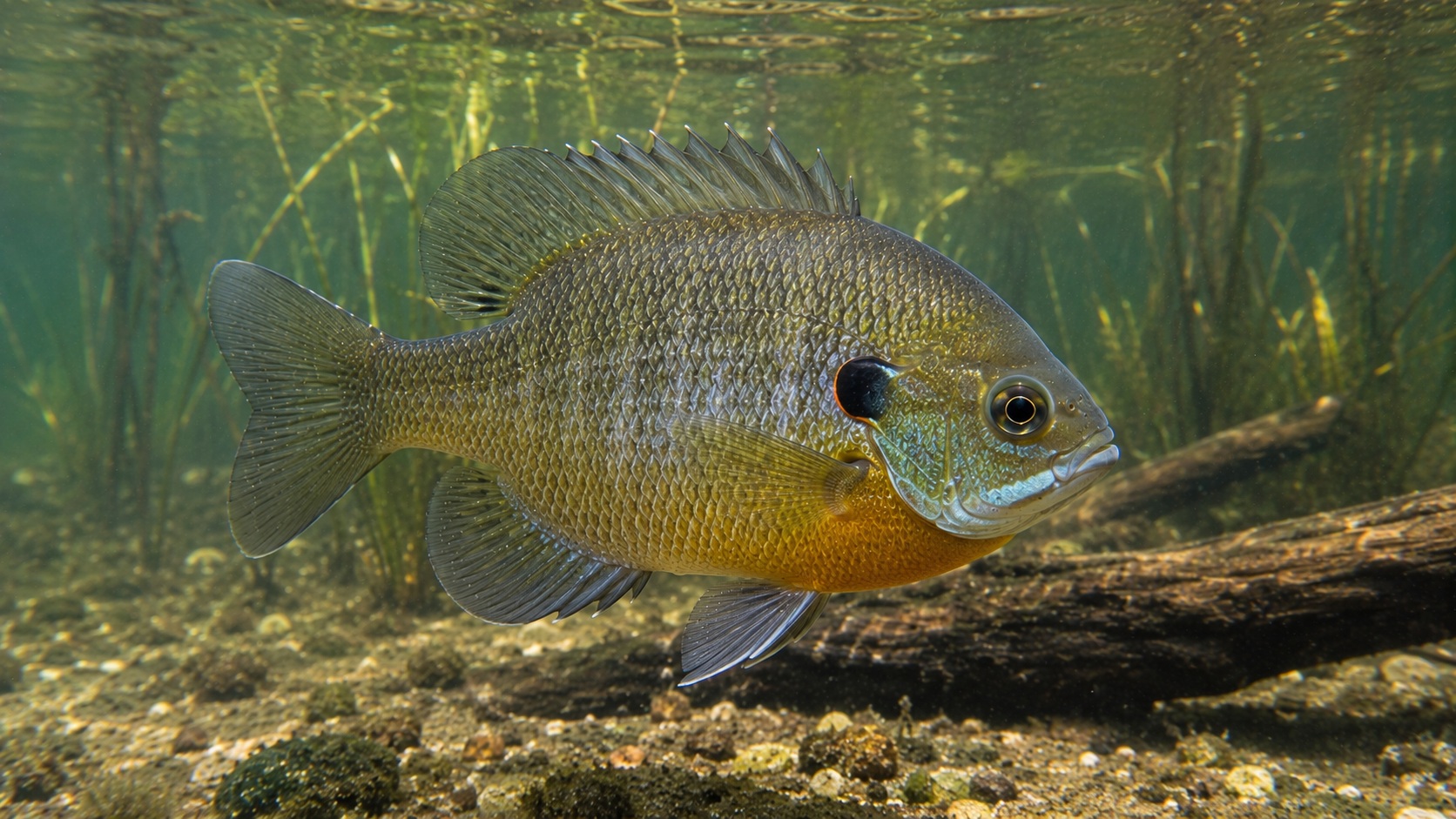
Bluegill have a deep, rounded body built more like a dinner plate than a torpedo. The sides run from olive-green to a warm orange-bronze, with six to eight faint vertical bars along the flanks that can be subtle or vivid depending on water clarity and season. The single most reliable ID feature is the opercular flap: a jet-black tab that extends from the back edge of the gill cover. In the sunfish family, that black ear is the giveaway. No other common sunfish has one that dark and that well-defined.
During spawning season, the males become genuinely striking. The breast and belly flush a deep orange-yellow that looks almost painted on. Big breeding males are some of the most colorful fish you will find in any freshwater system.
Lookalike alert: The redear sunfish (shellcracker) shares the same waters throughout much of their overlapping range and has a similar body shape. The redear’s opercular flap has a red or orange edge rather than solid black, and it lacks the bluegill’s vertical bars. If the ear flap is solid black and the mouth is small, it is almost certainly a bluegill.
Where to find them
If there is freshwater within the species’ range, there are likely bluegill in it. Retention ponds, community lakes, park ponds, canal systems, and river backwaters all hold established populations. You do not need a boat or a special destination. A pond with a 10-foot bank and a bottle of crickets is a legitimate bluegill spot.
Within any given body of water, bluegill orient to structure and shallow cover. Dock pilings are a classic location because bluegill stack in the shade below them and use the wood as a current break. Submerged logs, overhanging vegetation, patches of lily pads, and the edges of grass beds are all productive. In deeper lakes, look for drop-offs near the bank where shallow water transitions to a few feet of depth.
In rivers, bluegill favor the slow water. They avoid strong current and congregate in backwater pockets, eddies behind rocks or fallen timber, and quiet coves off the main channel. In the Great Lakes region, shallow bays and weedy inlets of lakes Erie, Huron, and Michigan produce bluegill through the warmer months. Across the river systems of the Mississippi Delta and the Tennessee Valley, oxbow lakes and sloughs are reliable producers. Throughout the mid-Atlantic and Southeast, warm-water reservoirs and river impoundments hold some of the largest populations on the continent.
When to go
Spring is the prime time, and the spawning season is the peak within the peak. As water temperatures climb into the mid-60s°F, bluegill begin moving into the shallows and fanning out nesting beds. On a clear day in calm water over a sandy or gravelly bottom, you can actually see the beds: round, light-colored circles ranging from saucer-sized to larger than a manhole cover, packed together in colonies that can cover a wide area.
The timing of this spawn shifts significantly by latitude. In the Gulf Coast states, beds may appear as early as March or April when water warms quickly. In the mid-Atlantic and lower Midwest, spawning activity peaks in May and June. In the Great Lakes states and the northern tier, expect the beds later — often late May through July depending on the season.
During the spawn, male bluegill are aggressively territorial. They will strike at virtually any small bait or lure that enters the bed, not necessarily because they are hungry, but because they are defending the nest. This makes them highly catchable in a way that is almost unsportsmanlike. Cast, wait, fish on. Repeat.
Outside of spawning season, summer mornings and evenings are most productive. Bluegill feed actively in low light and tend to retreat to deeper, shadier water during the heat of midday. Early morning and the last two hours before dark are the windows to prioritize through the warmest months. In northern states, winter fishing slows dramatically once water temperatures drop into the low 50s°F and below, though ice anglers consistently take bluegill through the hard-water season on small jigs tipped with waxworms. In southern states, winter activity never fully shuts off — expect slower but steady fishing on warm afternoons when water temps climb back toward 55–60°F.
What to throw
Live crickets are a definitive bluegill bait across much of their range, and there is a clear reason why: bluegill eat insects above everything else, and a live cricket moving naturally under a small bobber looks exactly like what they are programmed to eat. Hook the cricket through the thorax on a No. 8 or No. 10 wire hook. Pair it with a small round float (1 to 1.5 inches in diameter) set at a depth that keeps the cricket 12 to 18 inches off the bottom. Cast to structure, let everything settle, and wait. When the bobber goes down, lift the rod.
Red wigglers and earthworms are the second-best option and work everywhere crickets do. Pinch off a small piece of nightcrawler rather than threading the whole worm, which creates a bait that is too big for a bluegill’s small mouth.
Small soft plastics close the gap when live bait is unavailable or inconvenient. A 1.5-inch paddle tail swimbait or tube jig in chartreuse, white, or pink works well under a float or fished slowly along the bottom. Keep the jig head weight at 1/32 or 1/16 ounce so the presentation stays slow and natural.
Tiny spinners and beetle spins are worth keeping in the box. A 1/16-ounce beetle spin in black with a yellow blade will catch bluegill on nearly any clear-water pond and is useful for covering water quickly when you need to find where the fish are holding.
For tackle, a light or ultralight spinning rod in the 5.5 to 6.5-foot range with 4 to 6-pound monofilament is the ideal setup. This combination lets you feel every tap and makes even a modest fish feel like a serious opponent. Heavy tackle robs the experience. Bluegill are built for light gear.
Regulations
Bluegill regulations vary by state. Most states manage them as panfish with a daily bag limit and no minimum length requirement, though specific numbers differ — some states are more generous, others more restrictive, and certain designated waters carry special rules that override the statewide standard.
Before you fish, check the regulations published by your state’s fish and wildlife agency for the specific water you plan to fish. Many states maintain searchable online tools that show per-water rules. When in doubt, the statewide panfish rules are the starting point, but always confirm whether your target lake, river, or reservoir has any additional restrictions in effect.
Bluegill are a state-managed freshwater species; there is no federal (NOAA) management involvement.
Handling and release
Bluegill are hardy and handle easily. Wet your hand before picking one up to protect its slime coat, and use needle-nose pliers or forceps to back out the hook if it is set deep. If you plan to keep fish for the table, a small cooler with ice keeps them in ideal condition. Bluegill recover quickly from release and there is no special technique required beyond basic care.
On the Table
Bluegill are solid table fare and one of the most popular panfish kept for eating across North America. Their small size requires a bit of extra work at the cleaning table, but anglers who put in the effort are rewarded with sweet, mild, white-fleshed fillets that hold up well to a range of cooking methods.
Taste and texture: Bluegill flesh is white to off-white, fine-grained, and mildly sweet with almost no fishiness. The texture is delicate and flaky — similar to crappie but slightly firmer. Larger fish (8 inches and up) yield more usable meat per fillet and are generally preferred for the table.
Best preparation methods:
- Pan-frying whole or as fillets: The classic approach. Smaller bluegill are often scored and fried whole, which keeps the flesh moist and lets the skin crisp up beautifully. The mild flavor pairs well with a simple seasoned cornmeal or flour dredge. This method works because the thin fillets cook quickly and evenly in hot oil without drying out.
- Battering and deep-frying: A light beer batter or seasoned fish fry coating seals in moisture and complements the sweet flesh without overpowering it. This is arguably the most popular preparation at fish fries across the Midwest and South.
- Baking or broiling: For a lighter option, bluegill fillets brushed with butter and lemon hold together well in the oven. Their delicate texture means high heat for a short time works better than slow roasting.
- Sauteing in butter: The fillets are thin enough that a quick saute in clarified butter with garlic and fresh herbs is all they need. This method showcases the clean, sweet flavor without masking it.
Handling for table quality: Bluegill are best eaten fresh. Put fish on ice immediately after landing — a cooler with crushed ice keeps the flesh firm and prevents the rapid deterioration that warm water and summer temps accelerate. If keeping a limit, a live well is fine short-term, but transition to ice before cleaning. Fillet carefully to minimize the thin rib bones; a flexible fillet knife makes it easier to skin and debone the small fillets cleanly. Rinse fillets in cold water and pat dry before cooking or freezing.
Eating caveats: Bluegill from certain impaired or industrial waterways may carry pollutant advisories. Check your state fish consumption advisories before keeping fish from urban lakes, downstream of industrial sites, or waters with known contamination. No ciguatera, mercury, or parasite concerns apply to this freshwater species under normal conditions.