A note about links: If we include links to retail sites like Amazon or Bass Pro Shops, it's because they're relevant to the topic and, as anglers ourselves, we believe they're worth checking out. As an Amazon Associate we earn from qualifying purchases.
Ask any angler who has found a shellcracker bed on a spring morning what fish they want to be chasing, and you already know the answer. The redear sunfish is one of the most satisfying panfish across the entire southeastern and central United States, and not just because the eating is outstanding. There is something deeply appealing about targeting a fish that requires you to slow down, read the bottom, and present a small bait right on the bed. When a big redear takes your worm and peels line off a light ultralight spinning rod, you will understand immediately why generations of Southern families have made shellcracker trips a spring tradition.
How to identify one
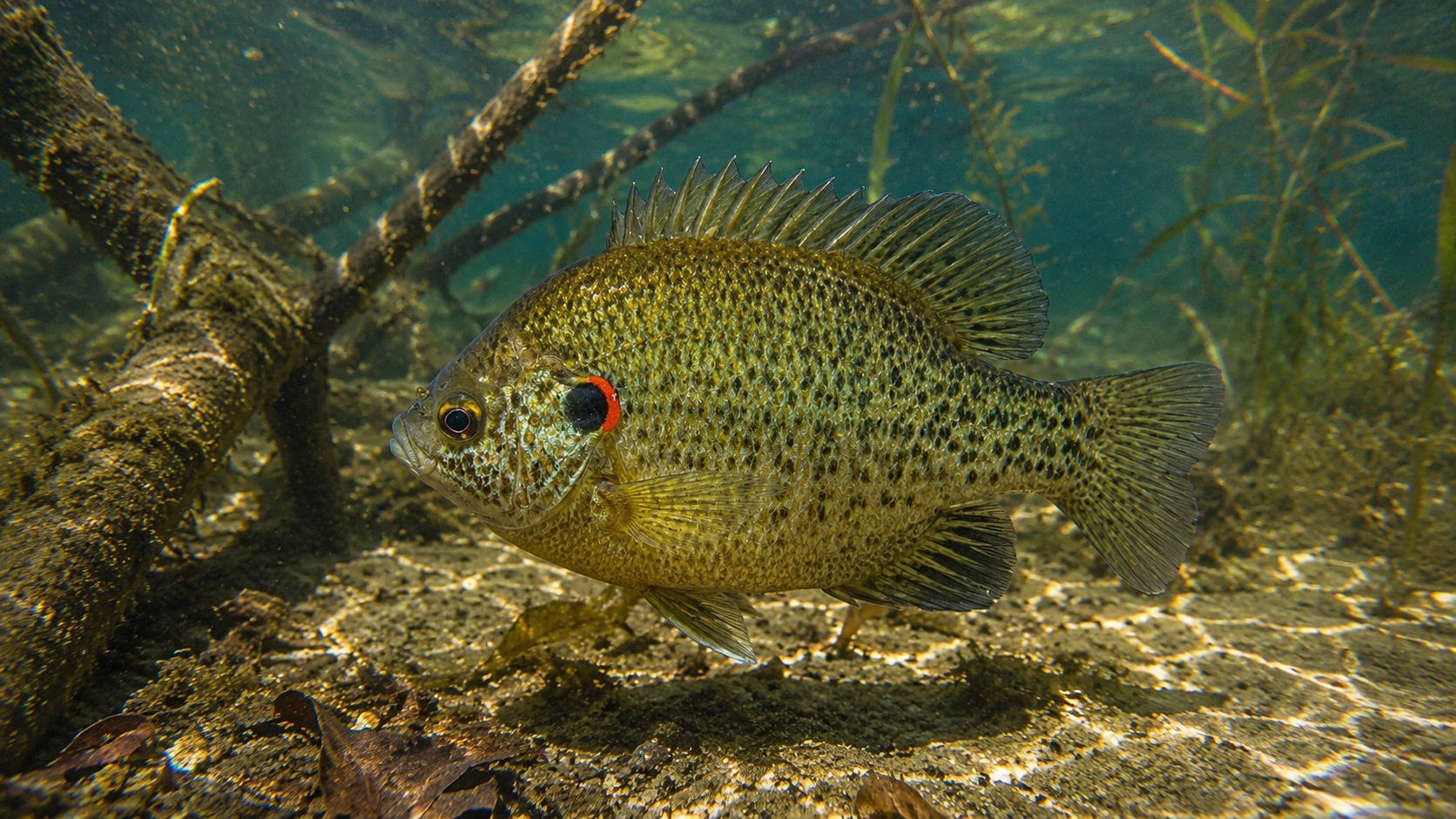
The redear sunfish is a chunky, deep-bodied panfish. The body is olive-green to brownish on the back, fading to a lighter cream or yellowish belly. The single most reliable field mark is the opercular flap, the stiff “ear” at the back edge of the gill cover. In males, the rear margin of that flap is a vivid red-orange to scarlet. In females and juveniles, the tab is yellow to pale orange. Either way, that colored border is what separates a redear from every other sunfish in the water.
Redear are often found alongside bluegill, and the two are easy to confuse at a glance. Key differences: redear are generally chunkier and deeper-bodied for their length, they lack the dark vertical bars that stripe a bluegill’s side, and they show little to none of the bright blue and orange facial coloring that bluegill males develop. If you pick the fish up and hold it close to your ear while it is still wet, you may actually hear the faint crackling sound of its pharyngeal teeth. Those molar-like teeth in the back of the throat are purpose-built for grinding snail and clam shells. That is where the name shellcracker comes from, and it is the single most distinctive biological fact about this fish.
Where to find them
Redear sunfish prefer harder substrates than most panfish. While bluegill will set up over soft muck or in heavy vegetation, shellcrackers are drawn to sandy bottoms, gravel transitions, and firm clay. They forage along the bottom almost exclusively, rooting out snails, small clams, and aquatic invertebrates from the substrate. This makes them somewhat predictable: follow the hard bottom transitions and you find the fish.
Look for redear holding near dock pilings over firm sand, along the edges of submerged shell bars, and at the points where soft-bottomed coves transition to sandy or gravelly flats. Any productive bass lake with a diverse bottom structure is worth targeting for redear.
Across the Southeast — including Gulf Coast states like Louisiana, Mississippi, Alabama, and Georgia — large river impoundments, oxbow lakes, and slow-moving river backwaters hold strong redear populations. In the mid-South and lower Midwest, the species thrives in reservoirs throughout Tennessee, Kentucky, and Arkansas, particularly where hard-bottom flats and gravel points are present. Throughout the Mississippi River drainage, redear share habitat with crappie and largemouth bass in the same oxbow lakes and sloughs that are famous for panfishing generally. In introduced populations farther west — including reservoirs in Texas, Oklahoma, and even Arizona — redear have established themselves wherever snail-rich sandy-bottom habitat exists.
When to go
Spring is the defining season for shellcracker fishing, and the spawn is the event that concentrates fish and makes them genuinely easy to locate. Water temperatures in the 65 to 70 degree range trigger spawning activity. In the Deep South and Gulf Coast states, that window typically arrives in late winter to early spring. Farther north — in Tennessee, Kentucky, Missouri, and Illinois — the same water temperature arrives weeks later, often in late spring or even early summer. The full moons of spring are historically the most productive days wherever you fish. Shellcrackers form large spawning colonies on sandy or gravelly flats in 1 to 5 feet of water. When you locate an active bed, the fishing can be exceptional: fish after fish, often running a half-pound to well over a pound.
Outside the spawn, shellcrackers scatter and become harder to target specifically. Summer heat pushes them deeper, and they tend to feed more early in the morning and late in the afternoon. Overcast days in the summer and fall will bring them shallower. The fish are there all year; the spawn concentrates them and makes them far more accessible to locate and catch.
What to throw
Redear are much more selective about baits than bluegill, and that selectivity is part of what makes them a satisfying target. Forget most artificial lures for this fish. Here is what actually works.
Red wigglers and small earthworms are the top bait by a wide margin. Red wigglers match the size of the natural invertebrates shellcrackers root for. Thread a small red wiggler on a No. 8 or No. 10 long-shank hook so it hangs naturally. Keep it small: a worm threaded once through the hook, not piled on in a big glob. Redear bite with a subtle, mouthing motion, and too much bait masks the take.
Small pieces of nightcrawler work when red wigglers are unavailable. Cut a nightcrawler into thirds and use a small piece. The same hook and presentation applies.
Live crickets are excellent during warmer months. A cricket on a small hook presented just off the bottom can outfish worms on certain days, particularly when fish are slightly suspended above the bed.
Small shrimp pieces work in ponds and lakes where shrimp are used as a general panfish bait. Use a small piece, not a whole shrimp.
The standard rig is a light spinning rod in the 5 to 6 foot range, 4 to 6 lb monofilament, a small clip-on or peg float set to keep the bait 12 to 18 inches off the bottom, and one or two small split shot pinched 8 inches above the hook. Cast to likely structure, let the bait settle, and watch the float. Redear bites are often subtle: a slight dip, a sideways drift, or the float laying flat on the surface. Set the hook with a short, firm snap.
When fish are actively spawning and willing to feed aggressively, a tiny 1/32 oz jig head with a small soft plastic grub in white or chartreuse can pick up fish. This is the exception rather than the rule. On most days, natural bait on bottom will dramatically outperform any artificial.
Regulations
Regulations for redear sunfish vary by state. Most states manage redear under a combined panfish or sunfish bag limit alongside bluegill and other centrarchids. Minimum size limits, daily bag limits, and special rules for specific water bodies differ significantly from one state to the next. Always check with your state fish and wildlife agency before fishing — regulations can also vary by individual lake or reservoir within the same state. Links to state agency regulation pages are typically found by searching “[your state] fishing regulations.”
Handling and release
Redear sunfish are hardy and handle well. Wet your hands before handling any fish you plan to release, and minimize air exposure. For fish being kept for the table, a small cooler with ice keeps them firm and improves the flavor of the fillets. The table quality of a fresh shellcracker is outstanding: sweet, white, and delicate, widely considered the best-eating sunfish across its range. Pan-fried in butter or cornmeal, a stringer of mixed bluegill and redear is the traditional reward for a good spring morning on the water.
On the Table
Redear sunfish are excellent table fare and are actively kept by anglers who know them — their white, sweet flesh rivals crappie and puts them firmly in the top tier of panfish worth bringing home.
Taste and texture: The flesh is white, mild, and slightly sweet with a clean, fresh flavor that lacks the earthy undertone found in some other sunfish. Texture is firm yet finely flaked, which holds up well to multiple cooking methods. Larger redear (over 8 inches) yield more usable meat per fish and are especially prized.
Best preparation methods:
- Pan-frying whole or filleted: The classic approach for redear. A light dredge in seasoned cornmeal or flour, then fried in butter or neutral oil over medium-high heat, produces a crispy skin and moist interior. The firm flesh does not fall apart in the pan, making it easy to cook through without overcooking.
- Batter-frying: A thicker beer or buttermilk batter adds crunch and pairs well with the mild sweetness of the meat. Works especially well for fish fry gatherings where multiple panfish species are cooked together.
- Baking or broiling: For a lighter preparation, redear fillets hold their shape under dry heat. A brushing of butter, lemon, and herbs is sufficient — the fish does not need heavy sauce because the natural flavor is the draw.
- Shore lunch / camp cooking: Cleaned fish cooked whole in a cast iron skillet with butter and garlic is a traditional approach that makes the most of a successful day on the water.
Handling for table quality: Redear are best kept alive on a stringer or in a livewell until you are ready to clean them. Like all panfish, they deteriorate quickly once dead in warm water. If you cannot keep them alive, ice them immediately — gut and gill them first if you are more than an hour from cleaning. The skin has a mild flavor and can be left on for pan-frying, but many anglers prefer scaled fillets or skinned fillets for baking.
Eating caveats: Redear are a freshwater species with no ciguatera risk and no significant mercury concerns at typical recreational sizes. No notable parasite issues affect eating quality when the fish are cooked to an internal temperature of 145 degrees F. Check local regulations for bag and size limits, which vary by state and water body — some impoundments have slot or minimum-size rules that influence which fish you keep.