A note about links: If we include links to retail sites like Amazon or Bass Pro Shops, it's because they're relevant to the topic and, as anglers ourselves, we believe they're worth checking out. As an Amazon Associate we earn from qualifying purchases.
What it is
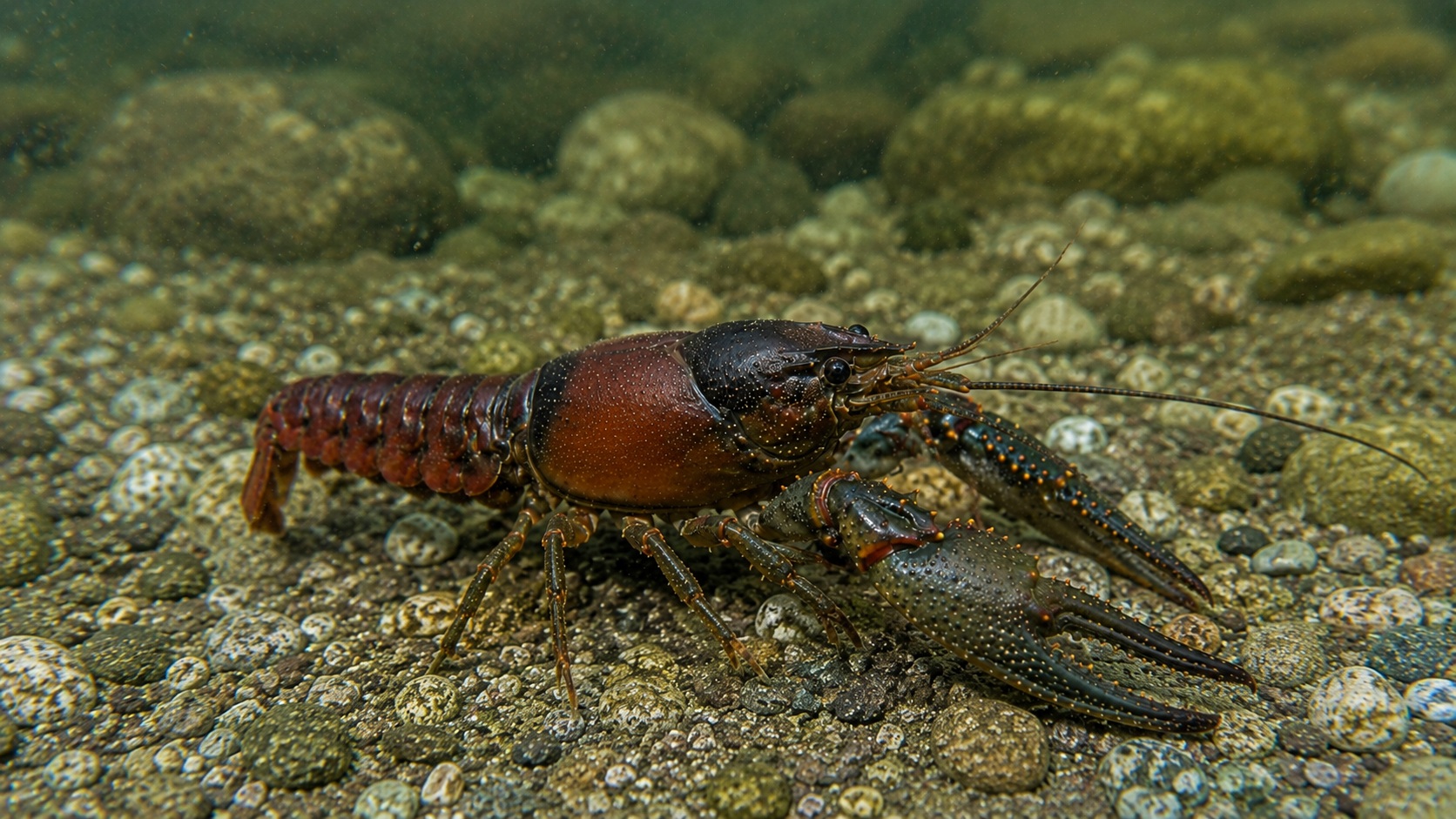
A crawfish — crayfish, crawdad, mudbug, call it what you like — is a small freshwater crustacean that lives under rocks and along the bottom of rivers, lakes, and ponds. To a bass, it is one of the most calorie-rich meals available, and where craws are present they are very often the number-one forage on the menu. That is especially true for smallmouth bass, which are built to root crawfish out of rocky bottoms and will key on them above almost anything else.
Here is the honest truth about this bait: a live crawfish is hard to beat. Largemouth bass, channel catfish, and even bigger redear sunfish eat them readily too. But this is also one of the very few baits where the soft-plastic imitations genuinely rival the real thing — so you have a real choice to make, and we will cover both.
How to rig and fish it
Hook a live craw so it stays alive and looks natural. The most common method is to run the hook point up through the soft underside of the tail and out the top, near the back of the tail. This lets the crawfish swim and scoot backward the way it naturally does, and bass almost always eat a craw tail-first to avoid the claws — so a tail-hooked bait sits exactly right in their mouth. An alternative is to hook through one of the horns (the bony points just behind the eyes), which keeps the bait lively and is gentle on the crawfish, though it gives a slightly less secure hold.
Once it is on the hook, fish it close to the bottom, where craws live:
- On the bottom, with just enough weight to hold position. A split shot or a light Carolina rig keeps the craw down near the rocks while letting it crawl naturally. Keep enough line tension that the crawfish cannot burrow under a rock and hide.
- Free-lined, with no weight at all, on a free-line rig. In current or shallow rocky water, a weightless craw drifts and behaves exactly like the real thing. This is a deadly smallmouth presentation.
- Under a float, on a bobber and float rig, when you want to suspend the craw just off the bottom or keep it out of snaggy cover. The float also signals the bite.
- On a drop-shot rig when you need to hold a craw at a precise depth over deeper structure — a finesse approach that shines on pressured smallmouth.
The bite is usually a single heavy thump. Give it a beat, reel down until you feel the fish’s weight, and set firmly. This is live-bait fishing and bottom-fishing at its most fundamental: natural bait, in the natural strike zone, doing what bass already expect to see.
When to use it
Crawfish shine from spring through fall, whenever water temperatures have craws up and active on hard bottom. Spring and fall are prime, because crawfish move into the shallows to mate and feed and become exposed on the rocks — and bass, according to Bassmaster’s research on crawfish forage, key in on that vulnerability hard. Target rocky banks, gravel flats, riprap, points, and submerged boulder fields. Anywhere you flip a rock and find craws, you have found a place worth fishing one.
Match the local craw color when you can. Crawfish are usually a camouflage olive-brown, but during and just after a molt they take on a brighter orange or red cast that makes them an easy visual target for bass. If the craws under the rocks you are fishing are red-orange, lean orange; if they are drab and brown, stay natural.
Forms and keeping it
You will encounter crawfish in two states, and the difference matters enormously.
A hard-shell craw is the everyday form — armored, drab, and tough. It fishes fine and stays on the hook well.
A soft-shell (molting) craw is the prize. As a crawfish outgrows its shell it sheds it, and for a short window the new shell underneath is soft and defenseless. Predators know this, and a soft-shell craw is darn near impossible for a bass to pass up. If you catch one molting, that is your premium bait — fish it first.
Catching and keeping them. You can catch your own by flipping rocks in a stream and grabbing fast (put one hand in front of the craw and one behind, since they dart backward), by setting a baited minnow-style trap overnight, or by working a seine net across current while a buddy stirs the streambed upstream. Keep them cool, damp, and lightly aerated — a bait bucket with a little water, some wet leaves or moss, and shade. They do not need to be fully submerged, and crowding or heat will kill them quickly. A cooler with a damp towel travels them well.
Removing the pincers. Before you fish a live craw, pinch or break off the large claws. This does two things: it stops the crawfish from grabbing hold of a rock or weed and anchoring itself out of the strike zone, and it makes the bait look smaller, easier, and less threatening to a bass. Anglers and tournament testing alike have found that craws with the claws removed — and sometimes pared down even further — can draw more strikes, not fewer. A handicapped-looking craw reads as an easy meal.
Gear and sourcing
You do not need much, and you should never buy or transport live animals across waters where they are not native — that is how invasive crawfish get spread, so use bait from the water you are fishing or buy local. For the artificial route, a soft-plastic craw is the responsible, always-available alternative that genuinely competes with the real thing.
- Bait hooks: A light-wire octopus or bait hook in #2 to 1/0 is ideal for live craws — small enough to hide, strong enough to hold. Step up toward 2/0 for big baits and catfish.
- Split shot: A few removable split shot let you add just enough weight to keep a craw on the bottom without killing its natural drift.
- Soft-plastic craws: When live bait is not an option, Strike King Rage Craw, Berkley PowerBait craws, and Zoom craws Texas- or Carolina-rigged are the imitations that truly rival a live mudbug. Match the color to your local craws — natural brown most days, orange-red around the molt.
Fish a real craw when you can get one, reach for the plastic when you cannot, and either way you are fishing the one thing a bass is built to eat.