A note about links: If we include links to retail sites like Amazon or Bass Pro Shops, it's because they're relevant to the topic and, as anglers ourselves, we believe they're worth checking out. As an Amazon Associate we earn from qualifying purchases.
What it is
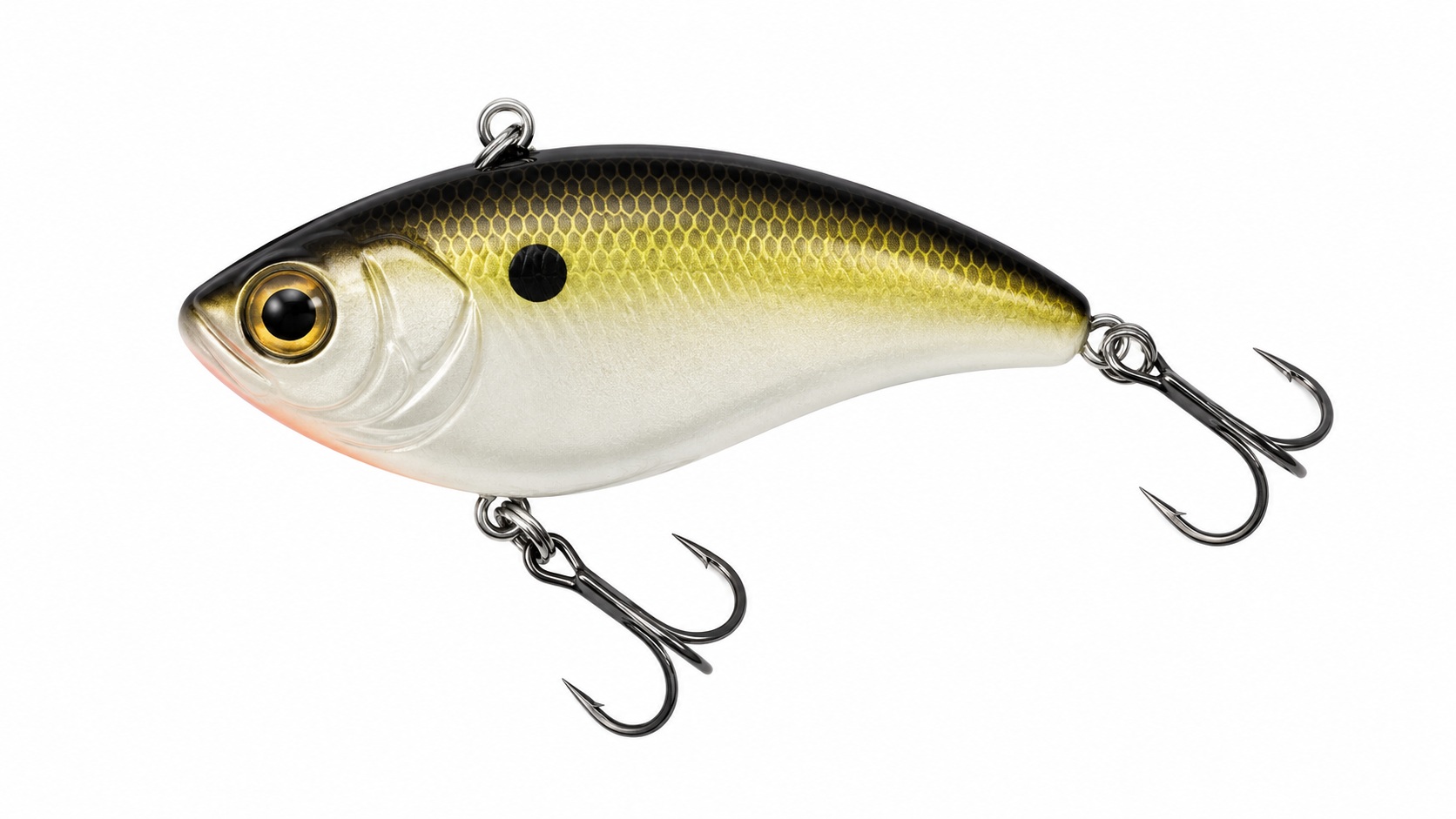
The lipless crankbait is a hard-bodied, flat-sided lure with no diving lip. Instead of diving toward the bottom under its own bill, it sinks freely on a slack line — about one foot per second — and vibrates tightly on a straight retrieve. A set of internal BBs or shot creates a distinct rattle that fish locate from a distance, even in stained water or heavy cover.
The result is a bait you can fish at virtually any depth: start the retrieve immediately to work the surface, or count it down to 10, 15, even 25 feet before engaging. That versatility is why tournament anglers keep one tied on year-round. It covers water fast, calls fish from a distance, and can be finessed through specific depth zones or ripped through vegetation for reaction strikes.
How to rig it
Lipless crankbaits come rigged with two treble hooks from the factory. No additional rigging is needed for most situations. Use a loop knot (Rapala knot) or a snap to attach it to your line — a direct cinch knot can restrict the bait’s action on lighter line. Avoid adding a wire leader for freshwater use; it dampens the vibration noticeably.
For fishing around grass, some anglers swap the front treble for a single hook with a weed guard, which reduces hang-ups while still getting hook-ups on hard strikes. This is optional — for open-water use, leave the factory trebles as-is.
How to fish it
Steady retrieve: The default. Cast out, let the bait sink to your target depth (count it down), then reel at a medium pace. The bait vibrates and rattles on any consistent retrieve. This is the starting point and covers the most water.
Yo-yo retrieve: The most productive technique for grass fishing and cold-water bass. Cast out and let the bait sink on a slack line. Rip the rod upward sharply — six inches to two feet — then immediately drop the rod tip and let the bait fall on slack again. Repeat all the way back to the boat. The rise-and-fall imitates a fleeing or dying baitfish. Most strikes come on the fall, often as dead weight on the line rather than a hard thump.
Counting down to depth: Lipless crankbaits sink at roughly one foot per second. Count to five before starting your retrieve and you are fishing at approximately five feet. This is one of the most precise depth-control methods available with any hard bait, and it lets you target fish you can mark on electronics without needing a deep-diving lip.
Ripping through grass: When submerged vegetation is present, burn the bait just above the grass tops, then kill the retrieve when you feel the bait catch a weed clump. The bait rises and pulls free; immediately resume the retrieve. Bass holding on grass edges ambush the bait during that erratic pause-and-pop. This technique produces some of the most violent strikes you will see in freshwater fishing.
When to use it
Spring on grass: One of the best situations in bass fishing. When bass are staging on submerged grass flats before the spawn, a lipless crankbait worked with the yo-yo retrieve over and through the tops of the vegetation is a primary technique. Fish are aggressive and the rattling bait is easy for them to locate.
Cold water (late winter / early spring): Lipless crankbaits produce when water temperatures are in the low to mid-40s — colder than most other hard baits remain effective. Slow the yo-yo retrieve down significantly; let the bait fall longer between rips. This is one of the only moving baits that remains legitimate below 50°F.
Covering open water: When fish are scattered on flats with no visible structure, a lipless crankbait fished on a steady retrieve covers more water per hour than almost any other lure. Work it fan-cast style to locate active fish, then switch to slower presentations once you know where the fish are.
Saltwater inshore: Spotted seatrout and striped bass respond well to lipless crankbaits worked over grass flats and in tidal creeks. The rattle is especially useful in stained coastal water.
Color and size selection
| Condition | Color to reach for |
|---|---|
| Stained or muddy water | Red craw, chartreuse, bright orange |
| Clear water | Chrome/shad, ghost minnow, natural silver |
| Overcast or low light | Gold/perch, citrus shad |
| Grass-heavy situations | Red craw, bleeding shad |
| Saltwater flats | Silver/white, mullet, ghost |
Size: The 1/2 oz (the “original” Rat-L-Trap size) is the all-around standard and accounts for most fish caught on this style of bait. A 3/4 oz model sinks faster and is useful for fishing deep or dealing with wind. A 1/4 oz size works for finesse situations — smaller bait, smaller hooks, lighter line — and is useful for walleye or inshore species where a larger profile is too much.
Gear setup
Rod: Medium or medium-heavy power with a moderate action. The key is a rod tip with enough give to absorb strikes and keep fish pinned without ripping the treble hooks free. An extra-fast rod throws fish. Many anglers use a 7-foot medium-heavy moderate-action casting rod as a dedicated lipless rod.
Reel: Baitcasting reel with a 6.4:1 to 7.1:1 gear ratio. You need to be able to rip the bait up and take up slack quickly on the fall. A high-speed reel (8:1+) is harder to control at slow yo-yo cadences.
Line: 14–17 lb fluorocarbon is the standard for most bass applications. Fluorocarbon sinks, so it helps keep the bait in the strike zone. For cold-water fishing where you want the most natural fall, drop to 12 lb. For grass ripping, some anglers go up to 20 lb to horse fish out of vegetation. Braided line is workable for grass situations where snag control matters more than feel, but it can pull hooks on hard strikes.
Brands worth knowing
Bill Lewis Rat-L-Trap is the original lipless crankbait and still a benchmark. The 1/2 oz chrome/blue model has caught more bass than nearly any other hard bait ever made. Its rattle is loud and distinct. If you have never thrown a lipless crankbait, start here.
Strike King Red Eye Shad is the most popular tournament choice of the last decade. The Red Eye has a slightly tighter wiggle than the Rat-L-Trap, sinks evenly (not nose-heavy), and is available in an enormous color range. The “Sexy Shad” color is a proven staple.
Rapala Rippin’ Rap has a wider, more erratic wobble than most lipless baits and produces exceptionally well on the yo-yo retrieve. It is a strong choice when fish are responding to a bigger profile.
Lucky Craft LV-500 is a premium option with extremely sharp hooks and consistent weighting. Popular among tournament anglers targeting larger fish.
Berkley Warpig offers a good value entry point with solid rattle and action for anglers who are new to the category and want to experiment without committing to premium pricing.