A note about links: If we include links to retail sites like Amazon or Bass Pro Shops, it's because they're relevant to the topic and, as anglers ourselves, we believe they're worth checking out. As an Amazon Associate we earn from qualifying purchases.
What just bit your line?
If you just pulled up a small, flat, silvery fish covered in blue-and-yellow stripes with a dark spot behind its gill plate and a fin full of sharp spines that immediately stabbed your thumb - congratulations, you caught a pinfish. These are among the most commonly caught saltwater bycatch species along the entire Atlantic and Gulf coast, from the Chesapeake Bay south through the Florida Keys and west across the Gulf to Texas and beyond. It does not matter what you were targeting, what bait you used, or what depth you were fishing. If you were in a seagrass flat, a dock shadow, a marsh creek, or a nearshore pass anywhere in their range, a pinfish eventually found your hook. They are small, aggressive, and absolutely everywhere.
How to identify one
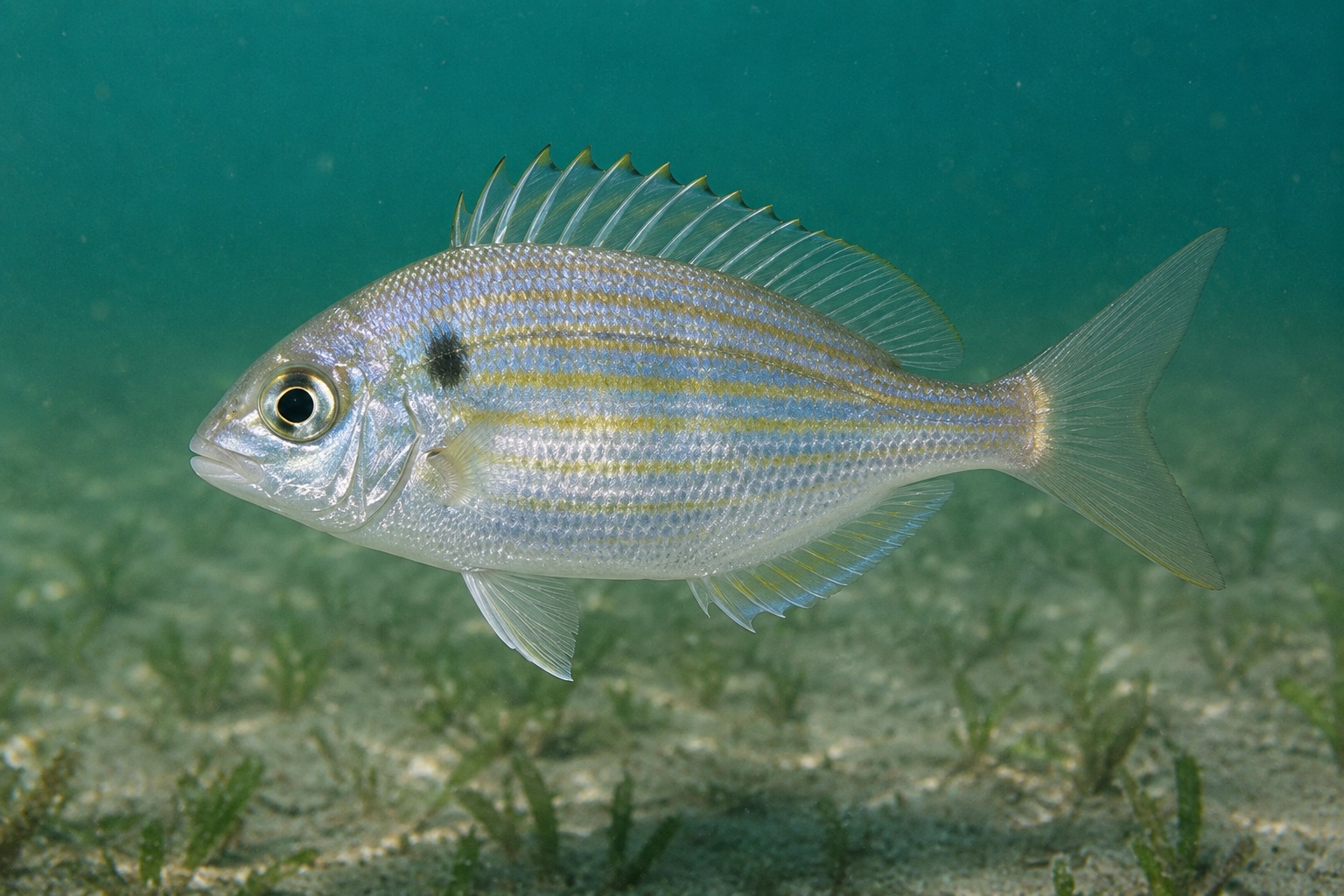
Pinfish are hard to mistake once you know the pattern. The body is oval and strongly compressed side-to-side, giving it that classic flat panfish shape. Coloration is bluish-silver overall with five or six alternating blue and yellow horizontal stripes running along the sides and six faint, diffuse vertical bars crossing the body. The single most reliable field mark is a prominent dark spot - almost black - sitting right at the upper edge of the lateral line just behind the gill cover. That spot is present at nearly every size and will not rub off.
The dorsal fin is the other thing you will notice immediately: it runs the full length of the back and starts with 12 stiff, needle-sharp spines before transitioning to softer rays. The anal fin also has three strong spines at the front. The name “pinfish” comes from those spines, not from any pin-shaped body part - they are what gets you.
The mouth is small relative to the head, and both jaws carry eight broad, notched incisor-style front teeth that are clearly visible when you look head-on. Behind those incisors are rows of molar-like crushing teeth for processing shellfish and plant material.
Most pinfish caught inshore measure 3 to 6 inches. Fish up to 8 inches are common. The species can reach 14 to 15 inches and over a pound, but you rarely encounter those sizes shallow. Adults tend to move to deeper passes and offshore reefs.
Common confusion species: Juvenile sheepshead look superficially similar but have much bolder, clearly defined black vertical bars on a white background with no horizontal stripes and no dark shoulder spot. Spottail pinfish (Diplodus holbrooki) are a close relative with a large black saddle at the tail base rather than behind the gill. Neither species is dangerous, and neither should alarm you.
Is it dangerous?
The spines are the main hazard and they are legitimately sharp. The dorsal fin contains 12 stiff spines that can puncture skin easily if you grab the fish without thinking, and the three anal spines on the underside will get you from below if you palm the fish. The spines are not venomous - there is no venom gland, no injection mechanism, no venom sac. A pinfish spine is a mechanical puncture, not an envenomation.
What that means practically: getting stabbed hurts for a minute, may draw a small amount of blood, and carries the same low-level infection risk as any minor puncture wound from a fish spine in seawater. Clean the wound with fresh water, apply antiseptic if you have it, and move on. You do not need a hospital trip for a pinfish spine.
The incisor teeth are real and reasonably sharp. A pinfish will bite if you put a finger near its mouth while it is flopping, and it can draw blood on thin skin. It cannot bite through a finger or cause serious injury. There are no toxins in the flesh, no ciguatera risk from this species, and no other hazards beyond the spines and teeth described above.
How to handle one safely: grip the fish firmly from above, with your thumb and first two fingers pressing down on the spines to flatten them against the body before you close your hand. If you are handling a lot of them - which you will on productive inshore flats - a small fish-gripping tool or a piece of old towel makes the process faster and keeps your fingers intact.
Where it comes from
Pinfish range from Massachusetts south through the Mid-Atlantic states, the Carolinas, Georgia, and Florida, then west across the entire Gulf of Mexico to the Yucatan Peninsula of Mexico. They are most abundant in the warm, shallow coastal waters of the Southeast and Gulf Coast states, but anglers fishing Chesapeake Bay tidal flats, North Carolina sounds, South Carolina tidal creeks, Mississippi and Alabama coastal marshes, and the Texas bays and estuaries all know them well.
They are euryhaline, meaning they tolerate a very wide range of salinity - from full-strength seawater to brackish estuaries to the brackish-fresh transition zone at the top of tidal creeks. Wherever there are seagrass beds, oyster reefs, dock pilings, or marsh edges in their range, pinfish will be present.
Juveniles recruit into shallow seagrass beds and estuaries where they find dense cover and food. This is why you catch them constantly over grass flats. Adults gradually move into deeper water - bay channels, tidal passes, and offshore reef structure - where they can reach larger sizes. The species spawns offshore in late fall through early winter, with juveniles recruiting inshore during spring. They are present in nearshore and estuarine waters year-round through most of their southern range, and are abundant inshore from spring through fall across their northern range.
They are omnivores with a strong lean toward invertebrates and plant material. Pinfish eat seagrass, algae, small crustaceans, mollusks, worms, and small fish. That broad diet is why they hit virtually every bait and many soft-plastic lures - shrimp, cut bait, fiddler crabs, live worms, and even small jigs are all fair game to them. They are aggressive, competitive feeders that will beat your target species to the bait repeatedly.
The reason they matter beyond being a nuisance: pinfish are one of the premier live baits for inshore predators throughout the Southeast and Gulf Coast. Snook, redfish, tarpon, cobia, flounder, and large seatrout all eat pinfish eagerly. Their spines actually help them survive in a livewell longer than softer bait species, and those same spines that annoy you while unhooking them do not stop a big redfish or flounder from inhaling one. If you have a castnet and a livewell, catching pinfish on purpose to use as bait is one of the most effective inshore strategies throughout their range. For how to catch, keep, and fish them, see our live baitfish guide.
When to find them inshore
Pinfish are present in inshore and estuarine waters year-round across the warmest parts of their range - Gulf Coast states and South Florida. Further north along the Atlantic seaboard, they are most abundant inshore during the warmer months and may be harder to find in shallow water during cold spells.
Water temperature is the best trigger to watch. Pinfish become most active and easiest to locate in shallow seagrass and dock structure when water temps are in the upper 60s through the 80s Fahrenheit. They do not disappear in cooler water, but they push deeper and become less aggressive at lower temperatures. In the Mid-Atlantic states, the peak inshore window runs roughly late spring through early fall. In the Gulf states and the Southeast, you can find them in the shallows most of the year, with the densest concentrations from spring through fall.
Peak juvenile recruitment into seagrass beds happens in spring, which is why pinfish seem to appear in overwhelming numbers by late spring across the mid-Atlantic and Southeast alike - those juveniles from the offshore winter spawn have moved inshore and settled onto the flats.
On the Table
Pinfish are edible and safe to eat. There is nothing toxic in the flesh. The eating quality is honestly modest but not bad - the meat is mild, slightly sweet white flesh with a flavor influenced by their shellfish-heavy diet. The problem is bones. Pinfish are heavily boned even by panfish standards, with a dense rib cage and numerous small intramuscular bones that make filleting frustrating on a 5-inch fish. You will get very small fillets and spend a lot of time on them.
If you want to eat pinfish, the two methods that actually work are frying them whole and pickling them. For whole frying, scale and gut the fish, score the sides, season simply, and fry at 375 degrees until crispy. Eat the meat off the bone the same way you eat a whole tilapia or a bluegill - work around the skeleton rather than trying to pick out every bone. The dorsal fin pulls cleanly out of a well-fried pinfish and the spine structure becomes readable once the fish is cooked. The second method is pickling: the acid in a vinegar-based brine will dissolve the small bones over time, making the fish fully edible without bone removal.
For most anglers, pinfish are better used as live bait than as table fare. The effort-to-reward ratio for eating them does not compete with the species you were probably targeting in the first place. That said, if you are at the dock with a dozen 8-inch pinfish and want to fry something, they will feed you.
What to do with it
Getting the hook out: Hold the fish from above with the spines pressed flat (see the handling note in the danger section above). If the fish is hooked in the lip on a small hook, standard needle-nose pliers will back the hook out easily. If it is deep-hooked, use a hook remover tool. Pinfish are hardy and recover well even from moderate hook sets.
Releasing it: Drop it back headfirst into the water. Pinfish do not need any revival time - they are extremely tough and will dart away immediately unless seriously injured.
Regulations: Pinfish are largely unregulated for recreational harvest in most states within their range, but rules can vary. Check your state’s fish and wildlife agency for current regulations before keeping them. In some states they are explicitly listed as an unregulated bait species; in others they may have minimal restrictions. When in doubt, a quick check with your state agency takes thirty seconds and keeps you legal.
Keeping it as bait: If you have a livewell or a bait bucket with aeration, pinfish keep exceptionally well compared to most bait species. Their hardiness is a big part of what makes them so valued. Hook them through the back just forward of the dorsal fin, staying away from the spine and the backbone, or hook them through the nose for a different action. Either method keeps them lively for long periods.
If a spine got you: Rinse the puncture with fresh water. Apply pressure if it is bleeding. Clean with antiseptic. There is no venom to neutralize, so no soaking in hot water (as you would with a catfish or stingray wound) is required. Watch for redness or swelling over the next day or two as you would with any puncture, but pinfish spine wounds routinely heal without complication.