A note about links: If we include links to retail sites like Amazon or Bass Pro Shops, it's because they're relevant to the topic and, as anglers ourselves, we believe they're worth checking out. As an Amazon Associate we earn from qualifying purchases.
Few inshore saltwater fish combine a distinctive look, a legitimate challenge, and a world-class dinner plate the way sheepshead do. They live on structure, eat with precision, and have built a reputation as the craftiest bait thieves on the coast — from the Chesapeake Bay to the Texas bays. That reputation is earned. But once you figure out the timing, the presentation, and the split-second hook set, sheepshead fishing becomes genuinely addictive, and you will eat very well afterward.
How to identify one
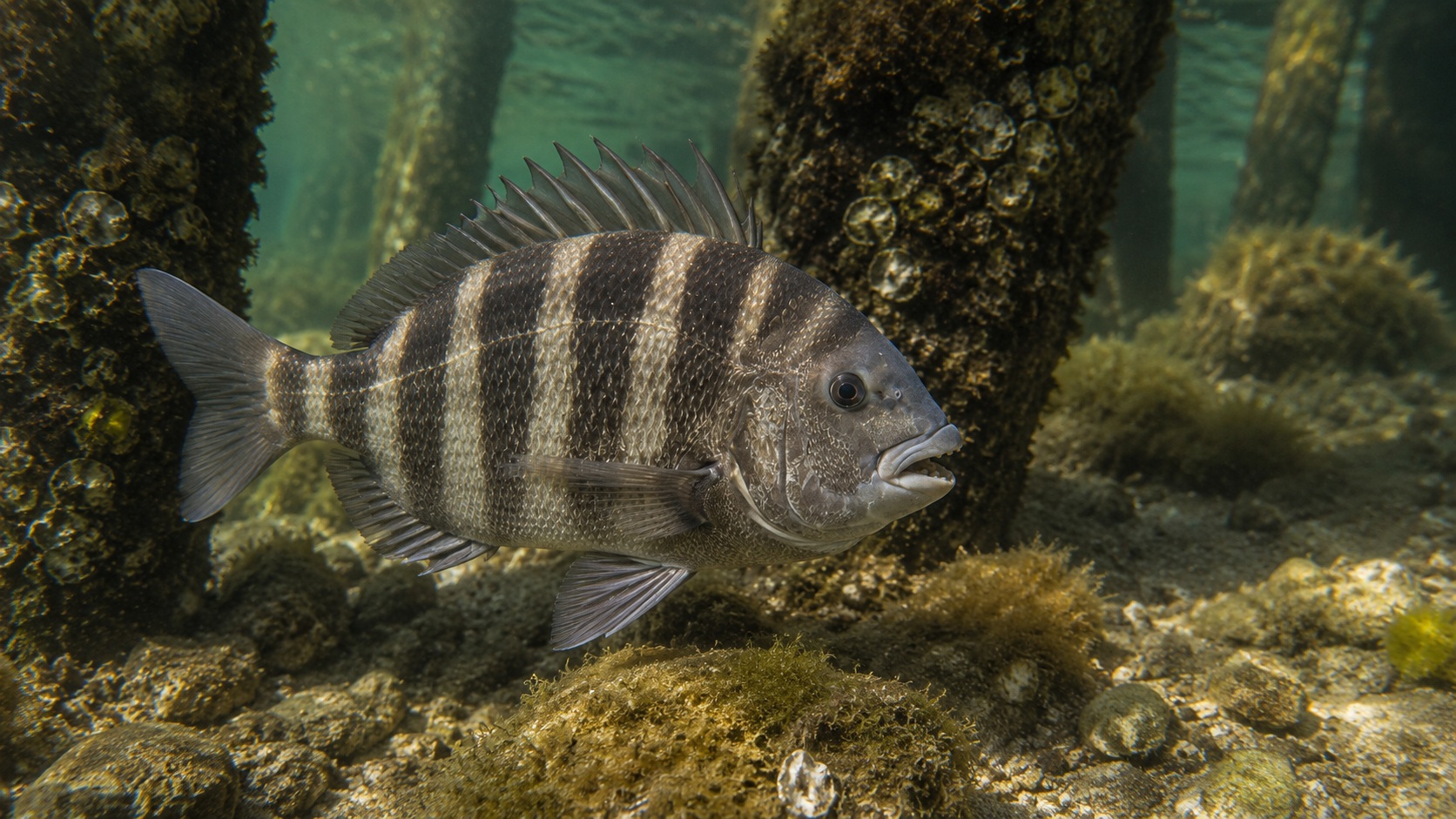
There is no mistaking a sheepshead. The body is deep and laterally compressed, covered in five to seven bold black vertical bars on a silver-white background. That pattern is where the nickname “convict fish” comes from, and it fits perfectly. First-time anglers often pull one up and do a double-take.
The second double-take comes from the mouth. Open a sheepshead’s jaw and you will see front incisors that look startlingly like human teeth, wide and flat for scraping barnacles off pilings. Further back sit rows of rounded molars built for grinding oysters and crustacean shells. It is one of the more unusual dental profiles in saltwater fishing, and it makes for a memorable photo.
Body size runs from 10 to 18 inches in typical catches, though fish over 20 inches show up regularly on productive structure in winter. The large, sharp dorsal spines and a razor-edged gill cover are worth noting before you reach into the livewell. Handle sheepshead from behind and grip them firmly.
No real lookalikes exist along the Atlantic or Gulf coast once you have seen the stripe pattern. Spadefish have a similar bar pattern but a much more rounded, disk-like body and no human teeth.
Where to find them
Sheepshead are structure fish, full stop. They do not free-roam grass flats looking for baitfish. They post up on anything encrusted with barnacles, oysters, or mussels and methodically work it over. If the structure has food growing on it, sheepshead are either there or nearby.
That logic applies coast to coast:
Jetties and inlet rocks: Jetty systems along the Atlantic and Gulf coasts are among the most reliable sheepshead spots anywhere in the species’ range. The rock faces hold heavy barnacle growth, current concentrates fish, and inlets draw winter aggregations when water temperatures cool. Fish tight against the rocks with the current working in your favor.
Bridge and causeway pilings: Any bridge or causeway piling with established barnacle growth is worth fishing. This applies from New York Harbor south through the Chesapeake Bay, the sounds of North and South Carolina, Georgia’s coastal estuaries, and across the northern Gulf from Pensacola Bay to Galveston Bay. If the piling has been in the water long enough to grow barnacles, sheepshead have found it.
Oyster bars: Sheepshead work oyster bar systems heavily throughout the Atlantic and Gulf coast estuaries. Moving tides concentrate fish at the drop-off edges adjacent to bars. This habitat is especially productive in the low-salinity sounds and marsh systems of the Southeast and Gulf Coast states.
Dock pilings: Any wooden dock with established barnacle growth holds resident fish. Private and commercial docks throughout back-bay and estuarine systems are year-round sheepshead habitat in the warmer portions of the range and productive seasonal spots farther north.
Nearshore reefs and wrecks: In the Gulf states and along the Southeast Atlantic coast, sheepshead also post up on nearshore hard bottom, artificial reefs, and wrecked structure. Larger fish in particular use these offshore-adjacent spots during winter aggregations.
When to go
The best sheepshead fishing coincides with cooler water. When water temperatures drop below roughly 68–72°F, sheepshead pack tightly onto structure and feed aggressively. When temperatures climb above 75°F, fish scatter and the bite slows. That temperature window is your primary trigger regardless of where you fish.
What changes by latitude is the calendar. Along the Gulf Coast and in the Southeast, that productive cool-water window typically runs from November through March, with peak action in February and March when spawning aggregations form around inlet and nearshore structure. In the mid-Atlantic states — Virginia, Maryland, Delaware, New Jersey — the bite compresses into a shorter window in spring and again in fall as fish migrate through on their way to and from wintering areas.
The spawning period is worth targeting anywhere in the range. Sheepshead spawn around inlet and nearshore structure in late winter and early spring, creating predictable concentrations of large fish. These aggregations are some of the most productive sheepshead fishing of the year.
The tidal phase matters significantly regardless of location. Moving tides, both incoming and outgoing, trigger feeding activity. Sheepshead use current to position themselves downstream of structure and intercept food washing off pilings and rocks. Plan to fish the two hours before and after a tide change.
What to throw
Fiddler crabs (the top bait): Nothing outperforms a live fiddler crab for sheepshead. The fish encounter fiddlers naturally around marsh edges and oyster bars throughout the species’ range, and the scent, movement, and profile are exactly what they expect to find near structure. Thread the hook through the back of the shell, leaving the legs free to move. Use a No. 1 or 1/0 hook, a small egg sinker just heavy enough to hold bottom, and present the bait as close to the piling or rock face as you can get it. Dead fiddlers still work when live ones are not available, but the live presentation is noticeably better.
Barnacles: Messy, inconvenient, and highly effective. Scrape barnacles off a piling with a putty knife into a bucket, crush a few as chum, and hook a clump directly onto your hook. Sheepshead are already eating barnacles off that same structure, so the presentation is entirely natural. The downside is that barnacles are soft and the bait does not stay on the hook well. Bring extra and refresh it often.
Sand fleas (mole crabs): Sand fleas fished under a float or on a bottom rig work well, particularly at inlets where they are a natural food source. They are easier to keep on the hook than barnacles and travel better than live fiddlers.
Fresh oyster: A chunk of fresh oyster meat on a small hook gets bit. Strip it from the shell, hook it through once, and keep the presentation compact. Not as good as fiddler crabs but a solid backup when other baits are unavailable.
The hook set: Everything above is secondary to this. Sheepshead have soft mouths and they nibble carefully. They will mouth a bait, feel resistance, and drop it faster than you can react if you wait to feel a thump. Stop waiting to feel the bite. Watch your line. Any sideways movement, any hesitation in the drift, any twitch you did not cause: set the hook immediately. The saying among sheepshead anglers is to set the hook before you feel the bite, and it is only a slight exaggeration. A firm, fast hook set the instant your line does something unexpected is the single skill that separates anglers who catch sheepshead from those who just lose bait.
Keep your hook small (No. 1 or 1/0), your sinker minimal, and your leader short. A flashy, highly visible rig will get less bites. The fish are sharp-eyed and live in clear, shallow water.
Regulations
Sheepshead regulations vary by state. Size limits, bag limits, and seasonal closures differ across the Atlantic and Gulf coast states, and some states have updated rules specifically to protect spawning aggregations. Always check the current regulations with your state fish and wildlife agency before keeping fish. State agencies to consult include: Florida FWC, Georgia DNR, South Carolina DNR, North Carolina Wildlife Resources Commission, Virginia Marine Resources Commission, Maryland DNR, NJDEP Division of Fish and Wildlife, Texas Parks and Wildlife Department, Louisiana Wildlife and Fisheries, Alabama Marine Resources Division, and Mississippi Department of Marine Resources. Sheepshead are managed at the state level; there is no federal offshore quota for this species.
Handling and release
Sheepshead are straightforward to handle with basic precautions. The large dorsal spines are stiff and sharp, and the gill covers have a hard, cutting edge. Grip the fish firmly from behind, your thumb and forefinger wrapping the base of the tail or your palm flat against the side to avoid the spines. If you are releasing a fish, a quick, wet-handed release is all that is needed. Sheepshead are hardy and recover quickly. The dense, oyster-fed flesh is outstanding: mild, sweet, and firm white meat that holds up well to almost any cooking method. Most anglers who eat sheepshead rate them among the best table fish available inshore along the Atlantic and Gulf coasts.
On the Table
Sheepshead are an underrated table fish that many anglers overlook, but those who do keep them are rewarded with clean, mild, sweet-flavored white meat that holds up well to a variety of cooking methods. The effort of cleaning them — due to their tough scales and heavy bony structure — keeps harvest low, which makes fresh sheepshead a genuine treat when you put in the work.
Taste and texture: The flesh is white, firm, and finely flaked with a mild, slightly sweet flavor that some compare to a cross between snapper and flounder. There is very little fishiness, and the fat content is low, which means the flavor stays clean even when the fish has been on ice for a day. Larger fish retain the same quality well, unlike some species that turn coarser with size.
Best preparation methods:
- Pan-frying or sauteing: The firm, low-fat flesh holds together beautifully in a hot skillet with butter or olive oil. A simple seasoned flour or light breadcrumb crust lets the mild sweet flavor come through without overpowering it.
- Blackening: Sheepshead takes Cajun blackening seasoning exceptionally well. The firm texture resists falling apart in a screaming-hot cast iron pan, and the mild base flavor contrasts nicely with bold spice.
- Baking or broiling: Because the flesh is lean and holds moisture well, a simple lemon-butter bake at high heat produces a clean, moist result with minimal prep. Good for showcasing the natural sweetness.
- Ceviche: The firm white flesh cubes cleanly and “cooks” evenly in citrus acid. Its mild flavor absorbs lime, onion, and cilantro without disappearing, making it an excellent ceviche candidate for fish caught in clean inshore waters.
Handling for table quality: Sheepshead are hardy fish but the eating quality drops quickly if they are not handled well. Kill the fish immediately after landing and place it directly on ice — do not leave sheepshead flopping in a livewell for extended periods in warm weather. The tough, ridged scales are notoriously difficult to remove; many anglers prefer to fillet and skin rather than scale. A sharp, flexible fillet knife is essential. Watch for the rib cage — the cavity is deep relative to body size, and rushing the rib cut wastes a significant amount of meat. Rinse fillets in cold water and keep them ice-cold until cooking.
Eating caveats: Sheepshead feed heavily on barnacles, oysters, crabs, and other shellfish in nearshore and inshore habitats. Fish taken from waters near heavy boat traffic, industrial shorelines, or areas with shellfish harvesting closures may carry elevated contaminant loads. Check your state’s fish consumption advisories for the specific water body before keeping sheepshead from urban or industrial areas. No significant ciguatera, mercury, or parasite concerns apply to this species under normal circumstances.