A note about links: If we include links to retail sites like Amazon or Bass Pro Shops, it's because they're relevant to the topic and, as anglers ourselves, we believe they're worth checking out. As an Amazon Associate we earn from qualifying purchases.
What it is
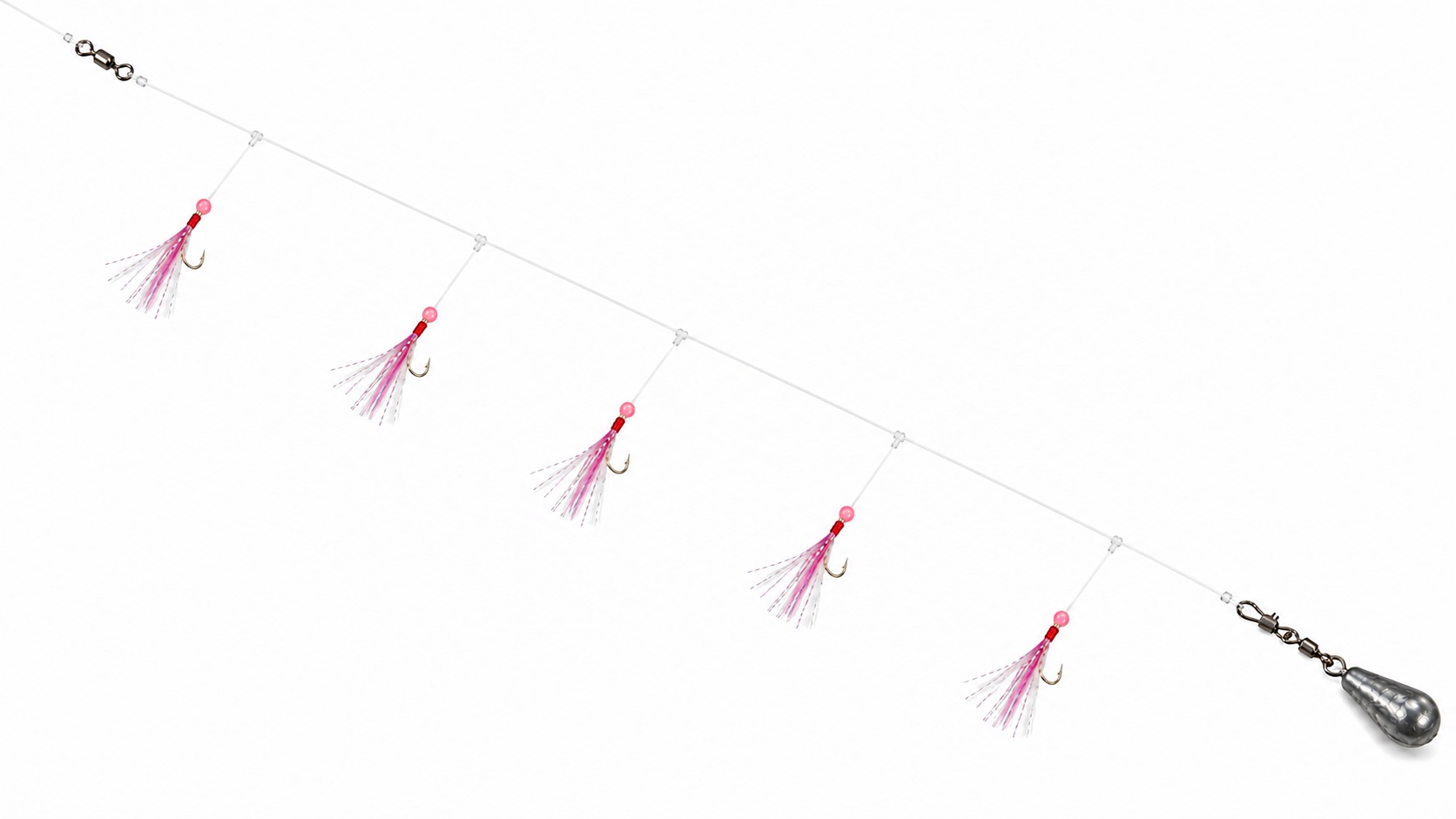
The sabiki rig is the saltwater angler’s answer to one specific problem: you need live bait, and you need a lot of it fast. It is not a lure. It is not a presentation rig. It is a bait-collection tool — a pre-tied leader strung with four to six small dropper hooks, each dressed with a bit of flashy synthetic fiber, gold tinsel, or fish-skin material that imitates a tiny shrimp or juvenile fish.
Drop it under a dock or bridge, and on a good day you pull up multiple pinfish or scaled sardines on a single drop. Nothing else in the tackle box matches that efficiency for live-bait fishing. On the Space Coast and throughout the Gulf, having a sabiki rod pre-rigged and ready is considered standard procedure before running offshore or targeting snook and tarpon inshore.
The setup
Sabiki rigs come pre-tied on a card — you are not building this from scratch, and you should not try to. The pre-tied versions are assembled with lighter monofilament and smaller hooks than most anglers tie at home, and that light presentation is part of why they work.
What you need:
- A pre-packaged sabiki rig (4–6 hook; Hayabusa HS007 in size #6 is the Space Coast benchmark for pinfish and scaled sardines)
- 1 to 2 oz bank sinker or egg sinker
- A light to medium spinning rod, 7–10 feet (longer rods help keep a multi-hook rig untangled)
- 10–20 lb mainline (braid works well for sensitivity)
To rig:
- Tie your mainline to the top swivel using an improved clinch or Palomar knot.
- Clip or tie a 1–2 oz weight to the loop at the bottom of the rig. Use enough weight to get the rig down quickly — more current means more weight.
- Optional but effective: tip each hook with a small piece of fresh shrimp about the size of a pea. Fresh shrimp out-fishes squid for pinfish by a wide margin. It adds scent to what is already a visually attractive rig.
Hook size matters: Size #6 is the Space Coast standard. Go up to #4 if you are targeting larger pinfish or Spanish sardines; drop to #8 for smaller threadfin shad and glass minnows. Larger hooks on a sabiki will make you miss small baitfish that mouth the hook without committing.
How to fish it
Location is 90 percent of sabiki fishing. You are looking for structure where small baitfish school — mangrove edges, bridge pilings, dock posts, channel markers, and the shadow lines under lighted docks at night. If you can see small fish boiling near the surface or flickering under a light, you are in the right place.
The technique:
- Drop the rig straight down alongside the structure.
- Let it fall to the depth where fish are holding. If you are not sure, start at mid-depth and work down.
- Once it settles, lift the rod slowly and steadily — a short, smooth lift of one to two feet, then let it fall back.
- Multiple quick taps on the rod tip mean multiple fish. Do not rush the retrieve; let them stay hooked by keeping slight tension.
- Bring the rig up slowly and steadily. Fast retrieves cause the fish to spin and tangle the rig.
Pinfish and scaled sardines hold at different depths depending on conditions. On a bright afternoon, bait tends to push deeper; early morning and overcast days they come up higher in the water column. The sabiki will tell you where they are — if you get no taps after several drops at one depth, move shallower or deeper.
When to use it
The sabiki rig is a year-round tool in Florida and along the Gulf Coast, but it shines hardest in warm months when baitfish schools are thick and snook, tarpon, and redfish are active. Winter fishing is slower but pinfish are still catchable under structure on mild days.
Use it whenever live bait is the plan. Free-lined live pinfish on a circle hook is one of the most effective snook presentations in the state, and that starts with a sabiki rig. Scaled sardines on a popping cork, threadfin shad drifted under a bridge — it all starts here.
Avoid the sabiki in strong current or heavy wind. In those conditions, the multiple-hook rig creates tremendous drag and tangles constantly. When conditions are rough, a cast net is the more practical tool. The sabiki earns its keep on calm mornings, under docks in protected water, and in areas where a cast net is not practical to throw.
Tangle management
Tangles are the number-one sabiki frustration, and they are largely avoidable with a few habits:
- Use a longer rod (9–10 feet). It keeps the rig extended as you drop it and reduces the chance of hooks fouling against each other.
- Drop straight down, not on an angle. Current at an angle to your drop is what causes spiraling and tangles.
- Keep the rig stored on its card between uses, or coil it carefully around a piece of foam. Dumping it loose in a tackle bag guarantees a snarled mess.
- Handle the rig carefully when removing fish — multiple small hooks in motion are a hand-puncture hazard. Keep a pair of needle-nose pliers handy and hold the fish firmly before working hooks free.
Live-bait transfer
Once you have bait, transfer immediately to an aerated livewell or a dedicated aerated bait bucket. Do not let fish pile up on deck — they die quickly from stress and handling.
Know your bait’s temperament. Pinfish are hardy and tolerate a livewell well; they can stay lively for hours with adequate aeration. Threadfin shad and scaled sardines are far more delicate — they die from net stress alone if handled roughly, and they need clean, well-oxygenated water. Change livewell water frequently when running scaled sardines.
Brands worth knowing
Hayabusa is the benchmark. Their HS007 is a sharper, stronger hook with better-tied flashers than most generic alternatives. It is worth the extra dollar per pack.
Mustad and Eagle Claw make functional budget options that work but dull faster.
Umi produces a few solid premium packs that compete with Hayabusa for serious bait fishers. Generic brand sabikis from big-box stores are often tied on hooks that bend or pull on larger pinfish — stick with Hayabusa if you fish sabikis regularly.
Buy sabikis in bulk before a trip, not the morning of. A good bait session can burn through three or four rigs between tangles, lost weights, and wear.