A note about links: If we include links to retail sites like Amazon or Bass Pro Shops, it's because they're relevant to the topic and, as anglers ourselves, we believe they're worth checking out. As an Amazon Associate we earn from qualifying purchases.
What is it?
Ask any offshore captain from the Carolinas to Texas what bait they want in the well before heading out and the answer is often the same: greenbacks. That word can mean a few different things depending on who you ask, but along much of the Atlantic and Gulf coasts it most often refers to the Atlantic thread herring, a silver baitfish that has become the backbone of sailfish and kingfish fisheries across the region.
The thread herring (Opisthonema oglinum) is a member of the herring family Clupeidae, the same family that includes scaled sardines (pilchards), Spanish sardines, and Atlantic herring. It ranges across the entire western Atlantic from the Gulf of Maine to Brazil, and it is abundant in coastal waters from North Carolina south through the Gulf of Mexico to Central America.
What separates thread herring from other common baitfish is a combination of size, toughness, and behavior on the hook. A typical specimen runs 8 to 12 inches long, noticeably larger than a scaled sardine or pilchard, which usually tops out around 6 inches. That extra body mass matters when you are fishing 100 feet of water on a kite. Thread herring can be bridled to a circle hook and suspended at the surface, where they stay active and create the frantic surface commotion that draws sailfish from a distance. Offshore captains from the Outer Banks to the Texas coast have relied on them for exactly this reason.
Thread herring also swim deeper in the water column than pilchards when free-lined or slow-trolled, which puts them in the strike zone for kingfish, cobia, and amberjack without requiring a weight or sinker. When a predator pushes them, they leap and splash at the surface, a distress signal that pelagic fish cannot ignore. For kite fishing specifically, thread herring are often preferred over goggle-eyes because their surface action is more erratic and they are easier to source in large numbers during the warmer months.
As cut bait, thread herring release an exceptional amount of oil and scent into the water column, making them effective for bottom fishing grouper and snapper even after they have died in the livewell.
How to identify one
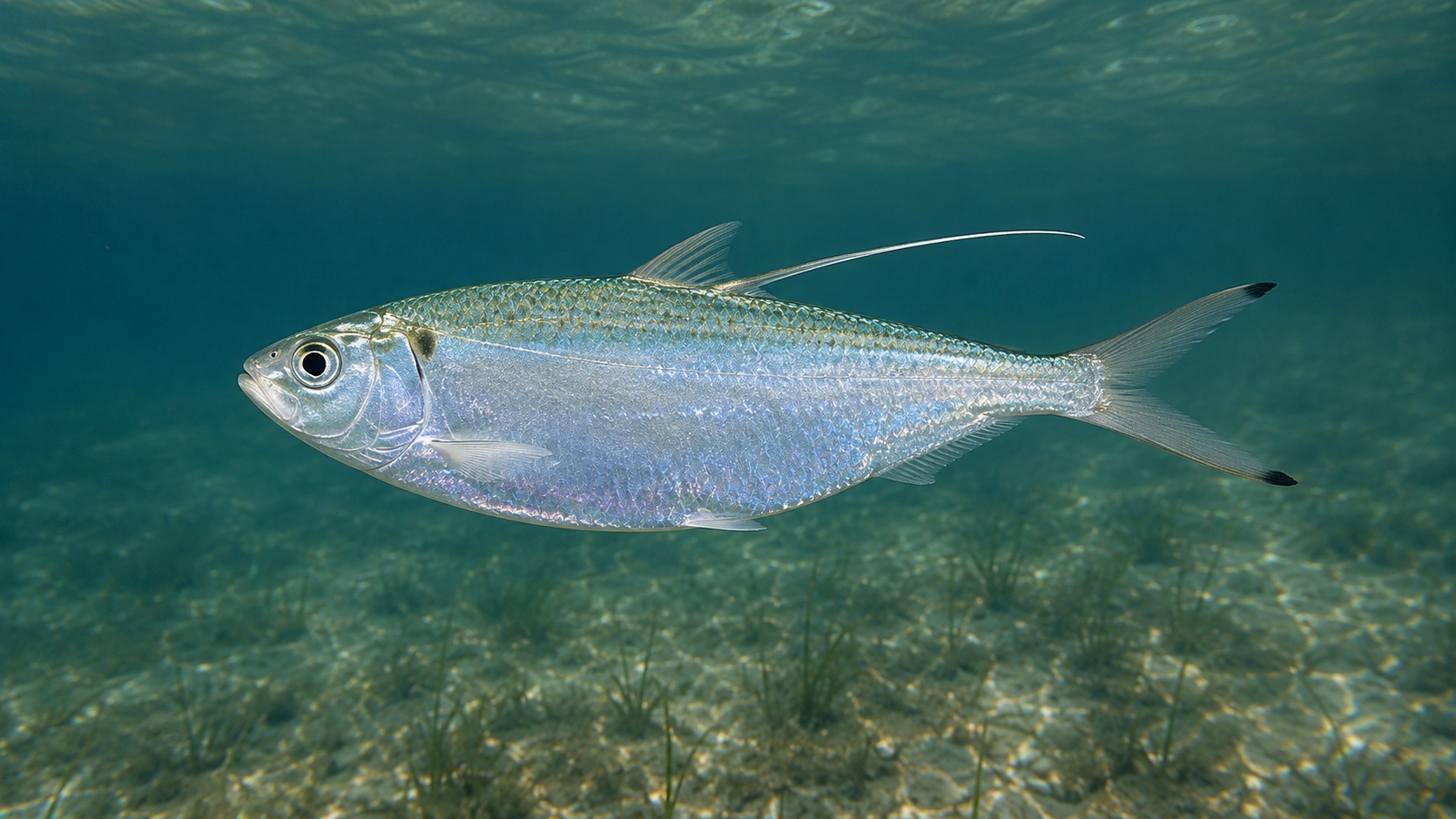
The single most reliable field mark on a thread herring is the long, thread-like filament extending backward from the last ray of the dorsal fin. This trailing extension, which can reach several inches on a large fish, is what gives the species its common name. No other common Atlantic or Gulf baitfish has this feature. If you see a silver herring-shaped fish with what looks like a hair or whisker trailing off the back of its dorsal fin, you are holding a thread herring.
Beyond that filament, look for these features:
Coloration: The back is a vivid blue-green or greenish-blue, which is why anglers often call them greenbacks. The sides and belly are bright silver. The tips of the dorsal fin and the upper and lower lobes of the forked tail fin are often dusky or black-tinged.
Spot at the shoulder: There is a prominent dark spot just behind the gill plate (opercle), a mark shared with several other clupeids but useful as part of the overall ID picture. Some fish show a short row of smaller dark spots trailing behind that first one along the upper flank.
Size: Adults commonly run 8 to 10 inches, with larger fish reaching 12 inches. Maximum reported length is around 19 inches, but fish that size are unusual in the bait schools you will encounter inshore. The body is moderately deep and laterally compressed, with a sharp, keeled belly.
The eye: Smaller than you would expect compared to a scaled sardine. If two silver baitfish are side by side and one has a noticeably large eye, the big-eyed fish is probably a scaled sardine. The thread herring has a smaller, less prominent eye.
Belly keel: Like all herrings, the thread herring has a row of sharp scutes along the belly. Run a finger along the underside and you will feel the serrated ridge.
Compared to the scaled sardine (pilchard), the thread herring is larger, has a smaller eye, lacks the distinctive hypomaxilla structure present in sardines, and of course has the dorsal filament. The scaled sardine is rounder in profile and paler on the back. Pilchards hug the bottom of the water column while thread herring suspend 5 to 10 feet below the surface and create visible surface disturbance when nervous. Both are silver baitfish that school in similar habitat, so anglers who want to sort the bucket quickly learn to check the dorsal fin first.
How to catch your own
Thread herring school near the surface and can be found from just inside the nearshore reefs out to the deeper current edges. In warmer months they are often visible from a boat as nervous water, a slight riffling or flickering on the surface where thousands of small fish are packed together and feeding. Early morning is the most productive time to hunt bait schools, before boat traffic pushes them deep and before surface temperatures climb.
Sabiki rigs: The recommended method for catching thread herring with minimum damage is a sabiki rig, a multi-hook rig strung with small metallic or UV-reactive flies or beads. Use a size 6 or size 8 sabiki with a 1-ounce dropper weight. Find the school by watching for surface activity or by using your fish finder to locate a dense cloud in the upper water column. Drop the rig into the school and slow-retrieve it with gentle rod pumps. When one fish hits, others in the school often pile onto adjacent hooks, and it is common to bring up three or four fish per drop. Unlike cast netting, this method allows you to load the livewell with fish that have retained almost all of their scales and slime coat, which makes a real difference in how long they survive.
Keep a de-hooker on deck. Running your fingers down the leader to wet-hand each fish is far better than gripping them dry, but a de-hooker removes them with no contact at all, preserving the slime coat that keeps them alive in the livewell. Fluorocarbon sabiki rigs outperform nylon versions when fish are finicky.
Cast netting: Cast nets can produce large volumes of thread herring quickly when schools are tight and concentrated. Check local regulations for allowable net sizes in your state, as these vary by jurisdiction. The drawback is that a net causes more scale loss and physical stress than a sabiki rig. If you cast-net your baits, use a fine-mesh net and transfer them immediately and gently into a well-oxygenated livewell. Avoid letting them pile in the net bag for more than a few seconds.
Where to look: Thread herring are most abundant from late spring through fall when water temperatures warm into the 70s and low 80s°F. They become scarcer in their northern range as water cools in autumn, but remain present year-round in the southern Gulf and off South Florida. Productive locations include nearshore reefs and ledges in 20 to 60 feet of water, current edges near passes and inlets, the shadow lines and pilings of large bridges, and the green-to-blue water transition zone offshore. Along the Atlantic coast they are common from North Carolina’s nearshore waters south through the entire Florida coast. In the Gulf, they school along the northern shelf from Texas through the Florida panhandle and beyond.
What bait schools look like from the boat: Thread herring schools appear on the fish finder as dense, compressed arcs or solid blobs sitting in the upper 20 to 50 feet of water. On the surface, a school in a feeding frenzy creates visible nervous water, a subtle riffling that looks different from wind chop. Birds diving or hovering low over a patch of water is another reliable sign of bait underneath.
Tides matter: Tidal movement is critical. Thread herring are nearly inactive during slack water. Moving tides concentrate them on current edges and predictable structure. Plan your bait stop around the tidal stage, and arrive at known bait spots during an incoming or outgoing tide for the best results.
Keeping them alive
Thread herring are more robust than scaled sardines but they are still a fragile baitfish compared to goggle-eyes or blue runners. Proper livewell management makes the difference between arriving at the fishing grounds with a tank full of lively greenbacks and arriving with a bucket of floating dead bait.
Water quality: Constantly circulate fresh, cool seawater through the well. Warm water holds less dissolved oxygen than cool water, and a crowded livewell full of active fish burns through oxygen quickly. Aim for dissolved oxygen levels of 7.0 ppm or higher. Thread herring need more oxygen than most other common baitfish because they are constantly swimming. If your standard recirculating pump cannot keep up, a dedicated oxygen injection system that introduces 100-percent pure oxygen directly into the well will push levels beyond what pumps alone can achieve.
Water flow: More is not always better. Thread herring forced to fight a strong current will exhaust themselves quickly. The ideal setup delivers a steady, gentle circulation without creating a current strong enough to tire the fish. A properly sized pump for herring-class baitfish runs at least 750 gallons per hour, but the outlet should be baffled or diffused to reduce velocity. Excessive flow is a common cause of unexplained baitfish mortality.
Density: Do not overload the well. Thread herring need room to swim in slow circles. Overcrowding depletes oxygen rapidly and increases the ammonia load in the water. Plan on no more than one fish per gallon of livewell capacity, and err on the conservative side for a full day’s fishing.
No hands: The oil in sunscreen, insect repellent, and even your skin can compromise the slime coat and kill baitfish quickly. Use a dip net to transfer fish between containers, and avoid reaching into the well unnecessarily. The same principle applies when the baits are penned overnight: check and skim the well daily, and transfer fish one at a time if moving them between containers.
Signs of stress: Thread herring that are dying will begin to list, swim near the surface, or roll. Skim dead and weak fish out immediately to reduce ammonia and prevent the stress from spreading to healthy fish.
Cut bait value: When thread herring die in the well they are not wasted. They are exceptionally oily fish that release strong scent into the water, making them effective cut bait for bottom fishing grouper, snapper, cobia, and sharks. Cut them into halves or chunk pieces on the way to the fishing grounds rather than discarding them.
How to rig it
Thread herring can be rigged several ways depending on the target species and presentation.
Kite fishing (rubber band bridle): The standard rig for kite fishing is a circle hook in sizes 4/0 to 6/0 bridled to the fish using a small rubber band and a rigging needle. Thread the rubber band through the needle, insert the needle through the fish just forward of the dorsal fin or through the forward edge of the eye socket, slip the rubber band off the needle, and pass the hook through the loop. The rubber band allows the fish to move naturally and breaks under the load of a hooked fish. This rig keeps the hook positioned just ahead of or at the top of the fish’s back, where a predator’s strike will drive it home cleanly. Kite fishing puts the bait at or just below the surface where the thrashing and splashing draws sailfish from a distance.
Nose or lip hook for free-lining: For free-lining or live-bait fishing without a kite, a nose hook or lip hook works well. Run a 1/0 to 3/0 circle hook up through the lower jaw and out through the upper jaw, or just behind the upper lip. This presentation allows the fish to swim naturally and works well when drifting over reefs or along current edges. For strong current or slow trolling, a hook through the back of the nose gives better control.
Back hook: Hooking through the back, just behind the skull and ahead of the dorsal fin, is a standard option for free-lining when the fish needs to sound (swim down into the water column) rather than stay near the surface. This position keeps the fish more upright and swimming naturally at depth. It is the preferred placement for targeting amberjack over deep structure.
Wire leader for kingfish: When targeting king mackerel, add a short section of wire leader ahead of your hook. King mackerel have sharp teeth that will cut through monofilament on the strike. A 6- to 12-inch section of No. 3 or No. 4 wire between the hook and the fluorocarbon leader prevents cut-offs while still allowing a natural presentation. A trailing stinger hook behind the dorsal fin converts short strikes.
Cut bait: For bottom fishing grouper, snapper, or cobia on structure, cut thread herring into halves or thirds and fish them on a knocker rig or fish-finder rig with a 3/0 to 5/0 hook. The oil content produces a strong scent trail that draws fish from the surrounding bottom.
Hook size summary: 1/0 to 3/0 for live rigging on free-line presentations; 4/0 to 6/0 for kite fishing and large live-bait presentations; 5/0 to 8/0 for cut bottom fishing.
What it catches
Thread herring are a top-tier live bait for virtually every major offshore target across the Atlantic and Gulf coasts.
Sailfish: Thread herring are a primary kite bait throughout the sailfish fishery along the Southeast Atlantic coast, particularly off the Carolinas and along reef lines from Palm Beach south through the Keys. The fish are bridled under a kite and suspended at the surface in 80 to 300 feet of water along the reef edge. Their frantic surface thrashing draws sails up from depth, and the kite presentation keeps the line out of the water for a near-perfect hookup angle. Thread herring are frequently preferred over pilchards for kite fishing because their larger size and more aggressive surface action produce more strikes per spread.
King mackerel: Thread herring are one of the most effective kingfish baits along both the Atlantic and Gulf coasts. They are typically slow-trolled or free-lined near nearshore wrecks, reefs, and ledges in 40 to 120 feet of water. The oily flesh and active swimming action make them irresistible to kings. A wire leader with a stinger hook is essential to prevent bite-offs and convert the kingfish’s slashing strike style.
Cobia: Cobia follow rays, turtles, and floating debris in spring, and they will readily eat a live thread herring drifted ahead of them. When sight-fishing cobia from the surface, pitch the live bait slightly ahead of the fish and let it sink naturally. Cobia also hold around nearshore structure and offshore wrecks where a free-lined greenback will find them on the drop.
Greater amberjack: Amberjack are aggressive and will charge a live thread herring dropped into deep structure. Work the bait on a stout rod down to ledges and wrecks in 80 to 200 feet of water and be ready for a serious pull. Circle hooks in the 5/0 to 7/0 range handle the load. The struggling bait on a slow descent mimics an injured fish and triggers the AJ’s ambush instinct.
Mahi-mahi: Mahi will eat virtually anything that looks alive in the blue water, and a lively thread herring pitched to a mahi spotted near a weedline or floating debris will often draw an immediate strike. Free-line the bait with minimal weight and let it swim naturally on the surface or just below it. The larger profile of a thread herring compared to a sardine helps when mahi are keying on bigger prey.
Wahoo: Wahoo hit hard and fast, and a thread herring rigged on a wire leader and slow-trolled along current edges or temperature breaks in 200 to 600 feet of water will produce wahoo strikes. Use a longer wire leader (12 to 18 inches) and a stinger setup to convert partial strikes, which wahoo deliver frequently.
Regulations
Thread herring are primarily used as bait rather than a targeted catch, but regulations on how you collect them — particularly cast net size and mesh restrictions — vary by state. Check your state fish and wildlife agency for current rules on baitfish collection methods and any applicable possession limits before you head out. If you are targeting the offshore species that thread herring are used to catch (sailfish, kingfish, amberjack, cobia), those fish are subject to their own state and federal regulations. Sailfish and several other pelagic species are also managed at the federal level; consult NOAA Fisheries for current federal guidelines in addition to your state agency.
On the Table
Thread herring are rarely eaten and most anglers do not keep them for the table. The flesh is very oily and highly perishable, breaking down quickly after the fish dies. The numerous fine bones throughout the body make cleaning and eating them time-consuming for little reward. The strong flavor typical of oily clupeids is an acquired taste that most anglers find unappealing compared to other species available in the same waters.
Commercial processors do use thread herring for fish meal, fish oil, canning, and pet food production, where the high oil content is an asset. In some traditional fishing communities across the Caribbean and Latin America, small herrings like these are salted, dried, or fried whole as a local protein source, but this is not a common practice along the U.S. coast.
The honest answer is that a live thread herring is worth far more in your kite clip than on your plate. Keep them in the livewell and let them do the work they are built for.