A note about links: If we include links to retail sites like Amazon or Bass Pro Shops, it's because they're relevant to the topic and, as anglers ourselves, we believe they're worth checking out. As an Amazon Associate we earn from qualifying purchases.
Few things in saltwater fishing match the moment a sailfish goes greyhounding across the surface with that enormous cobalt-blue sail fanned wide, the water turning white behind a fish that is moving faster than you thought a fish could move. This is high-octane, visual fishing that converts first-timers into lifelong offshore addicts — and thanks to the sailfish’s broad range up and down the Atlantic coast, it is accessible to a lot more anglers than most people realize. From the Outer Banks of North Carolina to the Gulf Stream edge off Virginia Beach to the warm-water grounds of South Florida and the Caribbean, the sailfish offers world-class billfishing within reach of the U.S. East Coast.
How to identify one
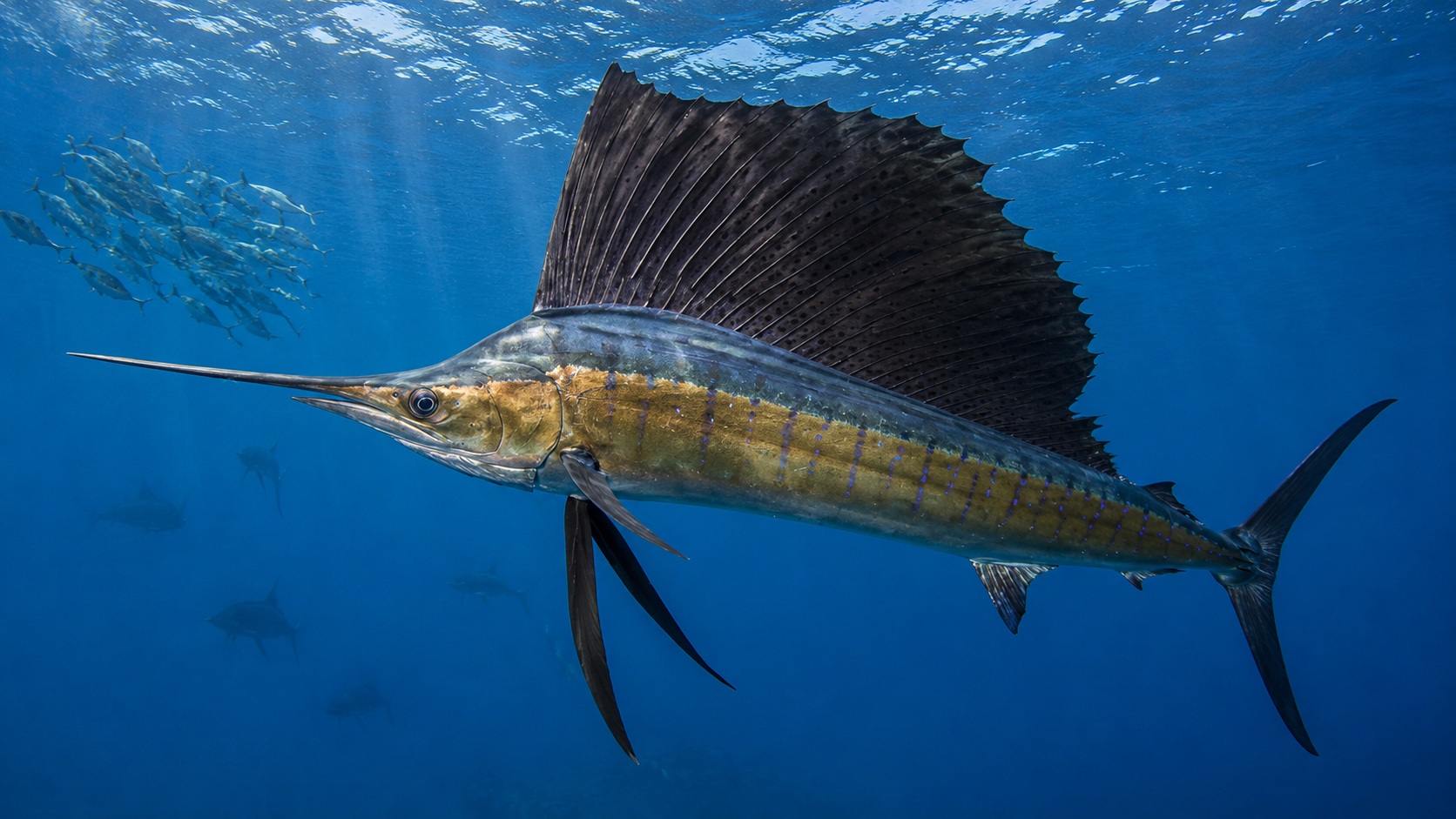
The sailfish is unmistakable once you have seen one. The defining feature is the dorsal fin, which runs nearly the full length of the body and can be held erect or folded flat into a groove along the back. When the fish is excited or feeding, the sail rises and shows vivid cobalt blue with scattered black spots. The body is dark blue-black on top and silver-white below, often with faint vertical bars of lavender-blue along the flanks. The upper jaw extends well beyond the lower jaw into a long, rounded bill. The two pelvic fins are extremely long and slender, almost thread-like, another quick visual key. Compared to the Atlantic blue marlin, sailfish are far smaller, have a much taller dorsal fin relative to body size, and lack the heavy, rounded bill of the marlin.
Where to find them
Atlantic sailfish range throughout the warm temperate and tropical Atlantic, from the U.S. East Coast south to Brazil and across to West Africa. The fish are closely tied to the Gulf Stream and warm-water eddies that spin off it — wherever that blue water pushes close to shore, sailfish congregate.
In the Southeast, the stretch of coast from South Florida northward to the Carolinas hosts the most consistent U.S. action. The Gulf Stream bends near shore along parts of the Florida and North Carolina coasts, putting fish within reach of smaller offshore boats. The Outer Banks of North Carolina are a well-known summer destination, where warm Gulf Stream water brushes close to the barrier islands and sailfish stack along the edges with other offshore species. Virginia Beach and the canyons off Virginia produce solid numbers in summer as warm-water eddies push north.
In the Gulf of Mexico, sailfish appear along the deep Gulf edges, particularly off the Florida Panhandle and Texas, though numbers are generally lower than on the Atlantic side.
The Yucatan Peninsula and Isla Mujeres, Mexico, are among the most celebrated sailfish destinations in the western Atlantic, with charter fleets that specialize in high-count live-bait days. Guatemala’s Pacific coast is famous for its closely related Indo-Pacific sailfish, which is a different species but fishes much the same way.
Sailfish have been recorded as far north as New England in summer, tracking warm-water eddies north along the Gulf Stream. These are not reliable fishery targets at the northern extreme of the range but do show up as incidental catches for offshore anglers pursuing tuna and mahi.
When to go
Timing varies significantly by latitude. Water temperature is the key variable: sailfish prefer surface temperatures between roughly 70°F and 86°F and follow the warm-water edge of the Gulf Stream as it shifts seasonally.
In the Southeast and Gulf Coast, the peak fishery generally runs from late fall through early spring, when cold fronts push bait southward along the coast and the Gulf Stream concentrates fish in a defined edge. Calm, clear days after a front passes are often the best fishing, as the water settles and baitfish schools cluster near the surface.
In the Mid-Atlantic (Carolinas, Virginia), sailfish arrive as surface temperatures warm into the preferred range — typically late spring through early fall — and depart as water cools in autumn. The peak months for the Outer Banks and Virginia canyons tend to be June through September.
Mornings are productive throughout the range, but sailfish bite throughout the day when conditions align. A secondary fall migration passes through many areas as fish move toward warmer wintering grounds, though peak concentrations are generally lower than the spring and early-summer push.
What to throw
Kite fishing with live bait is the signature technique of the South Florida sailfish fleet and is responsible for more fish in this region than any other method. Fishing kites suspend live baits directly on the surface, keeping the terminal tackle and leader out of the water and creating a frantic, splashing presentation that triggers aggressive strikes. The standard setup uses two kites flying off opposite gunwales, each with two or three release clips, putting up to six live baits in the strike zone simultaneously.
Goggle eyes (bigeye scad) are the premier kite bait when available. They are hardy, swim actively, and sailfish pick them up with conviction. Blue runners and pilchards are strong alternatives. Rigs are typically bridled rather than hooked directly, with a rubber band or rigging floss looped through the eye socket to keep the bait swimming naturally with the hook riding free for a better hookset.
Live-bait slow-trolling and drifting without kites is productive when kite conditions are unfavorable. The same bait selection applies. Dead ballyhoo rigged on circle hooks behind a Sea Witch or similar skirt, trolled at 6 to 8 knots on 20- to 30-pound conventional outfits, covers water efficiently and is the go-to approach for many charter operations throughout the range.
Pitch baiting is one of the most exciting methods: when a fish is spotted finning or a teaser raises one behind the boat, a live bait or artificial stick bait is pitched free-lined to the fish. Yo-Zuri Crystal Minnow and similar subsurface lures work well for this. Use spinning tackle in the 20- to 30-pound range for quick, long casts.
Artificial lures including skirted ballyhoo and small pusher-style lures work in a trolling spread. For those wanting a pure challenge, fly fishing for sailfish has grown significantly in recent years, typically by raising fish on teasers and then presenting a large streamer.
Standard leader is 30 to 60 pounds of fluorocarbon, 6 to 15 feet in length. Lighter leaders get more bites; heavier leaders survive the rough bill and body wrap more often.
Regulations
Atlantic sailfish are managed federally by NOAA Fisheries as Atlantic Highly Migratory Species (HMS) under 50 CFR Part 635. Federal rules apply in federal waters (beyond 3 nautical miles from shore) and govern the species range-wide in U.S. waters.
Any vessel fishing for sailfish in federal waters must carry a valid federal HMS Angling Permit. This is a vessel permit renewed annually and is distinct from any state saltwater license.
Federal rules set bag limits and minimum size requirements, and the fishery is overwhelmingly practiced as catch-and-release. Keeping a sailfish requires reporting to NOAA within 24 hours. A critical rule applies to catch-and-release: sailfish may not be removed from the water when fishing in federal waters, or when fishing in state waters while holding a federal HMS permit. Lifting a fish for a photo is a federal violation. Release must be done at the side of the boat with the fish in the water.
State regulations apply in state waters (within 3 miles of shore on the Atlantic coast; within 9 miles in the Gulf of Mexico). Rules vary by state. Always verify current federal and state regulations directly with NOAA HMS (fisheries.noaa.gov/atlantic-highly-migratory-species) and your state fish and wildlife agency before heading out, as these rules are subject to amendment.
Handling and release
Sailfish are almost universally released. The meat is edible but considered poor table fare, the fish is a billfish under federal protection, and the catch-and-release ethic is what keeps this fishery as productive as it is.
For a proper release, keep the fish in the water at all times. Use a dehooking tool to remove the hook at the side of the boat without lifting the fish. If the hook cannot be quickly removed, cut the leader as close to the hook as possible. Avoid touching the bill or gripping the body, which can damage internal organs. If the fish needs to be revived, hold it alongside the boat facing into the current or slowly move the boat forward in reverse to push water through the gills. A healthy sail will power away on its own with very little prompting. Do not drag the fish behind the boat for revival. A circle hook in the corner of the mouth is the norm in this fishery; J-hooks and bait rigs should be avoided where possible to minimize deep hooking.
On the Table
Atlantic sailfish are edible but are almost universally released by today’s anglers. The species is not commercially targeted for food, and recreational catch-and-release practice is the strong cultural and ethical norm in most billfish fisheries. Keeping one is legal in many U.S. waters (subject to bag limits), but doing so is widely discouraged by conservation organizations and the fishing community.
Taste and texture: Sailfish flesh is dark red to brownish-pink, dense, and moderately oily with a pronounced, meaty flavor that some describe as similar to swordfish but stronger and more gamey. The texture is firm and not flaky in the way of a white-fish fillet. The flavor is not unpleasant but is assertive enough that preparation method matters considerably.
Best preparation methods:
- Smoking: The dense, oily flesh holds up well to low-and-slow smoking, which mellows the strong flavor and produces a product similar to smoked marlin or swordfish.
- Sashimi or ceviche: In Japan and parts of Latin America, billfish including sailfish are eaten raw or acid-cured. Thin-sliced fresh sailfish has a clean, lean bite when very fresh; the lime acid in ceviche cuts through the richness effectively.
- Grilling over high heat: Thick steaks (not fillets) can be seared quickly over direct flame. The firm flesh does not fall apart on the grate. A citrus-herb marinade helps temper the stronger flavor notes.
- Blackening: The bold flavor of sailfish can stand up to aggressive Cajun-style spice rubs; this technique masks gaminess that milder methods can leave exposed.
Handling for table quality: If you choose to keep a sailfish, quality drops fast. Bleed the fish immediately at the gills and place it on ice belly-down. Remove the bloodline (the dark lateral strip along the fillet) before cooking — this strip holds the most intense flavor and the highest concentration of oil. Cook or freeze within 24 hours.
Mercury concerns: Sailfish, like all large pelagic billfish, carry elevated mercury levels due to their position at the top of the food chain and long lifespan. The FDA and EPA advise that adults limit consumption of billfish, and women of childbearing age and children should avoid it entirely. Larger, older fish carry higher mercury loads.
Legal and conservation notes: Atlantic sailfish are managed under NOAA billfish regulations. Bag limits and minimum size rules apply in U.S. waters, and many tournaments operate under mandatory release rules regardless of federal limits. Check current NOAA regulations before retaining any billfish, as rules change periodically.