A note about links: If we include links to retail sites like Amazon or Bass Pro Shops, it's because they're relevant to the topic and, as anglers ourselves, we believe they're worth checking out. As an Amazon Associate we earn from qualifying purchases.
Few things in saltwater fishing match the moment a blue marlin crashes a trolling spread. The bill breaks the surface first, followed by hundreds of pounds of muscle launching skyward in a full-body leap that rattles every angler in the cockpit. Blues fight dirty and fight long, demanding heavy tackle, practiced crews, and the physical endurance to stay in a fighting chair through an hour-long battle. When the leader finally comes to hand and that cobalt flank slides back into blue water, the experience stays with you for life.
How to identify one
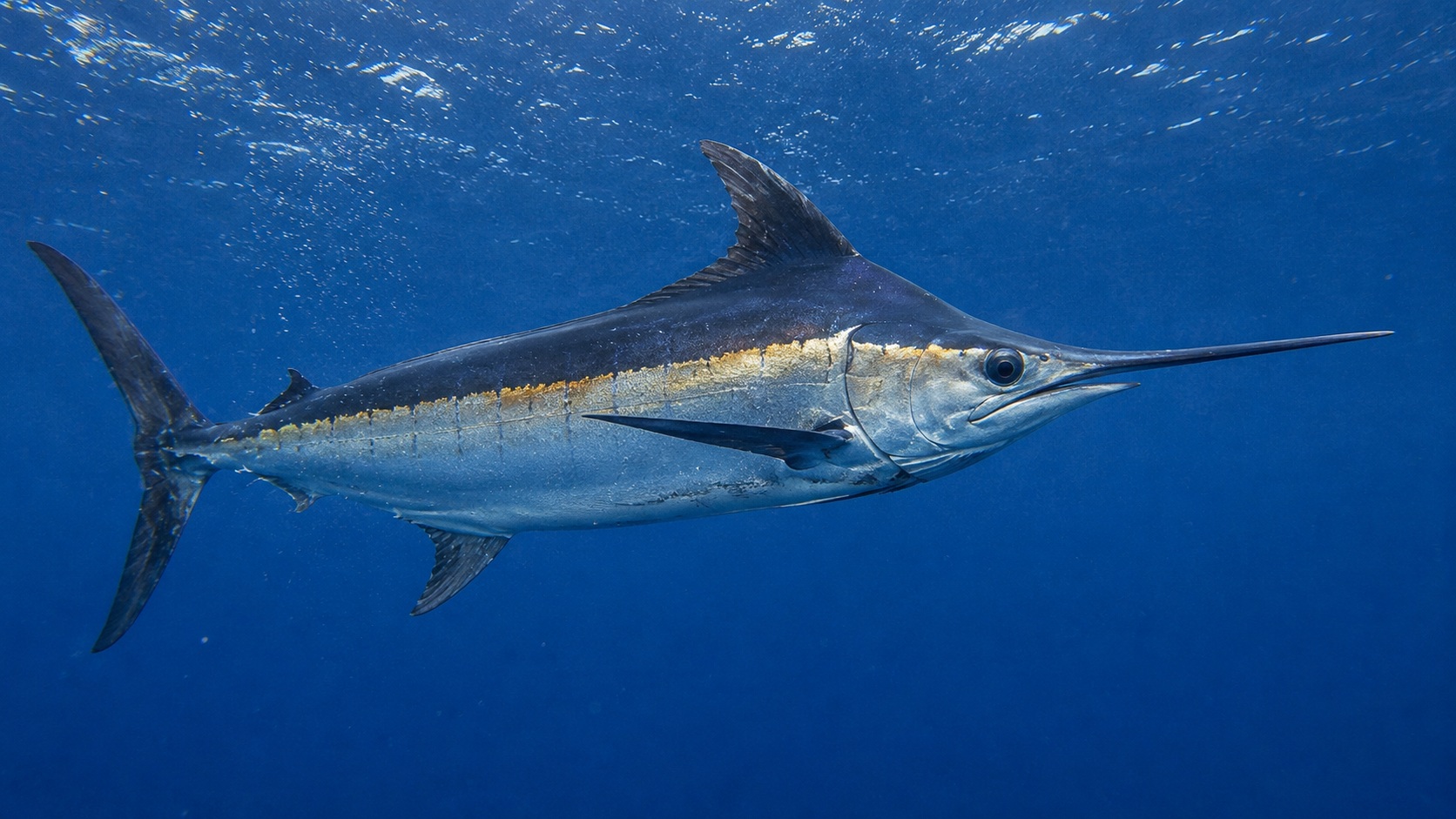
Blue marlin are the largest billfish in the Atlantic, with females routinely dwarfing males and reaching lengths beyond 14 feet. The body is deep blue-black along the dorsal surface, fading to silvery white on the belly, and is marked by roughly 15 vertical rows of pale blue spots or faint stripes on the flanks. The bill is long, stout, and round in cross-section. The first dorsal fin has a tall, pointed leading edge that drops sharply along the back. The pectoral fins fold flat against the body, which distinguishes blue marlin from sailfish, which cannot fold their pectorals the same way. White marlin are far smaller, rarely exceeding 80 pounds, and have rounded rather than pointed tips on their fins. Striped marlin, found primarily in the Pacific and Indian Oceans, show more pronounced, narrower stripes.
Where to find them
Blue marlin are open-ocean hunters that follow warm, blue water. They rarely appear in water shallower than 100 fathoms and prefer surface temperatures between 72 and 84 degrees Fahrenheit. Productive structure includes temperature breaks, rip lines, current edges, and the deep-water canyons that stack baitfish near the continental shelf edge.
Along the U.S. Atlantic coast, the Gulf Stream is the central corridor. Southeast Florida and the Keys see fish arrive in spring, with action building northward through the summer as warm water pushes toward Cape Hatteras, the Norfolk Canyon, and the Baltimore Canyon. By midsummer, the mid-Atlantic canyons off Virginia, Maryland, and New Jersey are consistently productive. The Gulf of Mexico holds fish from the Mississippi River Trough and around floating weed lines from late spring through October. Puerto Rico, the Dominican Republic, and the Bahamas all hold fish year-round in the right conditions.
In the Pacific, the Kona Coast of Hawaii is arguably the most famous blue marlin fishery in the world, producing granders — fish over 1,000 pounds — with regularity. Cabo San Lucas at the tip of Baja California is another world-class destination. Bermuda hosts well-attended blue marlin tournaments each summer and consistently produces large fish in Atlantic waters. Internationally, the waters off Vitoria, Brazil and Madeira, Portugal have produced some of the largest fish on record.
When to go
Timing for blue marlin follows warm water more than the calendar. Surface temperatures in the 72-to-84-degree range are the key trigger regardless of location.
On the U.S. Atlantic coast, summer is the main event. The season builds from the Southeast in spring and reaches peak action from the mid-Atlantic canyons through the Gulf through July and August, when warm water pushes farthest north. The Gulf of Mexico remains productive from May through October. The Caribbean runs warm year-round but sees the most consistent big-fish action from June through October. In Hawaii, blue marlin are available year-round, with summer and early fall generally producing the heaviest fish. The farther south you fish, the earlier the season begins; New England and mid-Atlantic anglers typically see peak action in July and August, while anglers in the Southeast and Gulf may encounter fish from April onward.
Successful blue marlin trips almost always start early, with lines in the water by sunrise to take advantage of peak feeding windows and cover maximum ground before afternoon sea breezes build. Look for temperature breaks, color changes, and floating weeds or debris as starting points each day.
What to throw
Trolling lures are the backbone of most blue marlin spreads. A five- or six-lure spread mixing sizes, colors, and positions covers multiple zones in the wake simultaneously. Favored patterns include Mold Craft Wide Range and Super Chugger heads, Black Bart lures, and Iland Lures in purple-and-black, pink-and-white, and dark green-and-black. Lures run on 80- to 130-pound-class tackle with 300- to 400-pound monofilament leaders and 9/0 to 12/0 forged hooks. Rigged natural baits such as whole ballyhoo, skipjack tuna, and mackerel often convert fish that follow without committing to artificials. Rig naturals on circle hooks to improve post-release survival rates. When fish are spotted following the spread but not biting, a pitch bait cast ahead of the fish’s path can trigger an immediate strike. Daisy chains of squid or bird-and-bait combinations add visual commotion in the long rigger positions. Running a mix of naturals and artificials, with natural baits inside and lures in the long positions, is a proven formula for boats targeting trophy fish.
Regulations
Blue marlin in the Atlantic and Gulf of Mexico are managed federally by NOAA Fisheries under the Atlantic Highly Migratory Species (HMS) program — not by individual state agencies. Any vessel fishing for Atlantic billfish must carry a valid HMS Angling Permit or HMS Charterboat/Headboat Permit, and that permit covers all anglers aboard. The current minimum size limit is 99 inches lower-jaw fork length for the Atlantic. U.S. combined annual landings of blue marlin, white marlin, and roundscale spearfish are capped at 250 fish total. Billfish cannot be retained if a hammerhead or oceanic whitetip shark is already on board or has been offloaded from the vessel.
In Hawaii and U.S. Pacific waters, blue marlin regulations are managed by NOAA’s Pacific Islands Regional Office; rules and permit requirements differ from the Atlantic program.
The vast majority of recreational blue marlin tournaments operate under mandatory catch-and-release rules for billfish, and releasing is strongly encouraged regardless of tournament rules. Always verify current regulations directly with NOAA Fisheries before heading offshore, as rules can change: https://www.fisheries.noaa.gov/atlantic-highly-migratory-species/recreational-atlantic-billfish-fishery-statuses-minimum-sizes-and
Handling and release
Blue marlin are almost universally released in U.S. recreational fisheries, both for conservation reasons and because the annual 250-fish combined landing cap for Atlantic billfish fills quickly. Fight time directly affects survival rates, so use the heaviest practical tackle to shorten the battle. Keep the fish in the water alongside the boat during the release process. Do not gaff a fish you intend to release. To revive a spent fish, hold the lower bill and move the fish forward and in gentle figure-eights to force water through the gills. Watch for strong, steady tail beats before letting go. If possible, cut the leader as close to the hook as the situation safely allows rather than removing the hook entirely, since attempting to de-hook a large marlin can extend handling time and injure the fish or crew. Document your catch with photos while the fish is still in the water. The Billfish Foundation’s tag-and-release program accepts data from released fish and contributes directly to population research that informs future management decisions.
On the Table
Blue marlin is edible and has been eaten in some parts of the world, but the overwhelming consensus among anglers and conservationists is to release them. Most serious offshore anglers treat blue marlin as a strict catch-and-release species, and in U.S. waters, Atlantic blue marlin are subject to federal billfish regulations that prohibit sale and impose strict retention limits — in practice, nearly all are released.
Taste and texture: The flesh is dark reddish-pink to brownish, dense, and moderately oily with a pronounced, robust flavor. It is not mild. The texture is firm and meaty, similar in some ways to swordfish but with a stronger, gamier taste that many find less appealing than other offshore species. Large fish tend to be coarser and more intensely flavored than smaller individuals.
Best preparation methods: For anglers who do lawfully retain a blue marlin, the following methods work best given the fish’s bold, oily flesh:
- Smoking: The high oil content and dense texture hold up well to low-and-slow smoking, and the process mellows some of the strong flavor.
- Grilling over high heat: Direct, fast heat chars the exterior and seals in moisture; marinades with acidic components (citrus, vinegar) help balance the richness.
- Sashimi or raw preparations: In Japanese and Hawaiian cuisine, marlin is sometimes served raw or lightly seared. Freshness is absolutely critical for this use.
Handling for table quality: If a fish is legally kept, immediate bleeding at the tail and gills right at boatside is essential — the dark flesh oxidizes and develops off-flavors quickly. Pack the carcass in ice within minutes. Rinse fillets in cold saltwater, not fresh water, and keep chilled through processing. Trim all dark lateral line meat and bloodline thoroughly, as these sections are the most intensely flavored and can taste strongly metallic if left on.
Eating caveats:
- Mercury: Blue marlin carry elevated mercury levels due to their position as apex predators and their large size. The FDA advises pregnant women and young children to avoid billfish entirely, and all adults to limit consumption. Larger, older fish accumulate more mercury.
- Legal status: In U.S. Atlantic and Gulf waters, blue marlin are a protected billfish species under federal law. Commercial sale is prohibited. Retention by recreational anglers is tightly regulated and varies by region — check current NOAA and state regulations before retaining any fish. The strong conservation ethic in the billfish community means that keeping a blue marlin is widely considered poor practice regardless of legality.