A note about links: If we include links to retail sites like Amazon or Bass Pro Shops, it's because they're relevant to the topic and, as anglers ourselves, we believe they're worth checking out. As an Amazon Associate we earn from qualifying purchases.
The reel screams before the rod even fully loads. Wahoo are built for exactly one thing: going fast. Capable of bursts topping 60 miles per hour, this offshore torpedo hits a trolled lure with the kind of authority that leaves anglers gripping the gunwale. The fight is short, explosive, and utterly unforgettable. Found in tropical and subtropical seas across the Atlantic, Pacific, and Indian Oceans, wahoo are a worldwide target for blue-water anglers — and when the day is done, they land on the short list of the best-tasting fish in any ocean.
How to identify one
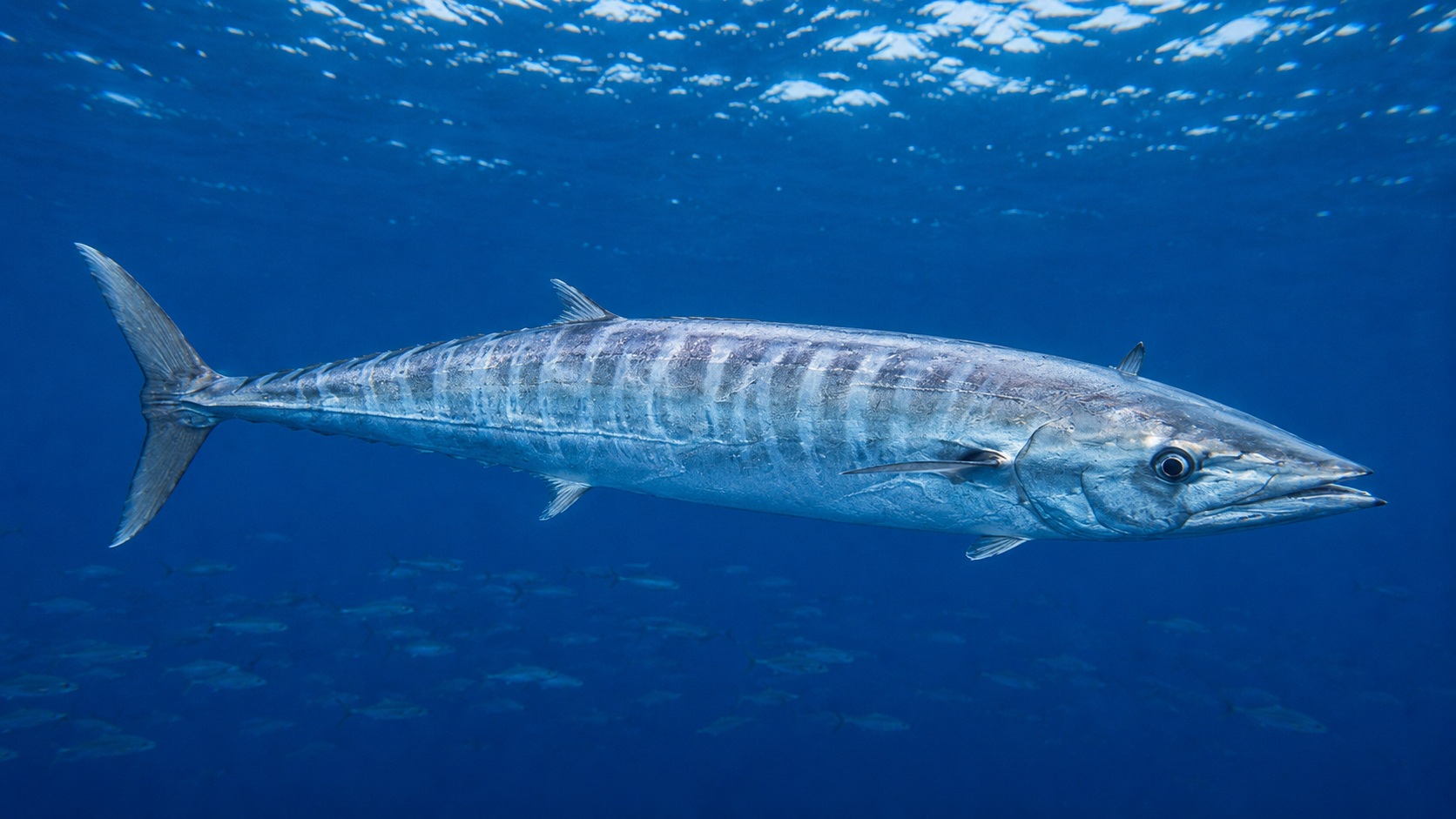
Wahoo have a long, compressed body that looks almost engineered for speed. The back is vivid iridescent blue and the flanks are silvery with 25 to 30 irregular vertical blue bars that fade quickly after the fish dies. The snout is long and pointed, roughly equal in length to the rest of the head, and the jaws carry razor-sharp, triangular, compacted teeth that will sever monofilament or fluorocarbon in an instant. A folding first dorsal fin lays flush when the fish accelerates. At 40 pounds a wahoo looks lean and tapered; at 80 pounds it looks like a torpedo wrapped in chrome. Anglers sometimes confuse juvenile wahoo with large king mackerel, but the solid blue-barred pattern and fully serrated teeth on both jaws distinguish wahoo from any kingfish.
Where to find them
Wahoo are open-ocean pelagics, living in the upper water column down to roughly 500 feet. They gravitate to sharp drop-offs, underwater ledges, and color changes where warm blue water meets cooler green — anywhere bait concentrates along a thermal edge. The speed and depth of that warm-water boundary varies by region, but the basic recipe is the same everywhere: find the warm blue water, find the structure or temperature break, and you’re in wahoo territory.
In the Atlantic Southeast and Gulf of Mexico, wahoo are found along the Gulf Stream’s western edge from the Florida Keys north through the Carolinas, as well as around offshore oil platforms and deep-water rigs in the Gulf. The Bahamas and the deep blue water off the Outer Banks of North Carolina are well-known Atlantic hot spots. Hawaii — where wahoo are called “ono,” meaning “delicious” — supports one of the world’s most productive wahoo fisheries, particularly along the Kona Coast drop-offs on the Big Island. In the Pacific, wahoo range along Baja California and into Southern California waters during warmer months, with Cabo San Lucas and the waters around the Revillagigedo Islands drawing serious wahoo hunters. The eastern Pacific off Central America and the Caribbean hold wahoo year-round wherever warm, deep water is accessible within a reasonable run from port.
The productive zone typically starts at the reef edge in around 100 feet of water and extends well offshore wherever warm current and structure combine. Deep offshore banks, seamount edges, and current rips concentrate fish. Wahoo are often lone hunters or travel in loose aggregations — unlike schooling pelagics, you may go some time between strikes even in productive water, which makes each hookup feel earned.
When to go
Wahoo don’t follow a single seasonal calendar — timing is driven by water temperature and latitude. Wahoo are most active when water temperatures sit in the mid-70s to low 80s Fahrenheit. In the tropics and subtropics, that window can span much of the year. At the northern edges of their range, the fishery compresses into the warmer months.
In the Gulf of Mexico and Southeast U.S. Atlantic, the fall and winter months are traditionally the most productive as cooler water intrusions and strong cold fronts concentrate fish along temperature breaks. The full moon periods through late fall and winter are widely regarded as peak timing for big fish. In Hawaii, wahoo fishing holds up year-round with summer often producing the heaviest concentrations. Along Baja and the Pacific coast, late summer through fall aligns with peak wahoo activity as the California Current warms. In the Caribbean and Bahamas, wahoo can be targeted most of the year, with some areas seeing stronger action in winter.
Regardless of region, early morning departures are standard practice. Wahoo tend to feed near the surface in low light and push deeper as the sun climbs, so lines in the water at first light gives you the best shot at surface-oriented fish.
What to throw
High-speed trolling lures are the go-to presentation. Wahoo are uniquely triggered by speed, and trolling at 12 to 18 knots with weighted skirted lures or diving plugs keeps the bait moving fast enough to exploit that instinct. Popular choices include the Zuker ZT-2 and ZT-3 trolling lures, Sea Witch skirts paired with a rigged ballyhoo or strip bait, and black-and-purple or pink-and-white color schemes that produce year-round. Deploy lines at staggered distances from 150 to 400 feet behind the boat for the best spread coverage.
Deep-diving plugs like the Nomad DTX Minnow and Halco Laser Pro 190 work well when fish are suspended 30 to 60 feet down. Troll these at 8 to 10 knots and use S-turns to vary lure speed and depth through the strike zone.
Wire leader is not optional. A number 7 or 8 single-strand stainless wire of at least 18 to 24 inches is the minimum, and many offshore captains run 3- to 4-foot sections of 80- to 130-pound coffee-colored or blue titanium wire to resist kinking at high trolling speeds. Any mono or fluorocarbon leader, no matter the test, will be cut on the first head shake.
High-speed jigs like the Hogy Prothin or Williamson Speed Jig worked vertically through a breaking school or beneath a boat that has already hooked a fish produce exciting strikes, especially when a school briefly shows itself at the surface. Use a direct-connect or short wire assist rig.
Slow-trolled live bait such as blue runners or large goggle-eyes on a flatline at 3 to 5 knots can produce the biggest fish. Deploy on a lightly weighted chin rig to keep the bait running true.
Regulations
Wahoo regulations vary by location. In U.S. federal Atlantic and Gulf of Mexico waters, wahoo are managed under the Dolphin-Wahoo Fishery Management Plan administered by NOAA Fisheries. Federal regulations set a recreational bag limit and require a federal HMS (Highly Migratory Species) Angling permit when targeting wahoo in federal waters. In state waters, rules are set by each state’s fish and wildlife agency and may differ from federal rules.
In Hawaii and Pacific waters, separate state and federal regulations apply. Internationally, rules vary by country and fishing zone.
Always check current regulations with the relevant agency before you fish. For U.S. Atlantic and Gulf waters, start at fisheries.noaa.gov/species/atlantic-wahoo. For Hawaii, check the Hawaii Division of Aquatic Resources. For state-specific rules in Atlantic and Gulf states, contact your state fish and wildlife agency directly.
Handling and release
Wahoo are high-intensity fish that burn through energy quickly during a fight, which generally makes them poor candidates for live release after a prolonged battle. If you are keeping your limit, bleed the fish immediately by cutting the gill arch and place it on ice belly-up to preserve the meat. The flesh is dense, white, and mild with very low fat content, making it one of the finest fish in the offshore spread for eating raw, grilled, or seared. Handle with heavy gloves: the teeth are surgical and the tail can deliver a serious strike even after the fish is boated. If releasing an undersized or extra fish, do it quickly at the surface with minimal air exposure, point the fish into the current to revive it, and confirm it swims away strongly before resuming trolling.
On the Table
Wahoo is considered one of the finest eating fish in the ocean, and anglers who target it offshore rarely need convincing to keep a limit. Its clean, mild flavor and firm texture put it in the same conversation as mahi-mahi and yellowfin tuna among offshore species prized equally for sport and the table.
Taste and texture: Wahoo has a mild, slightly sweet flavor with very little of the “fishy” taste common in other large pelagic species. The flesh is white to pale ivory, dense, and firm with a fine grain — it holds together well during cooking and doesn’t turn mushy. Fat content is low, which keeps the flavor clean but also means it can dry out quickly if overcooked.
Best preparation methods:
- Grilling or searing: Wahoo’s firm texture handles high direct heat well without falling apart. A hot sear on each side (2-3 minutes) leaves the center moist and translucent. Its low fat content benefits from a brush of oil or butter before cooking.
- Blackening: A classic preparation that complements wahoo’s mild flavor without overpowering it. The firm flesh stands up to heavy seasoning and a cast-iron crust, and the method compensates for the lean fish’s tendency to dry if overcooked by sealing the surface quickly.
- Sashimi and ceviche: Fresh wahoo caught and bled immediately is prized for raw preparations. The clean flavor and firm texture slice cleanly and hold their shape in citrus-based ceviche. Quality sashimi-grade handling is required (see below).
- Pan-frying with a light crust: A light breadcrumb or panko crust protects the lean flesh from drying out and adds textural contrast. Works well for smaller portions cut from the tail section.
Handling for table quality: Wahoo deteriorates faster than most pelagic fish if not handled correctly. Bleed the fish immediately after landing by cutting the gills or the tail, then get it into a slush ice cooler (ice and seawater) as fast as possible. Do not let it sit in the sun or on a dry deck. Wahoo has a dark lateral bloodline running along each fillet; remove it before cooking for the mildest flavor. Fillets are thick and benefit from scoring the skin side before refrigerating to prevent curling.
Mercury note: Wahoo is a large, fast-growing apex predator and carries elevated mercury levels compared to smaller pelagic species. The FDA and EPA advise that pregnant women, nursing mothers, and young children limit consumption. Healthy adults eating wahoo occasionally face minimal risk, but frequent large portions are not recommended. Smaller wahoo (under 30 lbs) generally carry lower mercury loads than trophy-sized fish.