A note about links: If we include links to retail sites like Amazon or Bass Pro Shops, it's because they're relevant to the topic and, as anglers ourselves, we believe they're worth checking out. As an Amazon Associate we earn from qualifying purchases.
The moment a yellowfin tuna finds your bait and turns, the reel screams and your arms know immediately you have hooked something extraordinary. These fish run deep and fast, making searing initial runs that drain hundreds of yards of line before you can even get a grip on the fight. A quality yellowfin in the 60- to 100-pound range is a legitimate test of tackle, captain, and angler working in sync. And when the fight ends and the cooler opens, the reward is unmistakable: the deep ruby flesh of fresh ahi-grade tuna, universally regarded as among the finest eating the ocean produces.
How to identify one
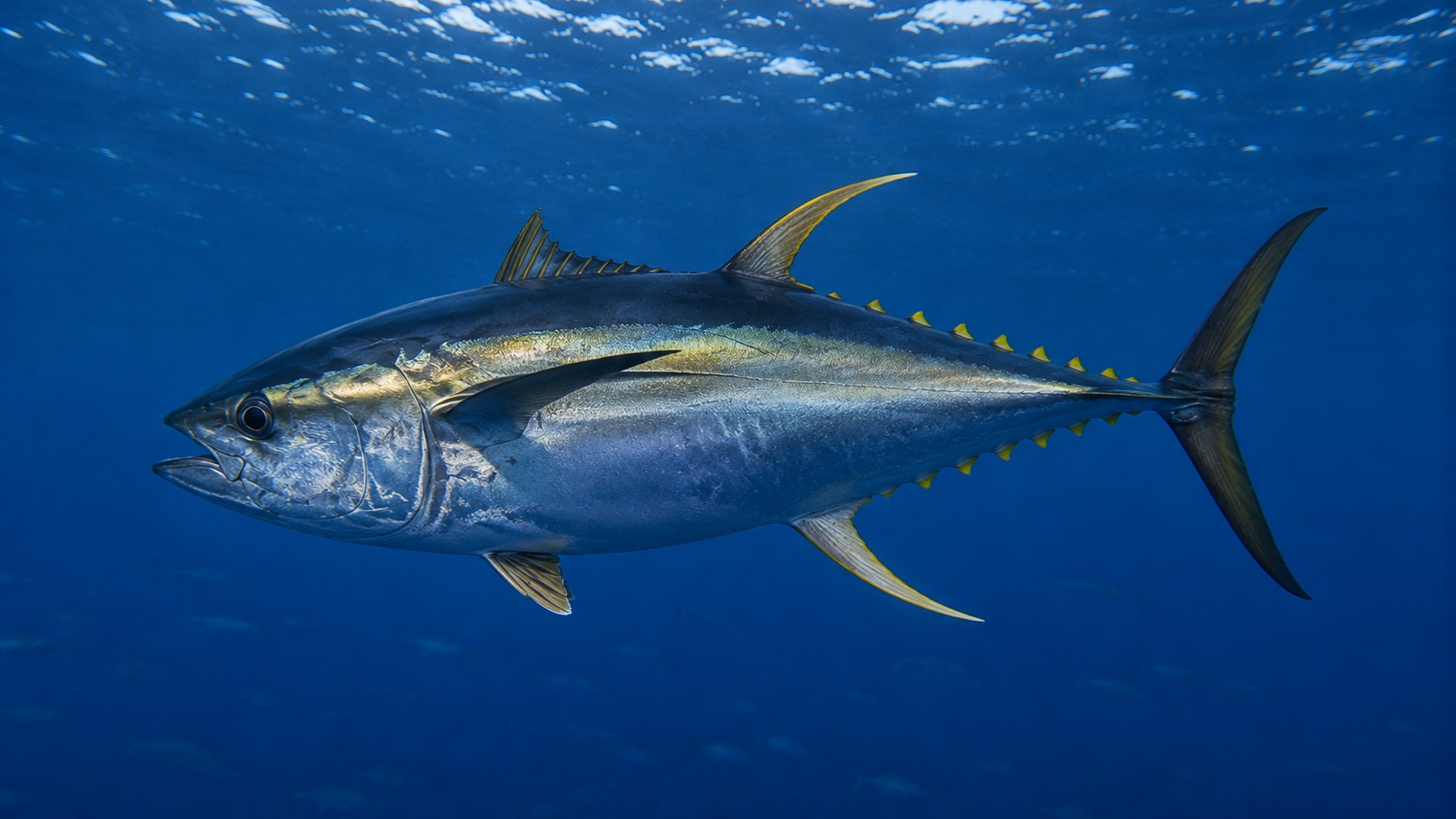
Yellowfin tuna have a streamlined, torpedo-shaped body built for sustained high-speed pursuit. The most obvious field marks are the brilliant yellow dorsal and anal fins and the yellow lateral stripe that runs from eye to tail. In larger fish (over roughly 60 pounds), the second dorsal and anal fins elongate dramatically into sickle-shaped extensions that can reach several inches long. The body is metallic blue-black on top, fading through gold on the sides to a white belly that typically shows a pattern of alternating pale spots and broken lines. The finlets running from the second dorsal and anal fins to the tail are yellow with black edges.
The most common lookalike is the bigeye tuna (Thunnus obesus). Key differences: bigeye have proportionally larger eyes and a more rounded head, the pectoral fins on bigeye are slightly longer and taper to a more pointed tip (versus yellowfin’s rounded, stiffer pectorals), and bigeye do not show the distinctive alternating spot-and-line belly pattern that yellowfin display. Blackfin tuna, common throughout the western Atlantic, are much smaller (rarely exceeding 40 pounds) and lack the elongated second dorsal and anal fins.
Where to find them
Yellowfin tuna are obligate open-ocean fish. They inhabit tropical and subtropical pelagic waters worldwide in the upper 250 meters of the water column, tracking sea surface temperatures between roughly 65 and 88 degrees Fahrenheit. They school heavily and move with the bait, making sea surface temperature (SST) charts and satellite imagery essential planning tools regardless of where you fish.
Gulf of Mexico: The northern Gulf is widely considered one of the most consistent yellowfin fisheries in U.S. waters. The oil and gas platforms off Louisiana — accessible from Venice and Grand Isle — act as artificial reefs, stacking baitfish and creating layered feeding zones in 300 to 1,000 feet of water. The rigs off the Alabama and Mississippi coasts produce similarly. Venice, Louisiana in particular has earned a reputation as a world-class yellowfin destination, drawing dedicated offshore boats from across the region. Peak action here often runs fall through early spring, when fish pile up in the northern Gulf.
U.S. Atlantic Coast: The Gulf Stream is the engine for Atlantic yellowfin. From the Carolinas through the Mid-Atlantic, captains target the Stream’s western wall and the temperature breaks and current edges that spin off it. The submarine canyons off the Mid-Atlantic states — including the Hudson Canyon, Baltimore Canyon, and Norfolk Canyon — concentrate baitfish and attract yellowfin on their seasonal northward push. From the Outer Banks of North Carolina, the Stream runs close enough that offshore runs of 40 to 80 miles reach productive blue water. In summer, fish push north into the New York Bight and southern New England as warming water extends their range.
U.S. Pacific and Hawaii: Hawaii is arguably the top yellowfin destination in the Pacific. Fish are present year-round in Hawaiian waters, where the local name ahi is synonymous with yellowfin. California anglers fishing the offshore banks and the blue-water zone beyond the Channel Islands encounter yellowfin during warmer water years, typically late summer through fall. The Baja peninsula and offshore Pacific Mexico are also productive for West Coast anglers willing to run south.
Throughout the range, productive structure includes temperature breaks and eddies, floating debris and weedlines, offshore seamounts and banks, and anywhere bait concentrations are visible on SST charts or confirmed on sonar.
When to go
Water temperature is the key variable, not the calendar. Yellowfin become increasingly active as water temperatures climb above 68 to 70 degrees Fahrenheit and are most productive between 72 and 82 degrees. The timing of those temperatures shifts significantly by latitude.
In the Gulf of Mexico, the northern Gulf fishery often peaks fall through early spring (roughly October through March), when cooler surface water pushes fish into concentrations around the rigs. Summer action is also productive, particularly deeper in the water column during warmer months.
Along the Atlantic seaboard, the season generally runs spring through fall. Southern Atlantic anglers (the Carolinas, Georgia coast) see fish from early spring through late fall. Mid-Atlantic anglers targeting the submarine canyons typically fish May through November, with the peak often in late summer and fall as fish push north and concentrations build. New England offshore trips targeting yellowfin are primarily a summer and early fall fishery.
In Hawaii and the Pacific, yellowfin are available year-round, with local conditions and bait availability driving the bite more than season.
Early morning is prime everywhere. Fish feed aggressively at dawn and in the first hours of daylight, often busting on the surface around bird activity. Midday action typically slows unless you are drifting a chum slick over a productive zone. Monitor SST charts and sea surface anomaly data — a hard temperature break or a warm eddy is worth more than any fixed date on the calendar.
What to throw
Chunking is the most reliable technique when fish are located or when anchoring or drifting over productive structure. Cut fresh oily baitfish (menhaden, sardines, bonito, mackerel) into 1-inch chunks and throw them overboard every 30 seconds to build a consistent scent trail downcurrent. Rig baited hooks on 80 to 130-pound fluorocarbon leader at multiple depths within the slick. The goal is a steady stream of bait flowing back with the current that draws fish from hundreds of yards away. Presentation at the same depth and drift rate as the free chunks is critical.
Live bait drifting with a kite or flat-line rig is one of the most effective presentations in offshore tuna fishing. A fishing kite suspends the line above the surface so only the bait touches the water, keeping the fluorocarbon leader completely out of the fish’s cone of vision. This allows heavier leader than you could otherwise use without spooking fish. Rig live blue runners (hardtails), scad, or sardines on a circle hook through the nose and let the kite hold them dancing on the surface. Strikes on kite baits are violent and visual. Two to four baits can be fished simultaneously at staggered distances.
Trolling a mixed spread at 6 to 9 knots is the standard search method. Run skirted ballyhoo (natural or with a jet-head over the top), cedar plugs, spreader bars with small squid, and a diving X-Rap or similar stick bait at the short corner. Vary the distance and depth until something gets eaten, then mirror it across the spread. Trolling locates fish; chunking and live bait close the deal.
Vertical jigging with 150 to 300-gram butterfly jigs in blue, silver, chartreuse, or pink works when fish are marked on the sonar but won’t come up for surface presentations. Work the jig with sharp, rhythmic rod strokes from the bottom of the marked school upward. Strikes often come on the fall.
For tackle, conventional reels in the 50 to 80-pound class paired with 65 to 100-pound braided line and 80 to 130-pound fluorocarbon leaders handle most yellowfin situations. Mono topshot (50 to 80-pound) absorbs shock better than straight braid on fish that make multiple searing runs.
Regulations
Yellowfin tuna are federally managed Highly Migratory Species (HMS) under NOAA Fisheries authority. Federal regulations apply in both federal and state waters throughout the Atlantic and Gulf of Mexico.
Recreational minimum size: 27 inches curved fork length.
Bag limit: 3 fish per person per day or trip.
No seasonal closures are currently in place for Atlantic and Gulf yellowfin tuna in the recreational fishery, but status can change. The fishery is managed under an open-access framework with ongoing status monitoring.
Required permit: Any vessel fishing for or retaining yellowfin tuna in Atlantic or Gulf waters must hold a valid HMS Angling Permit or HMS Charter/Headboat Permit. Permits are obtained through NOAA’s HMS Permit Shop at hmspermits.noaa.gov or by calling 888-872-8862. Landed fish must be reported within 24 hours.
Pacific waters: Yellowfin in Pacific federal waters and Hawaii are managed under separate federal and state frameworks. California, Hawaii, and other Pacific states have their own rules — check with NOAA’s Pacific Islands Regional Office or your state fish and wildlife agency for current limits and permit requirements.
Important restriction (Atlantic/Gulf): Yellowfin tuna cannot be retained if a hammerhead shark or oceanic whitetip shark is on board or has been offloaded from the vessel during the same trip.
Always verify current regulations before fishing at fisheries.noaa.gov/atlantic-highly-migratory-species and check the HMS Recreational Compliance Guide, as limits and status are subject to change.
Handling and release
Yellowfin tuna are warm-blooded fish with high metabolic rates and do not survive catch-and-release well, particularly after long fights in warm water. If you intend to keep fish, minimize fight time through appropriate heavy tackle and get the fish aboard quickly. Ice them immediately and thoroughly. Yellowfin intended for sashimi or sushi-grade use should be bled immediately at boatside by cutting the gill arch, then iced in a slush of seawater and ice to drop core temperature fast. Flesh quality degrades rapidly if the fish sits in a warm cooler.
For fish you do not intend to keep, a quick release with minimal handling gives them the best chance. Remove the hook at boatside without gaffing or lifting the fish entirely out of the water if possible. Revive by holding the fish upright with its head pointed into the current until it kicks away strongly on its own.
The flesh is exceptional by any measure: firm, deeply flavored, bright red when fresh, and versatile for raw preparations, grilling, or searing. A well-cared-for yellowfin is one of the finest fish you can bring to the table from U.S. offshore waters.
On the Table
Yellowfin tuna ranks among the finest eating fish in the ocean, and anglers who target them offshore almost universally keep what they can. The combination of rich, clean flavor, versatile flesh, and sashimi-grade quality when handled correctly makes yellowfin one of the most prized table fish in the world.
Taste and texture: Yellowfin flesh is deep pink to red-pink, darkening toward the bloodline, with a rich, meaty flavor that is cleaner and less pronounced than bluefin. The texture is dense and firm, far more steak-like than flaky, which sets it apart from most other saltwater species. Fat content is moderate — enough to carry flavor and hold up to high heat, but not so heavy as to feel oily.
Best preparation methods:
- Sashimi and sushi: Sashimi-grade yellowfin is the gold standard for raw preparation. The dense, clean flesh slices cleanly and delivers the fish’s flavor at its purest. Only use fish that was bled and iced immediately after landing.
- Seared rare: A high-heat sear on cast iron or a very hot grill — one to two minutes per side — creates a caramelized crust while leaving the center raw to medium-rare. This preparation highlights the steak-like density and is the most popular way to serve yellowfin in restaurants.
- Grilling steaks: Thick cuts (at least one inch) hold together well over direct heat. Light seasoning or a citrus-soy marinade suits the fish without masking its natural flavor.
- Poke: Cubed raw yellowfin is ideal for poke bowls, where the firm texture stays intact when tossed with sesame oil, soy, and aromatics.
Handling for table quality: Yellowfin quality degrades fast without proper care. Bleed the fish immediately at the gills and get it into an ice slurry as soon as possible — whole fish on ice, not just covered with ice. The bloodline runs prominently through each loin and carries a strong, metallic flavor; trim it out completely when filleting if you prefer a milder result, or leave it for those who enjoy the richer taste. For sashimi use, chill to near-freezing and consume within 24-48 hours of catch.
Mercury concerns: Yellowfin tuna carry moderate to moderately high mercury levels. The FDA and EPA advise that adults can eat yellowfin (labeled “albacore” or “tuna steaks” in guidance) in moderation — roughly one serving per week. Pregnant women, nursing mothers, and young children should limit consumption. Larger, older fish accumulate more mercury than smaller fish, so frequent large servings carry more risk than occasional meals.