A note about links: If we include links to retail sites like Amazon or Bass Pro Shops, it's because they're relevant to the topic and, as anglers ourselves, we believe they're worth checking out. As an Amazon Associate we earn from qualifying purchases.
There is no warmup fight with a greater amberjack. The moment a big AJ locks onto your bait and turns back toward the bottom, the rod doubles over and the reel screams with a ferocity that surprises anglers every single time. These fish are heavy, impossibly strong, and completely unwilling to cooperate, combining the raw power of a tuna with the structure-hugging stubbornness of a grouper. From the reefs of the Carolinas to the deep ledges of the Gulf of Mexico to the wrecks of Bermuda, the greater amberjack is a benchmark offshore species: if you can land a large one on appropriate tackle, you have genuinely earned it. They are the reason the phrase “reef donkey” exists.
How to identify one
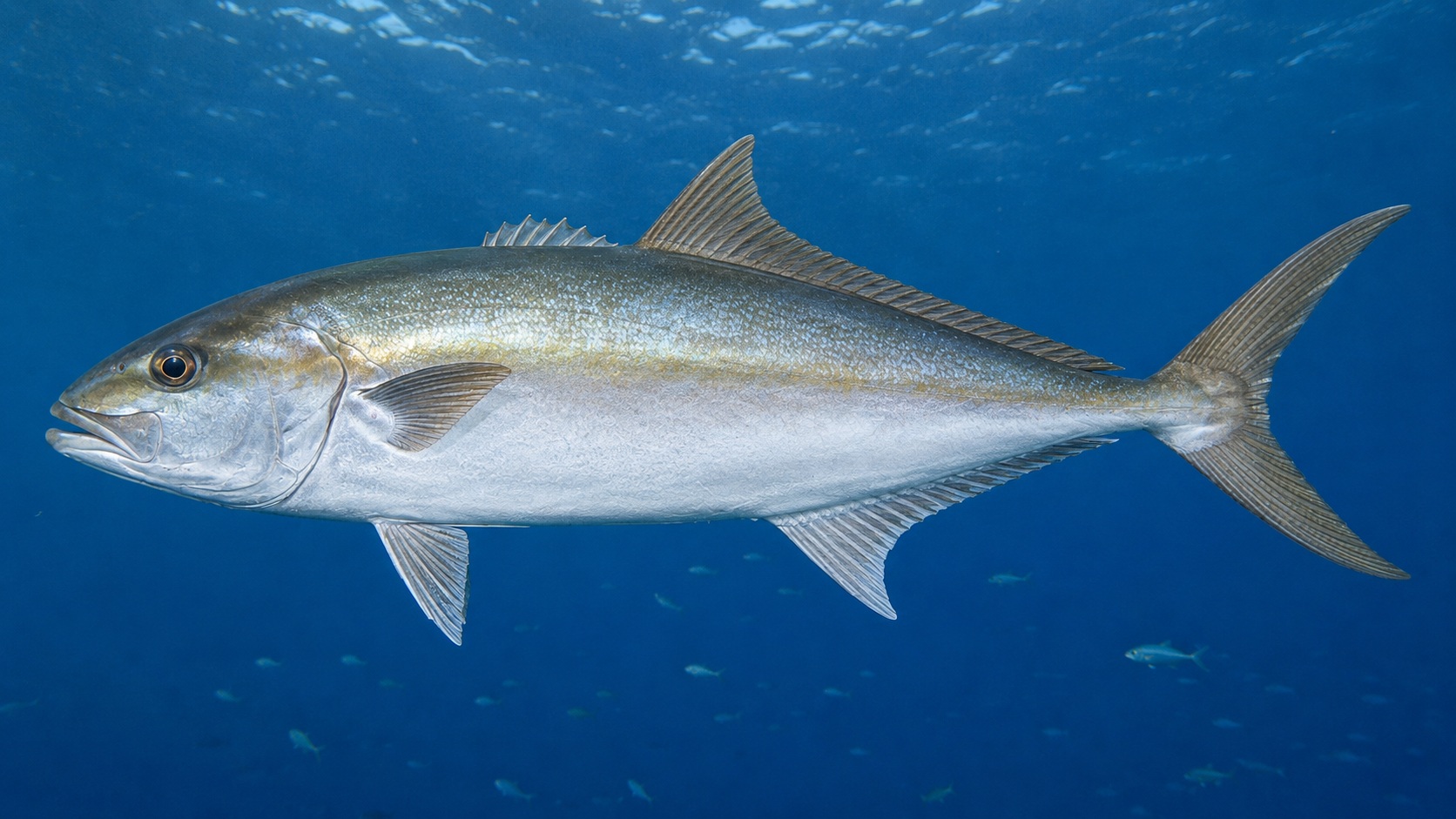
Greater amberjack are built like a torpedo with fins, all broad shoulders and forked tail. The body is silver to bronze on the flanks with a darker brownish or olive back, and a distinctive amber or gold stripe runs horizontally from the nose, through the eye, back to the tail. This stripe is most vivid on live fish and fades quickly after death. The head is large, the mouth wide, and the tail deeply forked for sustained speed. Juvenile AJs show faint vertical banding on the sides and often shelter in floating Sargassum lines offshore.
The closest lookalike in most of their range is the almaco jack (Seriola rivoliana), which has a deeper body, more angular dorsal fin, and a more pronounced amber stripe. Banded rudderfish and lesser amberjack are considerably smaller and have proportionally deeper bodies. When in doubt, count: greater amberjack have 7 isolated dorsal spines before the main dorsal fin, and the stripe through the eye is the most reliable field mark.
Where to find them
Greater amberjack live on structure. That means natural ledges, hard-bottom reefs, artificial reefs, and shipwrecks, typically in 60 to 240 feet of water. The species is broadly distributed along the U.S. Atlantic coast from Virginia southward, throughout the Gulf of Mexico, and into the Caribbean and Bermuda.
Along the Southeast Atlantic coast — the Carolinas, Georgia, and northern Florida — offshore ledges and reef systems in the 80 to 200-foot range hold strong populations. The Gulf Stream influence keeps fish active for much of the year in this zone, and numerous wrecks and artificial reefs along the coastal shelf are reliable producers.
In the Gulf of Mexico, the wrecks and artificial reefs scattered across the northern Gulf from Texas through Alabama hold AJs year-round. Natural hard-bottom ledges along the Gulf’s continental shelf edges are equally productive, and the deeper reef systems of the Dry Tortugas and eastern Gulf are renowned for large fish.
Bermuda and the Caribbean are destination fisheries for truly large amberjack. The blue water structure, seamounts, and deep reef edges in these areas regularly produce trophy-class fish.
Smaller fish (under 30 pounds) sometimes show up in surprisingly shallow water over nearshore wrecks in 40 to 60 feet. The largest individuals tend to hold deeper, in the 100 to 200-foot range, and are most reliably found on high-relief structure such as tall wrecks or rocky ledge edges where current creates an ambush point. Juveniles spend their first months offshore in Sargassum mats before transitioning to reef habitats around 5 to 6 months of age.
When to go
Spring and fall are the peak windows for greater amberjack throughout most of their U.S. range, but exact timing shifts significantly by latitude.
The bite picks up as water temperatures climb above roughly 68 to 72 degrees — earlier in late winter along the southern Gulf Coast and Southeast Atlantic, progressively later as you move northward up the Atlantic coast. Spring fish are actively feeding and often staging near spawning structure, making them more aggressive and concentrated.
During the hottest summer months, large AJs often push deeper to find cooler water, making them harder to reach from shallow-draft boats. As water temperatures ease in fall — again, earlier in the North and later in the South — fish return to mid-depth structure and the bite improves again.
Current and tide movement are significant factors regardless of season: AJs feed aggressively when current is running and often stack on the up-current side of structure. Early morning tends to produce better surface and mid-water action, while fish holding tight to structure can be targeted throughout the day.
Note that seasonal closures have a major impact on when you can legally target these fish in Gulf waters. Check current regulations before planning any trip (see Regulations section below).
What to throw
Live bait is the most effective and most exciting way to fish for AJs. Pinfish, blue runners (hardtails), cigar minnows, and sardines all draw aggressive strikes. Drop a lively bait to the level of the fish and hold on. Blue runners are a top choice because their swimming action and durability in the water column draw reaction strikes from large fish that ignore smaller baits.
Vertical jigs are the go-to for many serious amberjack anglers. Heavy butterfly jigs or speed jigs in the 4 to 8-ounce range work best over deep structure. Colors that produce reliably include blue/white, pink/white, and chartreuse. The retrieve is an important variable: a fast, erratic jig cadence often triggers strikes from fish that ignore a slower presentation. Drop the jig to the bottom or just above the structure, then work it up through the water column with a fast lift-drop or a continuous high-speed crank.
Knife jigs and slow-pitch jigs have gained popularity in recent years for targeting large AJs. Slow-pitch jigging with 300 to 400-gram jigs on a parabolic slow-pitch rod generates a natural flutter that draws strikes from fish that have seen every conventional offering.
Large plugs and swimbaits work well when fish are pushed up in the water column. Big Yo-Zuri Crystal Minnows, Williamson Jet Vibe Speed Vibes, and similar heavy-duty lures fished at speed on a 30 to 50-pound spinning setup are effective when you can see fish on the meter above structure.
Tackle should be heavy. A conventional setup with 50- to 80-pound braided line and a 60- to 100-pound fluorocarbon leader is standard for larger fish. A 7- to 7.5-foot heavy-action rod paired with a quality lever-drag conventional reel (Shimano Tiagra, Penn International, or equivalent) gives the power needed to keep fish out of the structure during the initial surge. Spinning gear in the 10,000 class with 50-pound braid also works, but the angler must be prepared for a prolonged fight.
Regulations
Greater amberjack is a federally managed species under NOAA Fisheries, with the Gulf of Mexico and South Atlantic managed by separate Fishery Management Councils. State regulations apply in state waters and typically mirror federal rules, but the two can differ.
Gulf of Mexico: The Gulf stock is currently classified as overfished and is under an active federal rebuilding plan. Recreational seasons are tightly managed with annual adjustments — seasons have been shortened in recent years due to quota accountability measures, and in-season closures can be announced with as little as a few days of notice. Minimum size limits and bag limits apply in both state and federal Gulf waters. Always verify the current season status with NOAA Fisheries before planning a Gulf trip.
South Atlantic / East Coast: Regulations are set by the South Atlantic Fishery Management Council for federal waters, with individual states managing their own waters. Size limits, bag limits, and any seasonal closures vary; always check the rules for the specific state and water zone you are fishing.
Other regions: Anglers fishing U.S. Caribbean waters (Puerto Rico, U.S. Virgin Islands) should check Caribbean Fishery Management Council regulations. Bermuda and international Caribbean destinations have their own rules.
Rules for this species change frequently. Always verify current regulations with NOAA Fisheries (fisheries.noaa.gov) and your state’s fish and wildlife agency before your trip.
Handling and release
Greater amberjack are durable fighters and generally handle catch-and-release well compared to deep-water species. Because they are powerful and athletic, they rarely suffer severe barotrauma at the depths where they are commonly caught (60 to 150 feet), unlike grouper and snapper that come up from deeper water. A fish that has been fought hard will need a moment to recover: hold it upright in the water, facing into any available current, until it kicks away strongly on its own.
For fish you intend to keep, table quality is good on smaller individuals (under 30 pounds). Amberjack has firm, mild white flesh that holds up well to grilling, smoking, and blackening. However, the ciguatera risk in larger fish is real and documented throughout their tropical and subtropical range. Ciguatoxins bioaccumulate in large reef predators, and amberjack over 30 to 40 pounds from reef areas carry a meaningful risk. There is no way to detect ciguatera by sight, smell, or taste. Avoid eating the liver, roe, or head organs regardless of fish size, and exercise caution with any large individual taken from tropical reef habitat. When in doubt, release large fish.
On the Table
Greater amberjack is a respectable table fish that rewards anglers who handle their catch well, though its reputation is mixed — smaller fish are legitimately good eating, while large specimens carry real food-safety concerns that push many anglers to release the biggest fish they catch.
Taste and texture: The flesh is white to off-white with a mild, slightly sweet flavor that is bolder and richer than grouper but not overpowering. Texture is firm and dense with large flakes — closer to swordfish than a delicate flounder — and a moderate fat content gives it a satisfying, meaty bite. Fish over 30-40 pounds can develop a stronger, more pronounced flavor; smaller fish (under 20 pounds) are noticeably milder and more versatile at the table.
Best preparation methods: Grilling is the classic choice and suits the dense flesh perfectly — the high heat chars the outside while keeping the interior moist, and the fish holds together on the grates without falling apart. Blackening in a screaming-hot cast-iron skillet is equally effective; the bold Cajun spice rub complements the fish’s own richness without masking it. Smoking is a natural fit given the higher fat content — amberjack takes smoke well and the result is moist and flavorful. For lighter preparations, simply pan-searing thick fillets in butter with garlic and lemon lets the clean flavor speak for itself. Fish tacos are a popular preparation along the Gulf Coast and Atlantic seaboard.
Handling for table quality: Bleed the fish immediately at boatside by slicing through the base of the gill arch and letting it bleed into the water or a bucket before placing it in the cooler. Get it into an ice slurry (crushed ice plus a little seawater) as fast as possible — an ice bath chills the flesh far faster than dry ice cubes. When filleting, remove the skin and trim away the dark red lateral-line meat, which is the source of most off-flavor. Eat or freeze within 48 hours for best results.
Eating caveats:
- Ciguatera risk: Greater amberjack is a known ciguatera vector throughout their tropical and subtropical range, including the Florida Keys, Bahamas, and Caribbean. Larger fish accumulate more ciguatoxin because it bioaccumulates up the food chain. The toxin cannot be destroyed by cooking or freezing. Many experienced anglers eat only fish under 20 pounds and avoid fish from reef areas in tropical waters. This is a moderate but real risk — take it seriously.
- Worm parasites: Anisakid worms are common in amberjack, particularly in larger fish. Thorough cooking to an internal temperature of 145 degrees F kills all parasites. Do not consume raw or undercooked amberjack.
- Stock status and bag limits: Greater amberjack in the Gulf of Mexico is currently classified as overfished and under a rebuilding plan. Recreational bag limits and minimum size limits are tightly managed and subject to annual change. Check current NOAA Fisheries and applicable state regulations before your trip.