A note about links: If we include links to retail sites like Amazon or Bass Pro Shops, it's because they're relevant to the topic and, as anglers ourselves, we believe they're worth checking out. As an Amazon Associate we earn from qualifying purchases.
Few saltwater fishing moments match spotting a cobia cruising behind a cownose ray in gin-clear spring water and making a cast before the fish disappears. Cobia are big, aggressive, and remarkably accessible: they show themselves on the surface, they eat a wide range of baits, and when one peels off on its first run, every angler on the boat understands immediately why people plan trips around them. The spring migration brings fish within sight of bridges and beaches from the Gulf Coast up through Virginia and the Carolinas, turning casual anglers into devoted cobia hunters. A thirty-pound fish is a realistic first catch; a sixty-pounder is a legitimate possibility on any good spring day.
How to identify one
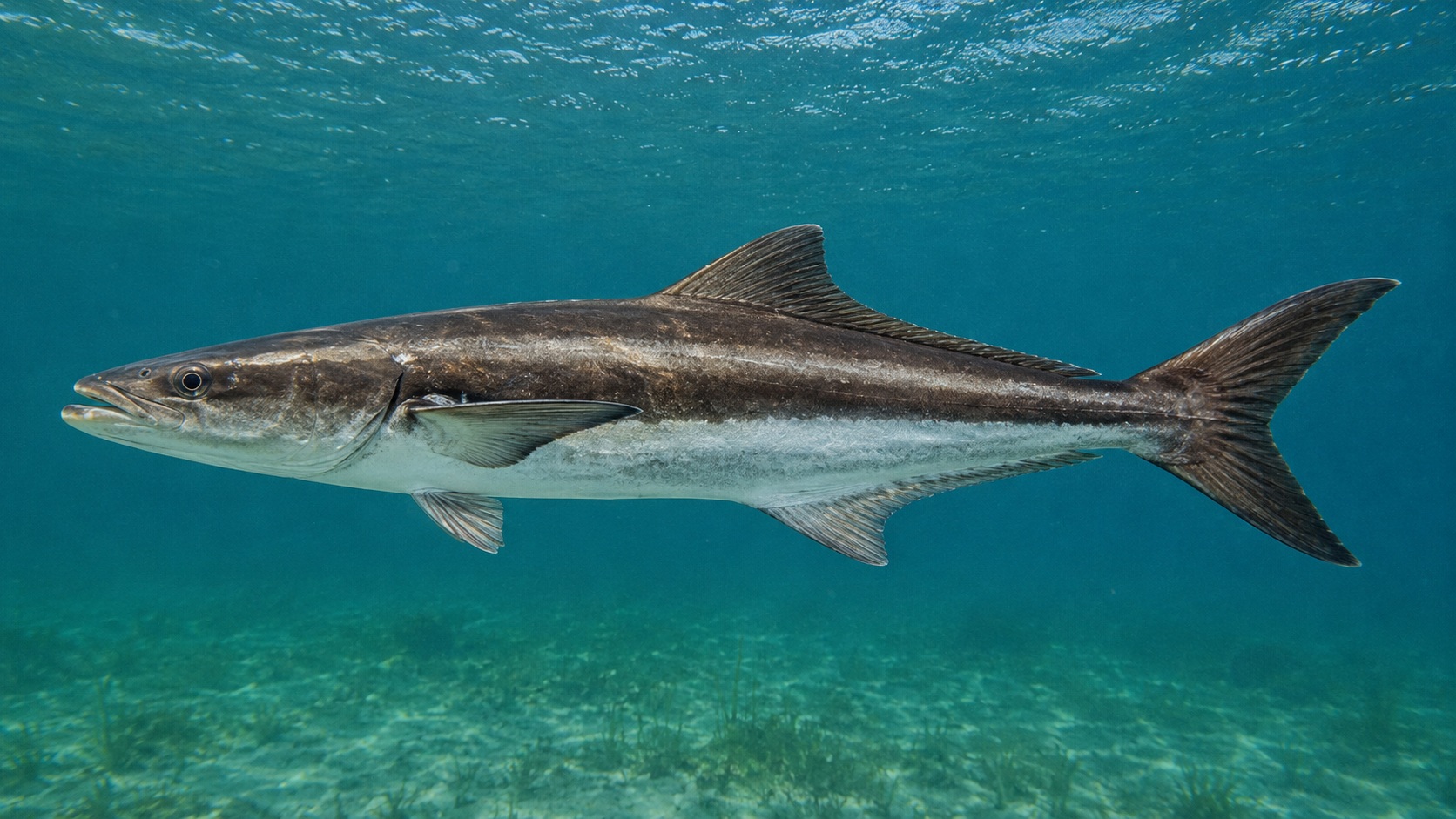
Cobia are unmistakable once you know what to look for. The body is long and cylindrical, dark brown to charcoal on the back fading to a creamy white or pale yellow on the sides and belly. A bold dark horizontal stripe runs from the eye to the base of the tail on each flank, darker on juveniles and sometimes faint on large adults. The head is broad and depressed, almost shark-like from above, with a protruding lower jaw. Before the dorsal fin, a row of 7 to 9 short, stout, isolated spines runs along the back: treat these with respect, as they are sharp and do not fold flat. The pectoral fins are large and held horizontally when the fish is gliding near the surface, giving it a silhouette that is easy to recognize from a bridge or a poling skiff. Juveniles show a more vivid black-and-white banding pattern. The only fish a cobia is occasionally confused with is the remora (sharksuckers), which it resembles loosely from a distance, but remoras lack the stripe, the isolated dorsal spines, and the cobia’s obvious bulk and power.
Where to find them
Cobia range across the western Atlantic from Virginia south through Florida and around the Gulf of Mexico, with a global distribution in tropical and subtropical coastal seas. They are a nearshore and inshore species during the warmer months, gravitating toward any structure that aggregates baitfish and crustaceans: channel markers, lighted bridges, artificial reefs, shipwrecks, crab pot floats, and navigation buoys. They also follow large mobile animals — a behavior that defines some of the most celebrated cobia fisheries on the coast.
In the mid-Atlantic, the spring migration through the Chesapeake Bay and the waters off Virginia and North Carolina ranks among the most storied cobia events in the country. Anglers target fish from boats and from the beach as large schools push northward, often visible at the surface. The Carolina coast — particularly the nearshore waters and inlets of North Carolina — sees excellent spring action before fish continue north. Along the Gulf Coast, fish stage and feed around offshore platforms, nearshore reefs, and the mouths of major bays from Texas through Alabama and the Florida Panhandle. Moving east along the Gulf, the Nature Coast of Florida and the Tampa Bay corridor are well-known spring staging grounds. On the Atlantic side, Florida’s nearshore reefs and inlets produce consistent spring fish before the migration carries the bulk of the population northward.
Offshore, cobia associate with structure, floating debris, and surface-busting activity year-round across their range. Anywhere you find open-water structure — oil rigs, buoys, wrecks, and even sea turtles or whale sharks — cobia are possible.
When to go
Spring is the primary season, and the timing shifts significantly by latitude. In the Gulf and along Florida’s Atlantic coast, fish become accessible earlier, typically when water temperatures climb into the upper 60s°F — often late March through May in the South. As temperatures continue rising, fish migrate northward: the Virginia and North Carolina fishery peaks in May and June, and cobia push into Chesapeake Bay waters through early summer. Water temperature is the reliable trigger regardless of where you fish — cobia are most active and aggressive in the 72 to 82°F range, and the bite tends to slow when water climbs much above 85°F.
Cobia are also caught through summer on nearshore reefs and wrecks across their range, and fall brings another push as fish begin moving back south. Early morning and late afternoon are traditionally better in calm conditions, but during peak spring migration the fishing is opportunity-driven: when you see a ray school or a cruising fish, the time of day is irrelevant. Overcast days with light wind can extend feeding activity throughout the day.
What to throw
Live crabs are the single most productive cobia bait across their range. A lively blue crab, hooked through the back of the shell on a 5/0 to 7/0 circle hook with a fish-finder rig or a short free-line, is hard for a cobia to turn down. Match the hook size to the crab: small peelers on a 5/0, larger crabs on a 7/0. Live eels are a close second on the Atlantic coast and are particularly effective when sight fishing to a single fish following a ray or shark. Live pinfish, mullet, and ladyfish also work well, rigged on a 6/0 to 8/0 circle hook under a float or free-lined at the right depth. When sight casting to visible fish, bucktail jigs in chartreuse, white, or natural in the 1 to 3-ounce range produce explosive strikes and give you control over the presentation. Pitch the jig ahead of the fish, let it sink slightly, and strip it back with an erratic, darting retrieve. Soft plastic swimbaits rigged on a weighted swimbait head, such as a 5-inch paddle tail in white or chartreuse, cover water quickly when searching for fish around ray schools or buoys. Topwater plugs trigger dramatic blow-ups in low-light conditions when fish are feeding near the surface. When fishing bridges and structure, live shrimp on a knocker rig will take cobia that are holding tight and not actively chasing. One technique note that matters: when a cobia follows a bait to the boat without committing, drop the rod tip, let the bait go slack for two seconds, then jerk it hard to one side. The change of speed and direction triggers a reflex bite far more reliably than simply speeding up the retrieve.
Regulations
Cobia regulations vary by state and by whether you are fishing state or federal waters. Each Atlantic and Gulf Coast state sets its own minimum size and bag limits, and those rules can change from year to year. Federal waters regulations are set by NOAA Fisheries in coordination with the South Atlantic and Gulf of Mexico Fishery Management Councils; federal rules may differ from your state’s rules, so confirm which apply based on where you are fishing.
Before every trip, check the regulations for your specific state with your state fish and wildlife agency. Cobia size and bag limits have changed in multiple states in recent years as managers respond to stock assessments, and what was current last season may not be current now. A quick search for “[your state] cobia regulations” will take you to the right page.
Handling and release
Cobia require careful handling. The isolated dorsal spines are stout and sharp: grip the fish firmly behind the pectoral fins or use a lip-grip tool, and keep your hand away from the dorsal row. A fish in the 30 to 50-pound range is powerful enough to injure an angler who is not ready for it at boatside, particularly when the fish makes a second lunge. If you plan to keep the fish, bleed it immediately by cutting the gills: the flesh is dense and retains heat, and bleeding plus a quick transfer to an ice-slurry dramatically improves table quality. Cobia are widely regarded as among the best-eating fish in saltwater, with firm, white, slightly sweet meat that holds up well to grilling, blackening, and sashimi. For fish you plan to release, keep them in the water as much as possible, revive them headfirst into a current or by moving them slowly forward, and watch for strong tail kicks before letting go. Cobia do not always revive quickly after a long fight; take the time to do it right.
On the Table
Cobia ranks among the finest eating fish in saltwater, and experienced anglers who encounter one rarely release it without serious consideration — the flesh is that good. It is widely regarded as a bucket-list table fish by anglers from the Gulf Coast to the mid-Atlantic.
Taste and texture: Cobia has firm, dense, off-white to pale tan flesh with a rich, mildly sweet flavor that is often compared to mahi-mahi or grouper but with a slightly more buttery quality. The fat content is notably higher than most inshore species, which gives it a moist, almost meaty texture that holds up well to high heat. There is no strong or fishy odor when fresh; the flavor is clean and versatile.
Best preparation methods:
- Grilling: The dense, fatty flesh is nearly ideal for the grill. Thick steaks or large fillets hold together without falling apart, and the natural fat bastes the fish from within, producing a lightly charred exterior with a moist, flaky interior. A simple salt, pepper, and citrus treatment lets the flavor speak.
- Blackening: Cobia’s firm texture and fat content make it one of the best candidates for cast-iron blackening. The bold spice crust contrasts well with the rich, mellow flesh underneath, and the density prevents overcooking in the initial sear.
- Sashimi and ceviche: Very fresh cobia is prized raw. The clean, sweet flavor and dense texture slice cleanly for sashimi, and the fat content gives it a satisfying mouthfeel that holds up in citrus-forward ceviche without turning mushy.
- Smoking: The higher fat content means cobia takes smoke exceptionally well. Cold- or hot-smoked cobia produces a richly flavored product similar to smoked amberjack but cleaner and less oily.
Handling for table quality: Cobia are large, powerful fish and their flesh degrades quickly if not handled properly. Bleed the fish immediately at the gills after landing, then ice it down hard in a slurry of ice and saltwater. Do not let the fish sit in fresh water or the flesh will absorb it and turn soft. When filleting, remove the dark lateral bloodline along the centerline of each fillet — it has a stronger, more pronounced flavor and is worth removing for cleaner-tasting results. Fillets can be skin-on or off depending on cooking method; skin-on works well for grilling.
Eating caveats: Cobia occasionally carry Anisakis roundworm larvae, as do many large pelagic and nearshore species. Thorough cooking (internal temperature above 145 degrees F) or proper freezing before raw consumption eliminates any risk. No significant ciguatera or mercury concerns at typical recreational sizes, though very large fish (above 50 pounds) caught in tropical waters warrant the same general caution applied to any large predatory species.