A note about links: If we include links to retail sites like Amazon or Bass Pro Shops, it's because they're relevant to the topic and, as anglers ourselves, we believe they're worth checking out. As an Amazon Associate we earn from qualifying purchases.
If you have ever wanted to watch a fish lose its mind at the end of your line, the ladyfish is your answer. Hook one on ultralight spinning gear or a 6-weight fly rod and brace yourself: a 2-pound ladyfish will jump five to eight times before you get it close enough to touch the leader. It cartwheels, it spins, it goes airborne again just when you think it is done. Most anglers who dismiss them as “trash fish” have only caught them on heavy gear, which is like judging a sports car by how it handles in a parking lot. On the right tackle, a ladyfish is one of the most electric experiences inshore fishing has to offer anywhere along the Gulf Coast or South Atlantic seaboard.
How to identify one
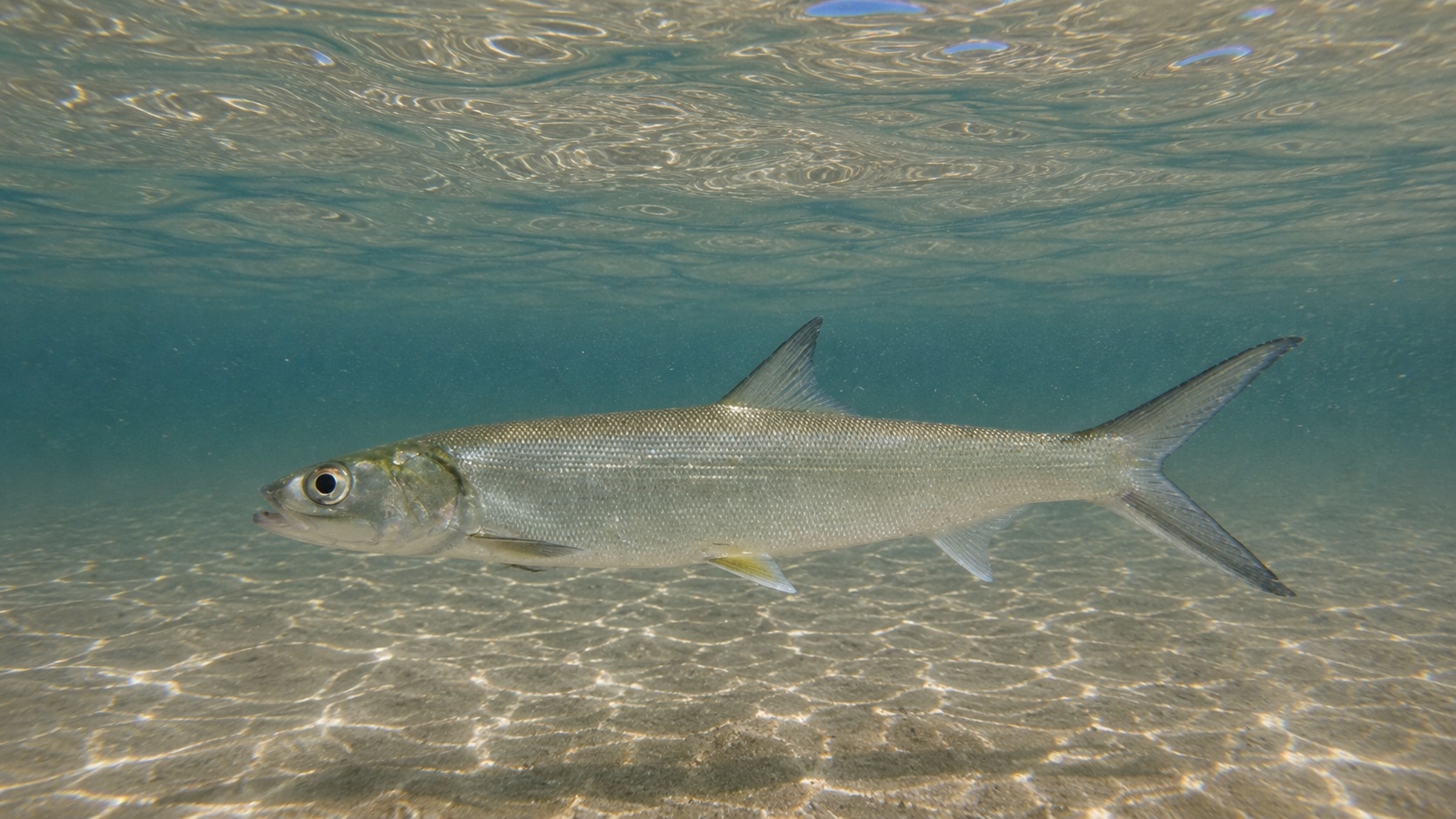
Ladyfish are built for speed. The body is long, slender, and covered in large, loosely attached scales that gleam like chrome and fall off in your hand the moment you touch them (wear a glove or use a wet rag if you need to grip one). The back is slightly blue-silver, the sides and belly are pure bright silver. No spots. No bars. No distinctive markings beyond that clean, reflective flash. The tail is deeply forked, the head is pointed, and the mouth is small and terminal, right at the tip of the snout.
One feature to note: ladyfish have small but sharp teeth on both the jaws and the tongue. A light monofilament or fluorocarbon leader will get cut quickly. Step up to at least 20-pound fluorocarbon if you are fishing around a school.
The most likely confusion is with juvenile tarpon, which shares the same water and a strikingly similar body shape. That is no accident. Ladyfish and tarpon are close relatives, both members of order Elopiformes, and both share the same primitive body plan and the same leptocephalus larva. The giveaway is size and head shape: juvenile tarpon have a larger mouth that extends well past the eye, while ladyfish keep that small, neat terminal mouth. Ladyfish also lack the tarpon’s bony “bucket” jaw. If it jumped twice and fit in your cooler, it was almost certainly a ladyfish.
Where to find them
Ladyfish are a true lagoon and estuary fish. They are most abundant in warm inshore waters from the Gulf Coast states through the South Atlantic — from Texas and Louisiana east through the Florida panhandle and peninsula, then north along the Atlantic coast into Georgia, South Carolina, and occasionally the lower Chesapeake region during warm months. Populations along the Gulf of Mexico from Galveston Bay and Matagorda Bay in Texas through the Mississippi Delta and Alabama’s Mobile Bay offer excellent inshore action. On the Atlantic side, coastal lagoons, tidal rivers, and barrier island backcountry from northeast Florida through Georgia and the Carolinas all hold fish seasonally.
They school heavily, so finding one often means finding fifty. Look for surface commotion: nervous baitfish pushing spray, quick flashes near the top of the water column, or the unmistakable dimpling of a school working a pocket of glass minnows against a shoreline. Grass flat edges, channel mouths, creek inflows, backcountry potholes, and around causeways and bridges that break up tidal flow are all productive staging areas.
Inlet areas are particularly reliable. Tidal cuts connecting bays to the open Gulf or ocean concentrate ladyfish on both sides during moving tides, especially when schools of baitfish push through. Creeks and canal mouths off coastal lagoons are worth checking at dawn and dusk, when ladyfish move shallow to feed.
They tolerate a wide salinity range and will push into brackish water readily. Anywhere a bay narrows to a creek or transitions into a mangrove or marsh shoreline is fair game. One thing ladyfish will not tolerate is cold water: they go quiet when water temperatures drop below the low 60s. During winter cold snaps, fish deep channel edges where the water holds warmth longer, or look for them near power plant discharge areas where warm outflow draws baitfish and the predators that follow.
When to go
The prime window is when water temperatures climb into the 70s and 80s °F. At those temps ladyfish are aggressive, school at the surface, and are easy to locate visually. In the Gulf Coast states and South Florida this window opens as early as March and stretches well into November; farther north along the Atlantic coast, peak activity compresses into summer and early fall as water warms later and cools earlier.
The rule of thumb: the farther south you are, the longer the season. Anglers in Texas and Louisiana can expect good action from spring through fall, with fish present nearly year-round in the warmest shallow bays. Anglers fishing Georgia and the Carolinas get a shorter but productive summer peak, typically June through September, when warm Atlantic water pushes ladyfish north into coastal estuaries.
Fall months can produce some of the largest concentrations along the entire range, coinciding with mullet runs and baitfish schools that move through coastal lagoons and barrier island inlets. Summer mornings before the wind picks up are often spectacular, with surface-busting schools visible across the flat.
Tidal movement matters more than time of day. An active tide edge with current pushing baitfish into a corner or against a point will hold more ladyfish than a slick, windless flat at high slack.
What to throw
Ladyfish are not picky. If it moves fast and looks like something small and edible, they will hit it.
Small jigs (1/8 to 1/4 oz). A white or chartreuse jig head with a 3-inch paddle tail or curly tail grub is the single most reliable ladyfish bait. Cast past the school, let the jig hit the surface, and retrieve fast. Erratic, quick hops with a lot of rod movement often trigger more strikes than a straight retrieve.
Soft plastics on a light head. Same concept as the jig, but a slightly softer profile can help on pressured fish. Light color patterns in white, pearl, or chartreuse work well across the range.
Small spoons. A 1/4-oz gold or silver weedless spoon worked quickly across a grass flat edge will find ladyfish fast when you are covering water.
Topwaters. This is the most fun way to catch ladyfish and also the most unreliable, which is part of the appeal. A small walking bait at dawn on a calm flat will draw blowups from ladyfish that are hard to top. Walk the bait with authority and stay focused.
Live shrimp under a popping cork. When ladyfish are the target species rather than an incidental catch, a live shrimp 18 inches below a popping cork is one of the most effective setups. Pop the cork to attract attention and let the shrimp flutter on a tight slack line. You will catch ladyfish and just about everything else that swims the grass flats.
Fly fishing. The ladyfish is a legitimate fly rod target and one of the best beginner fly fishing experiences in saltwater. A 6-weight with a 10-pound fluorocarbon tippet, a small Clouser Minnow in white and chartreuse, and a fast strip retrieve is all you need. Strip fast. Ladyfish want a fleeing baitfish, not a drifting one.
Whatever presentation you choose, use at least 20-pound fluorocarbon for the last 12 to 18 inches. Ladyfish teeth are small but abrasive, and a light tippet will not survive a long fight.
Handling and release
Ladyfish slime heavily and their scales shed on contact, so handle them quickly and gently. Wet your hands before touching the fish, support the body horizontally, and avoid squeezing. If you need a grip, a glove or a rubberized mesh landing net keeps the scales intact and reduces stress on the fish. Most ladyfish are released alive, and they revive quickly: point the fish into current, move it gently back and forth until it kicks free. They are hardy and rarely require extended revival.
Regulations
Ladyfish are largely unregulated across their US range — most states along the Gulf Coast and South Atlantic impose no bag limit, size limit, or closed season on the species. However, regulations can change, and a handful of states may have specific rules for certain water bodies or gear types. Always verify current rules with your state fish and wildlife agency before fishing. The relevant agencies are NOAA Fisheries for federal offshore waters and your state’s marine fisheries division for inshore and coastal waters.
On the Table
Ladyfish are almost universally released by anglers, not because regulations require it, but because the fish is famously bony, strongly flavored, and soft-fleshed — a combination that makes table preparation more trouble than most anglers find worthwhile.
Taste and texture: The flesh is off-white to pale gray, soft, and watery when raw. The flavor is pronounced and oily with a strong “fishy” quality that intensifies quickly after the catch. Unlike sport fish with mild white flesh, ladyfish lack the clean flavor profile that makes table fare appealing. The meat is also riddled with numerous small intermuscular bones throughout the fillet, making clean separation nearly impossible without extensive and time-consuming pin-boning.
Best preparation methods: For those committed to eating ladyfish, a few approaches help manage the bones and strong flavor:
- Fish cakes or fish patties: Grinding or food-processing the meat turns the bone problem into a non-issue; finely processed flesh can be pressed into patties and pan-fried with binding ingredients and seasoning that offset the strong flavor.
- Smoking: Cold or hot smoking concentrates the existing flavor in a way some anglers find acceptable; the smoke masks the gaminess and the soft texture becomes less of a liability.
- Ceviche (with caution): Acid-marinating finely minced ladyfish breaks down the soft texture further and can mellow the flavor, though bone fragments remain a concern unless the flesh is processed very finely.
Handling for table quality: If you intend to keep a ladyfish, act fast — the flesh degrades rapidly. Bleed the fish immediately at the gills, then get it onto ice without delay. Ladyfish should be filleted and processed the same day; holding them overnight typically results in a noticeably mushier, more pungent product. Keep fillets cold and dry, and plan to cook within hours of filleting rather than days.
Eating notes: There are no ciguatera concerns, mercury advisories, or legal restrictions on keeping ladyfish in most US waters. The barrier to eating them is entirely practical: excessive bones, soft texture, and strong flavor. Most guides and experienced inshore anglers treat ladyfish as a catch-and-release sport fish or cut bait rather than table fare, and that reputation is well-earned.