A note about links: If we include links to retail sites like Amazon or Bass Pro Shops, it's because they're relevant to the topic and, as anglers ourselves, we believe they're worth checking out. As an Amazon Associate we earn from qualifying purchases.
There are fish you catch, and then there is the tarpon. The Silver King. Hook one and it will launch itself 5 or 6 feet straight into the air, thrashing and shaking before it even knows what hit it, and your brain will simply stop working for a moment. The tarpon is the reason anglers book guides months in advance, drive through the night to reach the coast, and spend obscene amounts of money on tackle. It is one of the most technically demanding fish in the inshore world — it will humble you more than it rewards you — and nobody who has ever seen one explode off the surface walks away thinking about anything else for the rest of the week. From the backcountry flats of Florida to the passes of Texas, from the beaches of the Carolinas to the river mouths of the Caribbean, the tarpon is the mountain every serious coastal angler is working toward.
How to identify one
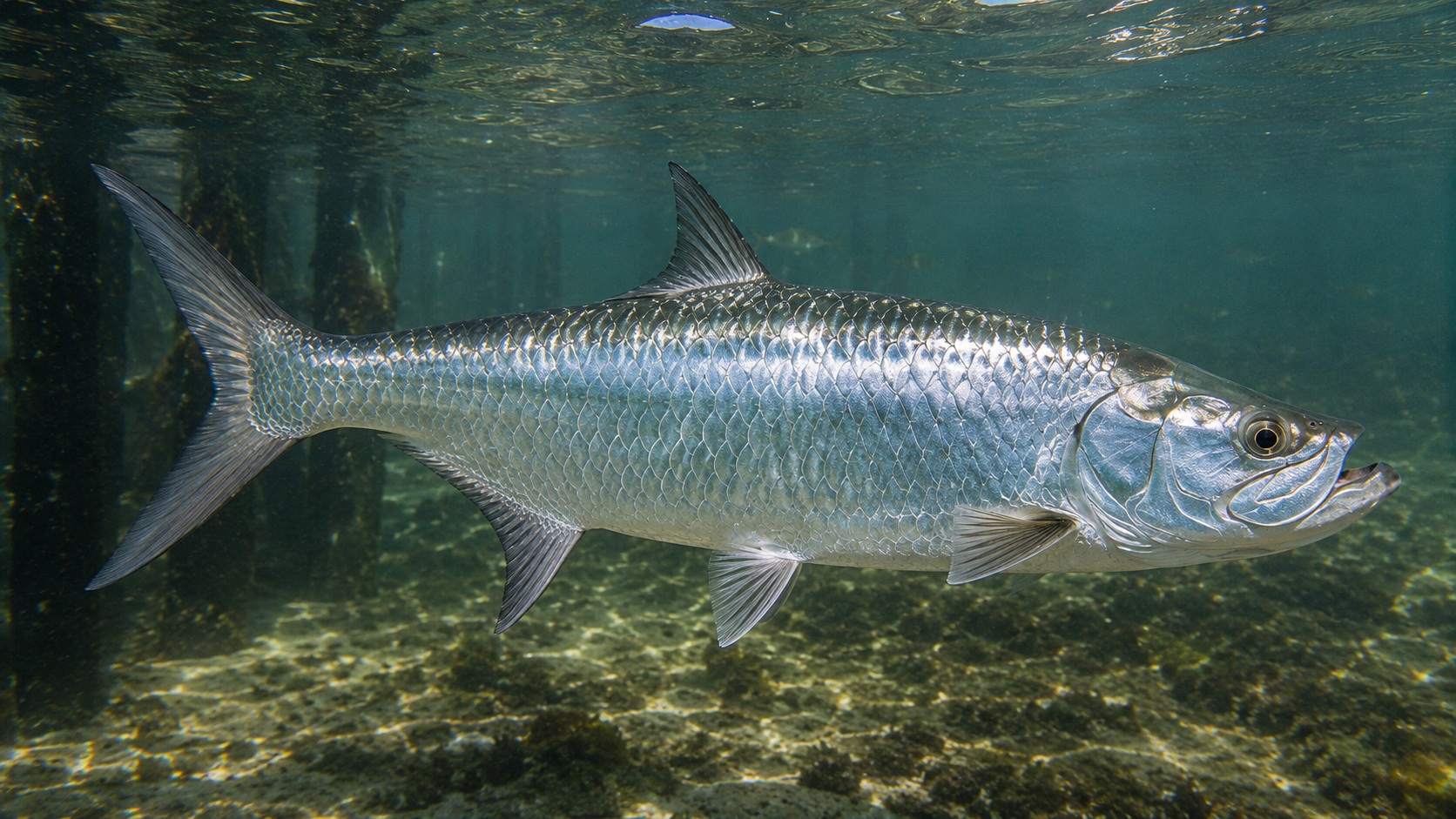
You will not confuse a tarpon with anything else in its range. They are enormous, bright silver fish with a deep body and enormous scales, called “coins,” that can be the size of a grown adult’s palm. The lateral line runs straight through the middle of the body, and the scales catch sunlight like mirrors when a fish rolls at the surface. The mouth is large, upturned, and hard-jawed, with a bony lower lip that juts forward. The last ray of the dorsal fin extends into a long, trailing filament. Juvenile tarpon, in the 10- to 20-pound range, look like miniature versions of the adults and are found in backcountry creeks, lagoons, and river mouths. Even a 20-pound fish is unmistakable.
The tarpon lineage dates back more than 100 million years. The fish you hook today is biologically nearly identical to the fish that swam these waters when dinosaurs were still around. Look at those scales, that underslung jaw, and the way it breathes air at the surface and you are looking at something that has not needed to change in a very long time.
Where to find them
Tarpon are a migratory species that follow warm water, baitfish, and seasonal cues up and down the Atlantic coast and across the Gulf. Their range in the United States runs from the Texas coast east through the Gulf states, around Florida, and up the Atlantic coast as far as North Carolina and occasionally Virginia during summer.
Florida holds the most consistent and heavily concentrated tarpon fishery in the country. The Keys and southwest Florida (Charlotte Harbor, Tampa Bay, Boca Grande Pass) are globally famous destinations where fish gather in extraordinary numbers from spring through early summer. Atlantic coast inlets and passes along the central and northeast coast also produce excellent migration fishing. The backwaters and lagoon systems throughout the state hold juvenile fish spring through fall.
The Gulf Coast states — Alabama, Mississippi, Louisiana, and Texas — all hold tarpon in their passes, bays, and nearshore surf zones during the warm months. The Louisiana marsh coast and the passes along the Texas coast are productive for anglers willing to look beyond the Florida crowds.
The Carolina coast sees migratory fish in summer, particularly along the nearshore surf zone and at inlets. These are typically the same fish moving north along the Atlantic coast in June and July as water temperatures warm.
The key to locating tarpon anywhere is the roll. Tarpon breathe air using a modified swim bladder that functions like a primitive lung. They regularly come to the surface to gulp air, especially in warm, low-oxygen water. If you see fish rolling, you have found tarpon. Stop, watch the direction they are traveling, and position yourself ahead of the pod rather than chasing them from behind.
Inlets, passes, and river mouths are the structural magnets. Moving tides push baitfish through these choke points and tarpon stack in the current to intercept them. Bridges and lit docks at night concentrate fish in many regions. Backcountry creeks and mangrove shorelines with good depth hold smaller fish in many estuarine systems throughout their range.
When to go
Water temperature is the primary driver of tarpon activity. Fish become reliably active once surface temps push above 74 degrees Fahrenheit and are most aggressive in the 77- to 84-degree range. What that means on the calendar shifts significantly by latitude.
In South Florida and the Keys, fishable tarpon action can begin as early as March and extend through October. In the mid-Florida range and along the Gulf Coast states, peak activity runs from late April through August. On the Carolina coast and at the northern edge of the range, summer concentrations are tightest from June through August, tailing off as water cools in September.
The spring migration is the big event across the species’ range. Adult tarpon move along the coasts in loosely organized pods, following warming water and baitfish. This is when the largest fish are most accessible, particularly at inlets and passes where moving tides concentrate bait. As summer progresses, fish disperse into backcountry feeding areas or continue moving north. Fall sees a gradual retreat back south as water temperatures drop.
Tides matter enormously at inlets and passes. Many guides prefer the last two hours of outgoing tide, when baitfish get flushed through the structure and tarpon stack and feed aggressively in the current.
What to throw
Live crabs are one of the top baits at inlets and passes throughout the species’ range. Blue crabs in the 3- to 4-inch range, fished on a circle hook with minimal weight and drifted through the current, are a standard approach when fish are stacked in moving water. Tarpon eat crabs with confidence, the presentation is natural in the current, and the hook-up rate on circles is high enough to compensate for the tarpon’s notoriously bony mouth. Thread the hook through the corner of the shell, not the body, to keep the crab alive and swimming.
Live mullet in the 6- to 8-inch range work well at inlets, passes, and around bridge structure. Rig them on a 7/0 to 9/0 circle hook through the nose or behind the dorsal fin, cast ahead of rolling fish, and let the mullet do the work.
Live pilchards and threadfin herring are effective when you can find them. Free-lined or fished under a popping cork just inside passes and inlets, they produce aggressive strikes when fish are in an active feeding mood.
Soft plastic swimbaits at night are an approach many anglers swear by around lit bridges, inlet structure, and docks. A large paddle-tail swimbait (5 to 7 inches) on a jig head heavy enough to hold bottom in the current, worked slowly through the light shadow line, is a consistent producer across the range. Dark colors like black, purple, and root beer often outperform natural shad colors at night.
Flies are the pinnacle of the sport. A large Deceiver, Tarpon Toad, or EP-style crab pattern in tan, brown, or chartreuse, presented on a 10- to 12-weight rod ahead of a rolling fish or a pod moving along the beach, is one of the hardest and most rewarding presentations in saltwater fly fishing.
Regardless of bait, the hookset on a tarpon requires commitment. Their mouths are dense bone. When a tarpon takes, do not set the hook once. Set it two or three times with hard, sweeping strokes before the fish knows it is hooked. When fishing circle hooks on live bait, come tight and let the circle do its job rather than hammering the rod.
Regulations
Tarpon regulations vary by state and sometimes by jurisdiction within states. In Florida, tarpon are a catch-and-release only fishery for all fish over 40 inches, with a very limited exception for anglers who purchase a special tarpon tag before fishing — intended primarily for anglers pursuing a record fish, not general harvest. Other Gulf and Atlantic states have their own rules governing possession, size limits, and licensing requirements for tarpon.
Always check the current regulations with your state fish and wildlife agency before fishing. NOAA Fisheries also has information on Atlantic tarpon management at the federal level. Rules change, and the tarpon’s slow-growth, long-lived life history (females can exceed 50 years of age) makes this a species where responsible, current information matters.
These protections exist for good reason. A large tarpon you release today may have been alive since the 1970s. The fishery is wild, irreplaceable, and entirely dependent on responsible handling.
Handling and release
The overwhelming norm for tarpon fishing across their range is catch-and-release, and best practices are consistent regardless of where you fish.
Never remove a large tarpon from the water. These are heavy fish and lifting them vertically puts catastrophic stress on internal organs that can cause delayed mortality even after a fish swims away looking healthy.
Keep the fish in the water alongside the boat or in the shallows. Use wet hands and support the body horizontally if you need to hold the fish for a quick photo. Use a dehooking tool to back the hook out without lifting the fish, or cut the leader close to the hook and let the fish shake it free. Revive the fish by holding it upright in the current, nose into the flow, until it kicks away strongly on its own. A fish that fought for 45 minutes may need several minutes of revival before it is ready. Do not rush the release.
On the Table
Tarpon are almost universally released rather than kept, and for good reason: the flesh is edible but exceptionally bony, strongly flavored, and widely regarded as poor table fare. The vast majority of tarpon anglers pursue this species purely for sport, and killing one for the table is considered wasteful by most in the fishing community.
Taste and texture: Tarpon flesh is dark, coarse, and carries a pronounced oily, gamey flavor that many describe as unpleasant compared to other saltwater species. The texture is dense and somewhat mushy when cooked, lacking the clean, flaky quality anglers expect from a quality table fish. The strong taste intensifies with fish size, and trophy-class tarpon (over 100 lbs) are essentially inedible by most standards.
Best preparation methods: If a legal harvest is made — rare and only practical with smaller tarpon in limited jurisdictions — the following approaches minimize the strong flavor:
- Frying in batter: Heavy seasoning and a thick batter help mask the pronounced flavor; small tarpon fillets respond better than large ones.
- Heavy smoking: Long, low smoking with assertive wood (hickory, mesquite) partially tames the gamey profile and makes the flesh more palatable.
Even with these approaches, the extreme bone structure makes filleting difficult and yield poor. The species is not considered worth the effort by most experienced anglers.
Handling for table quality: If you intend to keep a tarpon where legal, bleed the fish immediately at the gills and pack it in ice. Tarpon flesh degrades quickly and the strong flavor worsens significantly without prompt chilling. The lateral line area carries the most intense flavor; trimming it out aggressively during filleting improves the result.
Legal and conservation notes: Rules governing harvest vary by state and location throughout the tarpon’s range. Many jurisdictions have strict protections or strong cultural norms around release. Always verify current regulations before retaining any tarpon, as rules vary significantly by location and change frequently.
The overwhelming consensus among guides, tournament anglers, and fisheries managers is clear: tarpon are a premier catch-and-release gamefish, not a table species.