A note about links: If we include links to retail sites like Amazon or Bass Pro Shops, it's because they're relevant to the topic and, as anglers ourselves, we believe they're worth checking out. As an Amazon Associate we earn from qualifying purchases.
What is it?
Threadfin Shad are the backbone of the food chain in warm-water reservoirs from Texas to Virginia, and from the Tennessee Valley south to Florida. If you fish bass, crappie, striped bass, white bass, or catfish in a Southern lake, you are fishing a system built around this one small fish. Understanding what threadfin shad do, where they go, and how predators hunt them is the most practical piece of ecosystem knowledge a reservoir angler can carry.
Threadfin shad are filter feeders belonging to the herring family (Clupeidae). They spend their lives in open water, swimming in dense schools near the surface, filtering phytoplankton, zooplankton, and fine organic particles through their gill rakers. This biological role — pulling microscopic nutrients out of the water column and converting them into dense, protein-rich flesh — makes them the primary energy transfer link between algae and every sport fish in the system. Bass, crappie, stripers, and catfish do not exist in the densities Southern reservoirs support without an enormous, self-renewing supply of small forage. Threadfin shad are that supply.
Wildlife agencies throughout the South have stocked threadfin shad deliberately into reservoirs and ponds for decades specifically because they reproduce quickly, school tightly, and stay small enough to be consumed by a wide range of predator sizes. The Texas Parks and Wildlife Department notes that threadfin shad are native to large river systems across the South and have been introduced widely as forage throughout their range. The USGS Nonindigenous Aquatic Species database tracks their documented distribution across 30-plus states. When you watch bass boiling on a flat at first light or see white bass slashing through a silver shower on the surface, you are watching a predator-prey dynamic that threadfin shad anchor.
One critical fact that shapes every behavior pattern discussed below: threadfin shad cannot survive cold water. They begin dying off when water temperatures drop below roughly 42 to 45 degrees Fahrenheit. This winter die-off is a recurring event on most reservoirs and is not a fisheries management failure — it is a built-in seasonal reset that loads the shallows with fresh protein for scavengers and jumpstarts the next year’s forage cycle.
How to identify one
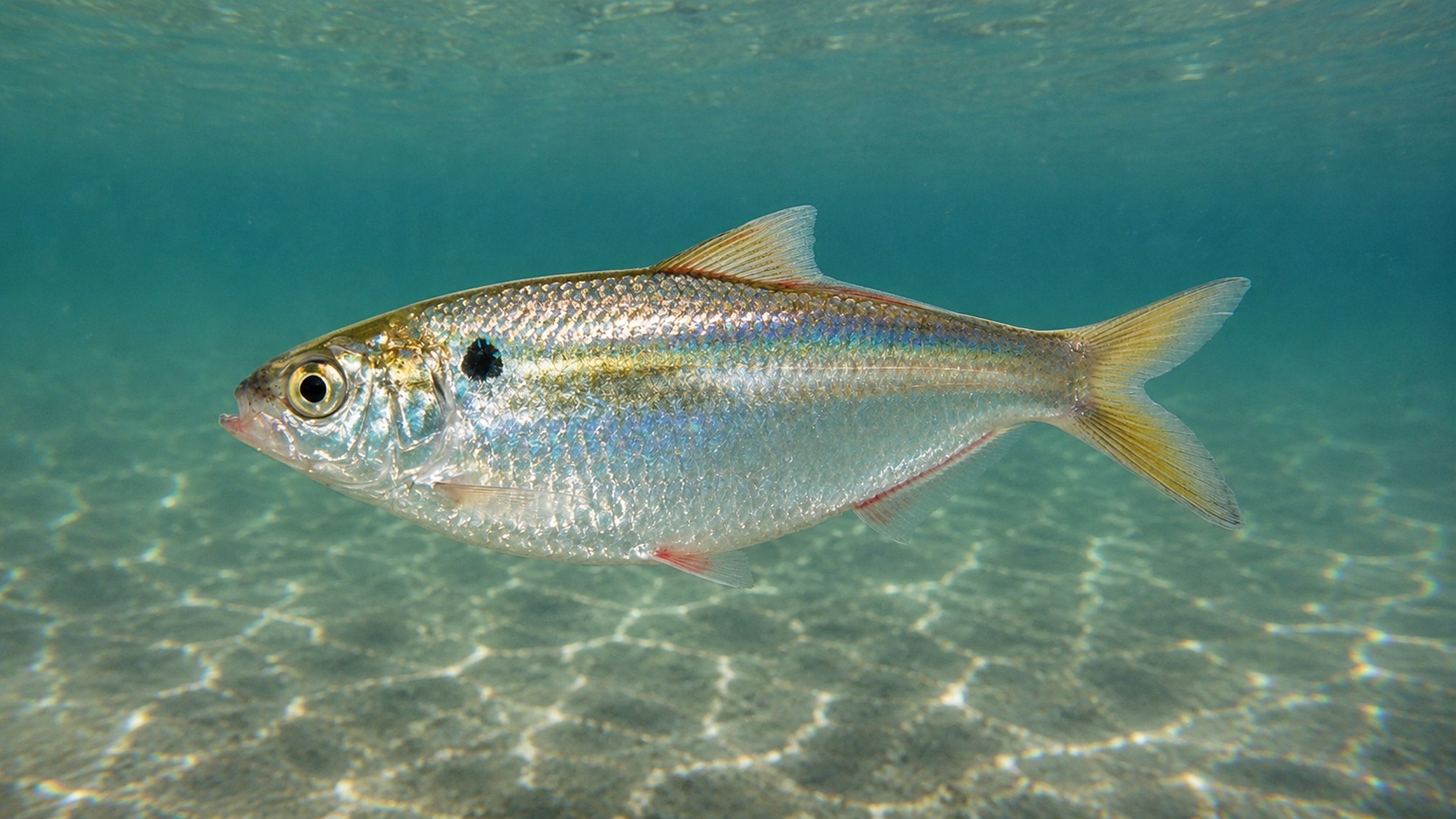
Threadfin shad are small, thin, and silver — easy to dismiss as “just a shad” until you look closely at a few distinguishing features that separate them from their larger relative, the gizzard shad.
Size: Most threadfin shad you encounter will run 2 to 5 inches. Adults occasionally reach 6 inches, and the documented maximum is around 8 inches, though a threadfin pushing 6 inches is already a genuinely large specimen. For practical reference: a threadfin fits comfortably in your palm. A gizzard shad of the same age is notably deeper-bodied and larger.
Body shape: The body is thin and highly compressed laterally — almost blade-like in cross-section. The back has a slight blue-gray to green tint. The sides are bright silver, fading to a pale white belly. Overall the fish looks like a tiny, delicate herring, which is exactly what it is.
Fins: This is the key field mark. All fins on a threadfin shad carry a distinct yellow to orange-yellow tint, particularly the tail (caudal fin) and the paired fins. The fin color is noticeable in good light and is the fastest way to confirm identification when a cast net full of shad is in front of you. The dorsal fin has an extended trailing filament — the “thread” in the name — a single elongated last ray that trails behind like a whisker. This filament is visible on adult fish but delicate, so it may be broken or absent on a netted specimen.
Shoulder spot: A single dark spot sits just behind and below the rear edge of the gill plate, on the upper shoulder. This spot is present on threadfin shad but is typically smaller and less prominent than the same mark on gizzard shad.
Distinguishing from gizzard shad: Gizzard shad (Dorosoma cepedianum) share the same reservoirs and can look similar at a glance. Key differences: gizzard shad have a blunter, more rounded snout with the upper jaw projecting forward (overhanging the lower jaw), a noticeably deeper and more robust body, and grow significantly larger — adults commonly reach 12 to 15 inches. Young gizzard shad in the 1- to 2-inch range can closely mimic threadfin shad, but gizzard shad juveniles typically lack the strong yellow-orange fin tint. The threadfin’s snout is more pointed, with the upper and lower jaws roughly even. In a cast net load with both species mixed together, the color and body depth differences become obvious quickly once you know what to look for.
Recognizing feeding fish
Most anglers will never catch or intentionally handle a threadfin shad. The value of this species, from a fishing standpoint, is in what it tells you about predator location and behavior. Learning to read shad activity on the surface is one of the highest-value skills in reservoir fishing.
What busting shad looks like: When bass, striped bass, or white bass push threadfin shad schools to the surface and begin feeding on them, the result is an eruption of small silver fish jumping clear of the water in a tight, flickering mass. This is often called a “blowup,” “boil,” or “surface bust.” The shad flicker like broken glass in the light. The bass or stripers carving through from below are visible as swirling wakes, tail slaps, and occasional full-body rolls. White bass feeding frenzies in particular can cover a large surface area and involve hundreds of fish. The sound is distinctive: a sustained hissing, splashing, and crackling noise that carries across calm water. Anglers learn to scan the horizon and the far banks specifically listening for this sound at first light.
Birds: Gulls, terns, herons, and osprey all respond to shad schools near the surface. Working birds — actively diving or hovering over a patch of open water — almost always indicate shad below. On large reservoirs, tracking bird activity from the boat launch before you leave the dock is a legitimate location strategy.
Matching the hatch: When predators are actively feeding on threadfin shad, lure selection should reflect what the fish are eating. The standard shad match in a lure is a silver or gray body with a white or pale belly and yellow or chartreuse accents on the fins or tail — a color pattern that directly mirrors the threadfin’s appearance. Wired2Fish and other sport fishing sources consistently identify this color combination as the most productive when shad are actively being targeted. Lure size matters as much as color: if fish are keyed on 2- to 3-inch threadfin, a 5-inch swimbait may be ignored while a smaller shad-profile lure draws immediate strikes.
Best lure styles for matching shad feeding: Topwater walkers (Spook-style lures) cover water fast and draw explosive strikes from stripers and white bass during surface busts. Swimbaits in shad colors fished just under the surface are productive when fish are pushing shad just below the waterline but not fully busting. Lipless crankbaits in silver/white/chartreuse work through the water column when shad are at varying depths. Small jerkbaits in shad colors are effective for bass working shad schools in clear water. The key principle across all of these: get to the fish fast, throw into or just past the leading edge of the activity, and retrieve at a pace that matches the speed of the fleeing shad.
Seasonal surface activity patterns: Surface shad feeding is most consistent in spring (post-spawn, when bass are actively chasing), fall (as water cools and shad schools push shallow), and on low-light summer mornings before surface temperatures rise. At midday in summer, shad schools and the predators that follow them descend in the water column and are best found with electronics.
How to catch your own
A minority of anglers specifically target threadfin shad with cast nets for use as cut bait, chum, or — rarely — live bait. The fish are catchable with the right approach, though working with them as bait requires managing their extreme fragility from the moment they leave the water.
Cast net setup: A 4- to 6-foot radius cast net with 3/8-inch mesh is the practical choice for threadfin shad. Larger mesh allows the small fish to pass through; smaller mesh is unnecessary and slows the net’s sink rate. Mono mesh outperforms nylon for small bait fish because it sinks faster and allows a cleaner close.
Finding them: Threadfin shad are almost always near the surface or in the upper five feet of the water column. Pre-dawn and the first hour of daylight are the most productive windows, as shad school tightly near the surface during low-light periods and become more scattered and difficult to net as the sun rises. Target the backs of coves, shallow flats adjacent to deep water, and the mouths of creek arms. Shad schools around dock lights and boat ramps at night are a reliable option in spring and fall. On calm mornings, shad schools are visible as a subtle dimpling or flickering on the water surface — similar to rain but without the sound.
Throwing the net: Approach the school slowly from upwind. Lead the school by throwing the net 3 to 4 feet in front of the visible surface activity, not on top of it. Shad are fast and will scatter under the shadow and splash of a cast net thrown directly onto them. A good net position in front of the school, allowed to sink through them, produces far better results than throwing at the center of the surface disturbance.
Immediate handling: This is where most anglers make the critical error. Threadfin shad begin dying within seconds of net contact. Handle the net in the water as much as possible. Transfer fish directly from the net to a bucket or bait well without laying them on a dry surface. A fish placed on the floor of a boat or on a dry towel is a dead fish within 30 seconds.
Keeping them alive
Keeping threadfin shad alive is genuinely difficult and is considered a specialized skill. Most experienced catfish and striper anglers who use them as bait simply use them fresh-dead or as cut bait immediately after netting. The fish’s fragility is not an exaggeration.
Why they die so fast: Threadfin shad have very thin, loosely attached scales and a delicate slime coat. Physical handling strips scales and disrupts the slime layer immediately, triggering rapid stress response. They are also highly sensitive to dissolved oxygen levels and water temperature changes. A bait well that would keep bluegill or perch alive for hours will kill threadfin shad in minutes if conditions are not carefully managed.
If you are going to try: Use a round or oval livewell of at least 25 gallons. Threadfin shad school in circular patterns and will pile up and suffocate in the corners of rectangular wells. Continuous aeration is non-negotiable — a recirculating aerator or oxygen injection system is far superior to a standard timed livewell pump. Keep water cool: threadfin shad are far more tolerant of cool water than warm, and a handful of ice added gradually can extend live time meaningfully on warm days. Minimize handling at every step. Do not overcrowd the well.
Realistic expectations: Under good conditions — cool morning, large round well, high oxygen, minimal handling — some anglers report keeping threadfin shad alive for 1 to 2 hours. In summer heat, 20 to 30 minutes of live time is a more honest expectation. Plan to make multiple bait-catching runs if you need live shad for an extended session.
Fresh-dead and cut bait: The practical alternative for most anglers is to use freshly netted shad as cut bait or fresh-dead whole bait immediately. Threadfin shad are oily and highly scented, and their effectiveness as catfish bait in particular does not depend on the fish being alive. Cut the fish in half or into chunks and fish on the bottom. A whole fresh-dead threadfin on a kahle hook or circle hook drifted near a shad school is a straightforward presentation for catfish and stripers. Freshness matters — threadfin shad deteriorate quickly once dead, so the window for maximum effectiveness as cut bait is roughly the first hour after netting.
What it catches
Threadfin shad are the primary forage for a wide range of Southern reservoir game fish. Understanding which predators respond to shad — and how — shapes the entire fishing approach for each species.
Largemouth bass: Largemouth are opportunistic shad predators throughout the year but become especially focused on threadfin shad in summer and fall when shad schools concentrate in open water and on secondary points. Bass stack below shad schools and push them upward, creating the surface feeding activity described earlier. Shad-pattern swimbaits, lipless crankbaits, and shallow-diving crankbaits in silver/white/chartreuse are the standard lure presentations. During winter die-offs, bass key on dying and dead shad in the shallows — a suspending jerkbait in shad colors fished slowly is the classic technique for this feeding window.
Striped bass and hybrid stripers: Stripers are the most aggressive surface feeders on threadfin shad in reservoirs. Schools of stripers herding shad to the surface and crashing them from below create the most explosive surface feeding action in freshwater fishing. Large threadfin shad populations are the reason reservoir striped bass fisheries sustain themselves in Southern impoundments. Heavy topwater lures, large swimbaits, and live or fresh-dead whole shad on circle hooks fished below the school are all productive. Locating the shad schools with electronics or surface observation is the entire strategy.
White bass: White bass are fast, aggressive, school-oriented predators that hunt threadfin shad cooperatively. Their feeding frenzies on surface shad schools are among the most exciting fishing events in freshwater. Small chrome spinners, tiny swimbaits, and 1/4-ounce white or chartreuse jigs thrown into active surface feeding produce consistent results. White bass will often continue feeding for 20 to 30 minutes in a single location before pushing the shad school deeper or moving on.
Crappie: Crappie do not typically engage in the same aggressive surface-feeding behavior as bass or white bass, but threadfin shad are a primary food source for larger crappie, particularly in summer and fall when shad schools suspend in the mid-water column. Finding suspended crappie near shad schools on the fishfinder and presenting small jigs, Roadrunner-style lures, or small shad-profile crappie cranks at the same depth as the shad is the core summertime crappie technique on shad-heavy reservoirs.
Catfish: Channel catfish and blue catfish opportunistically feed on threadfin shad throughout the year, with feeding activity spiking heavily during winter die-off events when dead and dying shad carpet the shallows. Fresh-cut threadfin shad on the bottom is a highly effective catfish bait from late fall through early winter on most Southern reservoirs. The oil content of the fish creates an immediate scent dispersion that draws catfish from a distance. During active die-off periods, catfish can often be found stacked in very shallow water — 2 to 4 feet — actively picking up dead and dying shad. Fresh whole shad fished on a slip-sinker rig requires no special preparation and is one of the most productive early winter catfish setups available.
Walleye: Where walleye and threadfin shad co-occur, walleye key heavily on them as a primary forage item. Shad-colored jigging spoons, vertical jigging with blade baits near suspended shad schools, and trolling with shad-profile crankbaits near shad concentrations are the standard approaches. This overlap is most significant in the upper South and in reservoirs where walleye have been stocked.
On the Table
Threadfin shad are not eaten. There is no realistic scenario where an angler targets them for table fare. The fish average 3 to 4 inches in length, have extremely small, soft flesh, and are exceptionally oily — characteristics that make commercial processing impractical and home preparation not worth attempting. The bones are numerous and fine. No culinary tradition around threadfin shad exists in the United States, and none is likely to develop. Their value is entirely ecological and as bait. Catch them, use them, and release them back to the water if you do not need them.