A note about links: If we include links to retail sites like Amazon or Bass Pro Shops, it's because they're relevant to the topic and, as anglers ourselves, we believe they're worth checking out. As an Amazon Associate we earn from qualifying purchases.
What is it?
The gizzard shad (Dorosoma cepedianum) is one of the most important fish in freshwater North America — not because anglers target it directly, but because almost everything else does. It is the dominant forage fish in hundreds of reservoirs, rivers, and natural lakes from the Great Plains east to the Atlantic coast and from the Great Lakes south into northern Mexico. Where gizzard shad are abundant, trophy catfish, striped bass, largemouth bass, and walleye follow.
For most anglers, the gizzard shad matters in two distinct ways. First, it is the single best cut bait available for channel catfish, blue catfish, and flathead catfish. A fresh-cut chunk of gizzard shad — oily, pungent, and rich — outperforms most commercial stink baits and prepared pastes because catfish evolved hunting these fish. Second, large gizzard shad are used as live bait on reservoirs where trophy largemouth bass and striped bass feed almost exclusively on shad schools. Understanding how to catch, keep, and rig gizzard shad unlocks a level of big-fish production that most artificials simply cannot match.
Unlike the smaller threadfin shad (Dorosoma petenense), which rarely exceeds 8 inches and is considered more delicate, gizzard shad are a robust, large-growing species. Adults commonly run 10 to 14 inches, and fish exceeding 17 to 20 inches are not rare in well-fed reservoir populations. This size range makes them the right-sized package for big catfish and large predators that want a substantial meal, not a snack.
How to identify one
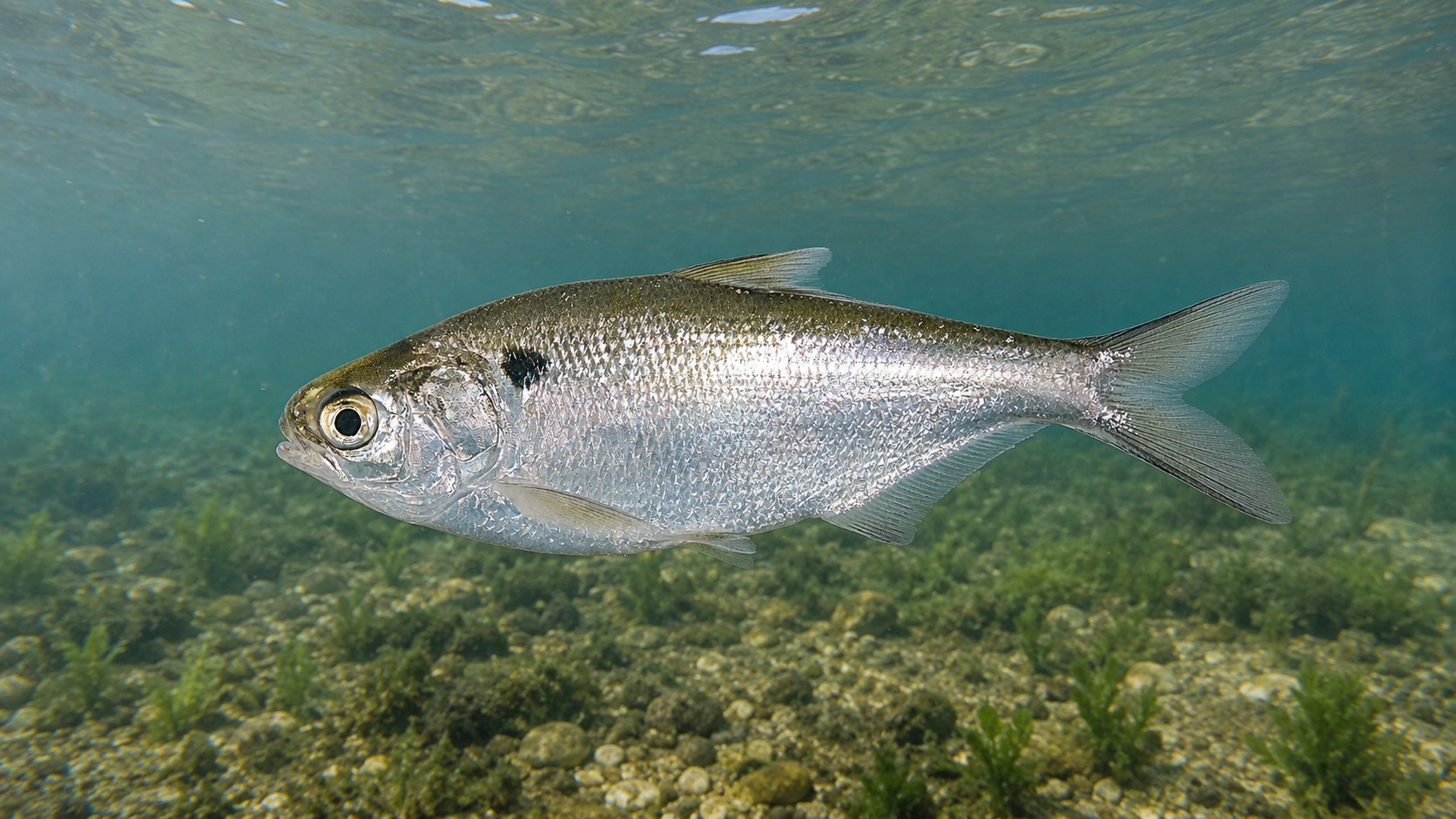
Gizzard shad have a very distinct body shape that, once learned, is hard to confuse with most other species. The body is deep and strongly laterally compressed — almost disc-shaped when viewed head-on — with a silvery, reflective sheen that makes them flash brilliantly in a cast net. The back is steel blue to blue-green, fading to bright silver on the sides and white to yellow on the belly.
The single most reliable field mark is the snout. Gizzard shad have a blunt, rounded snout that projects noticeably beyond the lower jaw, giving the fish an underslung, subterminal mouth. This toothless mouth is designed for filtering plankton and organic material from the water column — not for chasing other fish. Running your finger along the underside of the jaw, you will feel the lower jaw recede well behind the rounded tip of the upper snout. This profile immediately separates gizzard shad from most other large silvery fish.
A second unmistakable feature is the dorsal filament — the last ray of the dorsal fin extends into a long, trailing, threadlike filament that can be nearly as long as the fish’s body in juveniles and remains visible in adults. This filament is fragile and often broken on larger fish, but a partial filament or the stubbed base is still visible.
Look for a dusky to dark spot behind the upper edge of the gill plate. This spot is pronounced in young fish and fades somewhat as the fish grows but remains identifiable in most adults. The scales are large and easily shed — a netted shad leaves scales coating your hands and the mesh of the net.
Distinguishing gizzard shad from threadfin shad: Threadfin shad are significantly smaller (rarely over 8 inches), have a yellow tinge to the tail and fins, and carry a more pointed snout than the blunt-nosed gizzard. Gizzard shad also have a noticeably deeper body for their length. In practice, in most reservoirs you will pull up both species in the same cast net throw and the size difference alone usually resolves the question.
Size context: Juvenile gizzard shad in their first summer run 3 to 6 inches and are often the preferred size for catfish bait due to easy rigging. Second-year fish reach 8 to 12 inches. Mature adults run 10 to 14 inches commonly, with fish in fertile southern reservoirs reaching 17 to 20 inches.
How to catch your own
Cast netting is the standard method for gizzard shad, and there is no real substitute for it if you want a reliable supply. A 10-foot radius cast net with 3/8-inch mesh is the workingman’s shad net for most reservoir fishing. Smaller 6- to 8-foot nets work fine for juvenile shad but will not hang adults reliably. Heavier lead lines (1 to 1.5 lb per foot of radius) help the net sink fast enough to close before shad scatter out from below.
Gizzard shad school tightly, and finding the school is 90 percent of the work. The most productive locations by season:
Spring: Shad push into the warming shallows and congregate near dam tailwaters, the backs of coves, and river bends where current deposits organic material. In rivers, look for large, slow eddies just below oxbow bends and behind wingdams. On reservoirs, the mouths of creek arms at daybreak often hold thousands of shad dimpling the surface.
Fall: As surface temperatures drop into the low 60s, shad schools compress into huge aggregations moving toward the main lake basins. Shad rolls — the telltale flickering and swirling of a large school at the surface — are visible from a distance. Follow the birds. Gulls and cormorants diving on a surface boil almost always indicate a shad school beneath.
Timing matters. The best window for netting shad is typically the first 90 minutes after first light and the last hour before dark. Shad rise toward the surface in low light and are more easily concentrated. Midday shad in summer often go deep and become nearly impossible to net from a boat.
Throw the net over the densest part of the school, not the edges. Retrieve quickly — gizzard shad can compress out of a slow-sinking net before it closes. After the throw, let the net sink for a full 2 to 3 seconds before beginning the pull-in so the weighted edge has time to close under the fish.
Where a cast net is not practical — restricted areas, shallow brushy streams, timber-choked coves — snagging with a weighted treble hook works as an alternative. Use a 1-ounce egg sinker above a swivel, with a size 2 to 1/0 treble hook on an 18-inch leader. Blind-cast into the school and jerk the rod sharply to snag fish as they pass. This is slower and less efficient than a net but produces shad where netting is difficult.
Check your state regulations before netting. Most states allow cast netting for baitfish without a specific license, but some states have restrictions on net size, mesh size, or location.
Keeping them alive
Gizzard shad are significantly more robust than threadfin shad, but they are still more fragile than most hook-caught species. They do not tolerate handling, crowding, or oxygen-depleted water, and they are prone to going belly-up within an hour if care is sloppy.
Most experienced catfish anglers do not bother keeping gizzard shad alive at all — they use them as cut bait, which means the fish can be killed immediately after capture and either used fresh on the spot or packed on ice for later use. Fresh-killed gizzard shad cut into chunks is one of the most effective catfish baits that exists. Dead bait is not a compromise here — catfish find it by scent, and a freshly killed shad bleeds scent into the current just as effectively as a live one.
For anglers who need live shad — typically striper fishermen and trophy bass anglers — a properly equipped live well is required. The well needs continuous aeration via an aerator pump (not just a recirculating pump without aeration), and the water needs to be exchanged or recirculated from the lake. Overcrowding is fatal. A 20-gallon aerated live well can hold perhaps a dozen adult shad comfortably; most die-offs happen when anglers pack three times that many in. Add a quarter-cup of non-iodized salt per 10 gallons to reduce osmoregulatory stress.
Gizzard shad survive best at water temperatures between 60 and 72 degrees F. In summer, adding ice to the live well in a sealed bag (not loose ice) to cool the water helps significantly. Change out at least half the water every hour from the body of water you are fishing.
Realistically, even well-cared-for live gizzard shad begin dying within 2 to 4 hours of capture in warm weather. Plan to net fresh bait as close to fishing time as possible, and know that dead shad in a well-aerated live well should be moved immediately to an ice cooler for use as cut bait rather than being left to degrade in warm water.
How to rig it
Gizzard shad are rigged differently depending on whether you are using them live or as cut bait, and whether you are fishing for catfish, striped bass, or bass.
Cut bait for catfish — chunks: Cut a fresh shad crosswise into 1.5- to 2-inch chunks. A 10-inch shad yields 4 to 5 fishing chunks. The belly section, which is the oiliest part of the fish, is particularly effective. Thread the chunk onto a 5/0 to 7/0 circle hook so the hook point exits through the skin. Fish on a slip sinker rig: run a 1- to 3-ounce egg sinker above a barrel swivel, add a 12- to 24-inch leader of 30- to 50-pound monofilament, and tie on the circle hook. This is the standard setup for channel catfish and blue catfish in rivers.
Cut bait for big blue and flathead catfish — half-shad: Split a large shad down the backbone and fish one half whole, skin-side up, on a 7/0 to 9/0 circle hook. The exposed flesh and organs release scent aggressively in current. Trophy flathead and blue catfish respond well to larger cut presentations that smell like a substantial meal rather than a nibble.
Whole dead shad for striped bass: A fresh-dead 8- to 12-inch whole gizzard shad rigged through the lips on a 6/0 to 8/0 circle hook and drifted through a tailwater current or along a thermocline is an extremely effective striper presentation. The fish is fished on a three-way swivel rig: main line to the swivel, short dropper with a 2- to 4-ounce weight, and a 24- to 36-inch leader to the shad.
Whole live shad for striped bass and trophy largemouth: Hook a live shad through the back just behind the dorsal fin, avoiding the spine, on a 4/0 to 6/0 circle hook. Fish freelined around visible shad schools at dawn, or suspend under a large float at a depth matching where sonar marks fish. This rig requires a healthy, active shad and rewards anglers who can keep bait alive.
Butterfly cut for catfish on a Carolina rig: Run a knife from just behind the head to the tail along both sides of the backbone without separating the two halves, then open the fish flat like a book. This exposes maximum flesh surface area to the water and dramatically increases scent dispersal. Fish on a Carolina rig with a 3- to 4-ounce weight for staying pinned in heavy river current.
Scored whole shad: For drift fishing big tailwaters, score the sides of a whole 8- to 12-inch dead shad with three or four diagonal cuts reaching to the backbone. This releases blood and oils as the bait drifts through the current. Rig through the lips with a 7/0 to 9/0 circle hook and drift it along the downstream face of wing dams and ledge drops.
What it catches
Blue Catfish: The gizzard shad is the defining bait for blue catfish in large rivers and reservoirs. Blue cats are themselves shad specialists — their entire migration pattern on many major reservoirs follows shad schools through the seasons. Fresh-cut gizzard shad chunks in the 2- to 4-inch range fished on the bottom in current seams, tailwater eddies, and main channel borders produce blue cats from 5 pounds to well over 50 pounds. The oily flesh is unmatched for cutting through current and broadcasting scent.
Flathead Catfish: Flatheads are ambush predators that prefer live or very fresh bait. A fresh-dead half-shad or a live large gizzard shad presented on the bottom near woody structure, submerged timber, or bridge pilings at night is the top natural bait for flatheads exceeding 20 pounds. The size of a large gizzard shad matches exactly the kind of prey a trophy flathead targets — a substantial, oily fish rather than a worm or small minnow.
Channel Catfish: Cut gizzard shad is effective for channel cats throughout the season. Smaller chunks (1 to 2 inches) from juvenile shad are ideal for channels in the 2- to 8-pound range. Larger channels approaching 10 to 15 pounds respond to bigger presentations — a half-shad or large belly chunk — especially in river systems.
Striped Bass: Striped bass and hybrid striped bass feed aggressively on gizzard shad schools from spring through fall. Live gizzard shad freelined around surface feeding activity or drifted through deep thermoclines accounts for trophy stripers in inland reservoirs. A fresh-dead whole shad drifted in tailwater current below dams is a classic landlocked striper technique.
Largemouth Bass: Large largemouth bass on southern impoundments grow fat primarily on gizzard shad. While artificials dominate most bass fishing, a live 8- to 12-inch gizzard shad freelined around points and offshore humps near visible shad schools is a proven big-fish technique that outperforms most lures for bass over 5 pounds. This is a specialty tactic rather than everyday bass fishing, but anglers targeting a personal best largemouth should know about it.
Walleye: On reservoirs where walleye and gizzard shad coexist, a live or fresh-dead medium shad rigged on a lindy rig or three-way swivel and slow-drifted across main-lake points produces large walleye. Walleye chase injured and dying shad — the slow, erratic action of a struggling shad is a precise match for what walleye key in on during early spring and late fall.
On the Table
Gizzard shad are edible but are almost never eaten by anglers, and for practical reasons. The flesh is very oily, has a strong, pronounced flavor that most palates find unpleasant, and the fish is extraordinarily bony — a network of small Y-shaped intramuscular bones runs through the flesh that is difficult to remove and nearly impossible to avoid when eating. This bone structure is a trait shared across the Clupeidae family, which includes herrings and menhaden, and is part of why most shad-family fish are ignored at the table in the United States.
Some traditional preparations do exist. Smoked gizzard shad was eaten by Indigenous communities throughout the Mississippi and Ohio River basins and remains a niche traditional food in some parts of the rural South. Very long, slow smoking breaks down the small bones sufficiently to make them edible rather than a choking hazard — a technique sometimes called “Southern-style shad” that requires 12 or more hours of low-temperature smoking. The result is strongly flavored and oily in a way that suits some tastes and not others.
The roe (eggs) is the most prized part of the fish for the small number of people who do eat gizzard shad. Female shad heavy with roe in early spring, before spawning, yield egg masses that can be pan-fried or smoked. This mirrors the historical value placed on American shad (Alosa sapidissima) roe in the mid-Atlantic, where shad roe is considered a seasonal delicacy. Gizzard shad roe is similarly rich and nutritious, though the fish is rarely targeted for this purpose today.
For practical purposes, the gizzard shad’s value is almost entirely as bait and forage. Its ranking in the freshwater food chain — as a primary converter of plankton into fish flesh that larger predators can harvest — makes it one of the most ecologically important fish in any reservoir it inhabits. The fact that it makes poor table fare is, from an ecosystem standpoint, probably a good thing.