A note about links: If we include links to retail sites like Amazon or Bass Pro Shops, it's because they're relevant to the topic and, as anglers ourselves, we believe they're worth checking out. As an Amazon Associate we earn from qualifying purchases.
What is it?
Atlantic Menhaden - called bunker in the Northeast, pogies in New England, and mossbunker by old-timers - is the most ecologically significant fish in the Atlantic coastal system. It is not a game fish, and most anglers will never try to eat one. But if you fish saltwater from Maine to North Carolina, you will build your entire bait strategy around this species at some point in your fishing life.
Menhaden are filter feeders. They swim in tight, swirling schools near the surface with their mouths agape, consuming phytoplankton and zooplankton. This biological role — converting microscopic organic matter into oily, protein-rich flesh — makes them the primary energy transfer vehicle in the coastal food web. Striped bass, bluefish, weakfish, false albacore, bluefin tuna, osprey, dolphins, and humpback whales all depend on menhaden as a core food source. When bunker show up in a bay or along a beach, every predator in the ecosystem responds. Knowing where menhaden are is, in practical terms, knowing where the fishing is.
NOAA Fisheries identifies menhaden as one of the largest commercial fisheries by volume on the entire U.S. Atlantic coast. The Atlantic States Marine Fisheries Commission (ASMFC) manages them coastwide with ecological reference points that specifically account for the forage demands of striped bass. In short: this fish is important enough that two federal and interstate bodies spend serious scientific energy managing it. For anglers, that matters because healthy bunker populations mean healthy striper fishing.
How to identify one
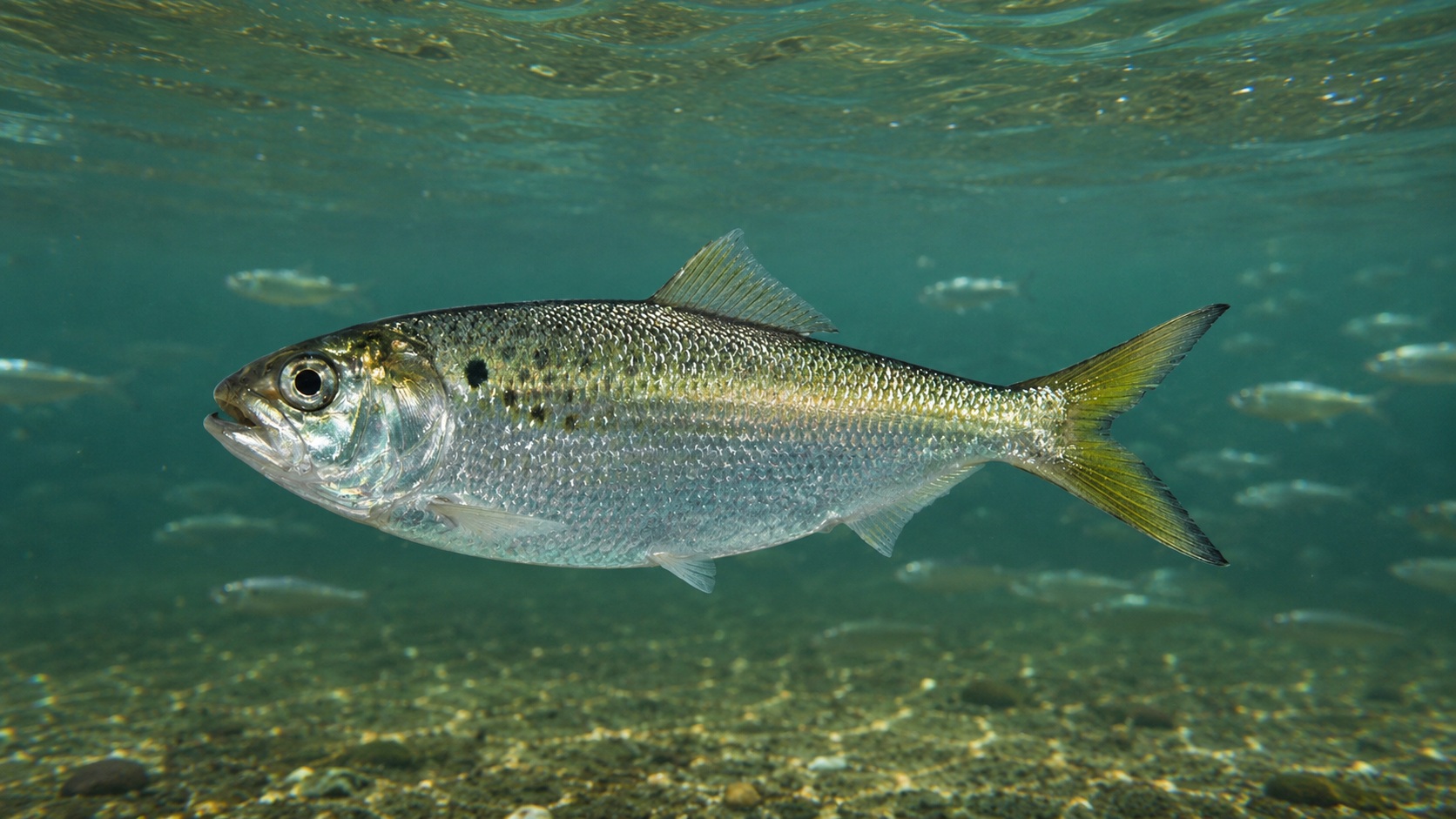
Menhaden are a herring-family fish with a deep, compressed body, a noticeably large head relative to body size, and a distinctly forked tail. The back is blue-green to olive, fading to silver-gold on the sides, with a brassy or yellowish tint that intensifies in larger adults. The belly is white to pale silver. The most reliable field mark is a single dark spot just behind the gill plate, usually surrounded by a loose scattering of smaller spots along the upper sides. The mouth is terminal and large for a filter feeder, with a notably upturned lower jaw.
Adults typically run 9 to 15 inches and weigh half a pound to a pound and a half. FishBase records maximum length at 50 cm (about 20 inches), though anything over 16 inches is genuinely large. In mixed-school settings, juveniles and sub-adults as small as 3 inches are common in late summer and fall. A “big” bunker in live bait terms is 10 to 12 inches; anything larger is called a “cow bunker” and is specifically prized for trophy striped bass. For how to snag, live-line, and chunk it, see our bunker bait guide.
Confusion species: Menhaden are most commonly confused with American Shad (Alosa sapidissima) and Hickory Shad (Alosa mediocris). The key differences are body depth and head proportion — menhaden have a noticeably bigger head and blunter snout than the shads. Alewife (Alosa pseudoharengus) is another look-alike but is slimmer, paler, and lacks the prominent dark shoulder spot. Gizzard Shad (Dorosoma cepedianum) appears in brackish and freshwater contexts but has a distinctive elongated dorsal ray that menhaden lack entirely.
How to catch your own
Catching your own live bunker is a skill that sets serious anglers apart. When you control your bait supply, you control your morning.
Finding schools: The most reliable bunker indicator is birds. Working terns and diving gannets over a patch of disturbed water almost always signal a bunker school below. On the surface, look for “nervous water” — a subtle dimpling or flickering across an otherwise calm patch, caused by thousands of fish moving just below the surface. In late spring and fall, schools often roll near the surface in calm conditions, visible as a dark mass slowly moving along. Gulls, osprey, and cormorants circling or diving are another tell. On the fishfinder, menhaden schools appear as dense, irregular clouds or large diffuse blobs in the upper water column.
Cast net: This is the primary method for most anglers. A 6- to 10-foot radius cast net with 3/8- to 1/2-inch mesh is the standard. Larger mesh (up to 5/8 inch) handles adult bunker more efficiently and allows smaller fish to escape. Approach the school slowly from upwind or upcurrent. Throw the net to lead the school slightly — menhaden do not school as tight as mullet, so aim for the densest visible surface activity. A good throw over a productive school can yield 10 to 30 fish in a single cast. Early morning is the most productive time, as menhaden are near the surface and active. They tend to sound (dive deeper) as the sun rises and water warms.
Snag rig (weighted treble): In situations where schools are visible but hard to net — from a dock, jetty, or when the school is just out of cast net range — a snag rig is the answer. Rig a 2/0 to 4/0 weighted treble hook on a 20- to 30-pound leader. Cast past the school, let the rig sink a few feet, and rip it back through the fish with sharp rod jerks. You are physically foul-hooking the fish, which is legal in most states for personal bait use (check your local regulations). Snag rigs are faster than Sabiki rigs in dense schools.
Sabiki rig: Effective when schools are tight to the surface and fish are small (juvenile fall run). A standard 6- to 8-hook Sabiki rig on light spinning gear — 10- to 15-pound braid with a fluorocarbon leader — works well. Drop into or cast over the school and use slow, rhythmic jigging. This method is gentler and results in fewer descaling injuries compared to snagging.
Seasonal timing: Spring is the main arrival — menhaden push northward from overwintering grounds off the Carolinas, typically appearing in Delaware Bay, Chesapeake Bay inlets, and Long Island Sound by late April or May. Fall brings southward migration from July through November, often with massive schools along open beaches. The best bait-catching windows are the first two hours after sunrise and the last hour before sunset.
Keeping them alive
Menhaden are notoriously fragile in captivity. They are high-metabolism, schooling fish that require exceptional water quality and oxygenation. Experienced bunker anglers will tell you: you catch them, you get them in the water fast, and you do everything right — or you have dead baits within an hour.
Livewell requirements: Continuous aeration is non-negotiable. A recirculating livewell with a dedicated aerator or oxygen-injection system is far superior to a standard livewell with a timer. Round livewells are preferred — menhaden school in circles and straight-walled rectangular wells cause fish to pile up in corners and suffocate. Water temperature matters: bunker survive best in cooler water. On hot summer days, add ice to the livewell water gradually to keep temps below 68 degrees Fahrenheit. Above 72 degrees, mortality accelerates sharply.
Stocking density: This is where most anglers kill their bait. A standard 30-gallon livewell should hold no more than 12 to 15 adult menhaden. Overcrowding drops oxygen levels within minutes. Scale up significantly for larger wells. Add fish in batches and watch behavior before adding more.
Signs of stress: Menhaden rolling at the surface (belly-up or swimming erratically), gasping, or slowing down indicates poor oxygen or temperature stress. A healthy bunker swims in a steady circular pattern and stays toward the bottom of the well. As soon as fish begin showing distress, start a water exchange with fresh, aerated water.
Survival time: Expect 2 to 4 hours of reliable livewell time under good conditions. On a cool fall morning with a well-oxygenated system, some anglers report keeping bunker alive for 6 to 8 hours. In summer, plan to make multiple bait runs.
Dead and dying fish: Do not discard them. Menhaden that die in the well have immediate cut bait value. Their high oil content makes them effective chunk bait even at low levels of freshness. You can also freeze them: wrap individually in plastic and freeze for future chunk fishing. Frozen bunker is one of the best striper baits available when fresh fish are not accessible.
How to rig it
Atlantic Menhaden is versatile. You can fish it live, fresh dead, or frozen, and multiple rigging styles each produce under different conditions.
Nose/lip hook (live bait): Run a 6/0 to 8/0 circle hook or live bait hook through the nose (top lip into the bottom lip) or through the cartilage just ahead of the nostrils. This allows the fish to swim naturally and is the standard presentation for drifting or slow-trolling. Use circle hooks — they dramatically improve hook-up rates on stripers and reduce gut hooking.
Dorsal/back hook (live bait): Thread the hook through the back just ahead of the dorsal fin, staying shallow to avoid the spine. This rigging lets the fish swim downward and outward, which works well when free-lining in current or fishing near the surface under birds. It creates more erratic action than a nose hook.
Tail hook: Used less commonly, but effective when fishing a bunker under a large float where you want the fish to face down in the water column. Hook placement just above the tail base. This position stresses the fish more than other placements and reduces swimming duration.
Under a float/cork: Rig a live bunker under a large egg float or balloon at a set depth — typically 3 to 6 feet off the surface. Effective around bridge pilings, inlet edges, and rock structure where you want to keep the bait out of snags. Balloon fishing is popular for bluefin tuna in canyon and nearshore trolling grounds.
Free-lined: No weight, no float — just hook and fish. Cast upcurrent of structure or near a pod of working fish and let the menhaden swim freely. This is the most natural presentation and the most effective when fish are actively feeding near the surface. Requires some slack in your line to allow the bait to move.
Chunking: Cut the fish into 2- to 3-inch cross-sections (chunks). Hook through the chunk once, leaving the point exposed. Drop to the bottom or let chunks drift in current. This is the dominant technique for trophy striped bass along the New Jersey and New York coastlines. Chunking with fresh or fresh-frozen bunker creates a strong oily scent slick that draws fish from a distance.
Butterfly cut: Fillet both sides of the fish connected at the tail, leaving the spine out. The butterfly cut produces a wide, fluttering presentation on the drift — popular for bluefish and stripers from party boats and surf.
Chum: Grind or dice menhaden into small pieces and mix with fish oil to create a chum slick. This technique draws fish from long distances and is standard practice on charter boats targeting striped bass, bluefish, and sharks along the Mid-Atlantic coast.
Hook size: For live rigging adult bunker, 6/0 to 8/0 circle hooks. For chunk fishing, 4/0 to 6/0 Octopus or J-hooks. For juvenile or small pogies, scale down to 2/0 to 4/0.
What it catches
Atlantic Menhaden functions as bait across a wider range of target species than almost any other Atlantic baitfish.
- Striped Bass - The primary use. Live bunker free-lined in current or chunked on the bottom is the dominant technique for trophy stripers in the Northeast, especially in New York Bight, Raritan Bay, Delaware Bay, and the Chesapeake Bay mouth. Big cow bunker (10 inches and up) specifically targets big (30-plus inch) stripers.
- Bluefish - Blues smash menhaden at the surface and on chunk. Free-lined live bunker near surface schools and butterfly-cut chunks drifted on the tide are both effective. Blues do not care about presentation subtleties.
- Weakfish (Spotted Sea Trout) - Live small or medium bunker on a light circle hook works well in back-bay and estuary water where weakfish stage in spring and fall.
- False Albacore (Little Tunny) - Albies key heavily on menhaden schools during fall migration. If you locate a school of bunker with albies crashing it from below and birds from above, a small chunk or a live finger mullet/juvenile bunker on a plain hook pitched into the melee will draw a strike.
- Bluefin Tuna - Chunking with menhaden and oily chum is the standard approach for bluefin in the New York Bight canyon grounds and nearshore troll lanes. Balloon-rigged live bunker is also used in nearshore tuna grounds when fish are feeding on surface schools.
- Cobia - Along the Mid-Atlantic and Chesapeake Bay region, live bunker fished near channel edges and buoys is a top cobia bait during summer migration.
- Sharks (Sandbar, Dusky, Mako) - Menhaden chunks and oily chum are standard shark fishing bait up and down the coast. The oil content and scent dispersion make it ideal for establishing a chum line.
On the Table
Menhaden have been commercially processed for fish oil, fish meal, and fertilizer for over 150 years — which tells you something about how they are regarded at the dinner table. The flesh is extremely oily, soft-textured, and strongly flavored. It bones out heavily with a complex rib structure. Most American anglers and sport fishers do not eat them, and there is no real recreational tradition of keeping bunker for personal consumption.
That said, menhaden are technically edible and are consumed in parts of the world where strong-flavored oily fish are more culturally common. Some older coastal communities pickled or smoked them, and the fish has historical significance as a protein and fertilizer source in early American agriculture (the Wampanoag famously showed colonists how to use them as crop fertilizer). The oil extracted from menhaden is used in dietary omega-3 supplements.
If you catch more than you need for bait, the best options are: chunk and freeze for future use, use as chum (grind or dice and keep frozen), or return them to the water. Do not waste them. In the ecosystem, a dead bunker returned to the water feeds crabs, eels, and the next round of predators. In your freezer, it is a versatile and highly effective chunk bait for your next striper session.