A note about links: If we include links to retail sites like Amazon or Bass Pro Shops, it's because they're relevant to the topic and, as anglers ourselves, we believe they're worth checking out. As an Amazon Associate we earn from qualifying purchases.
What it is
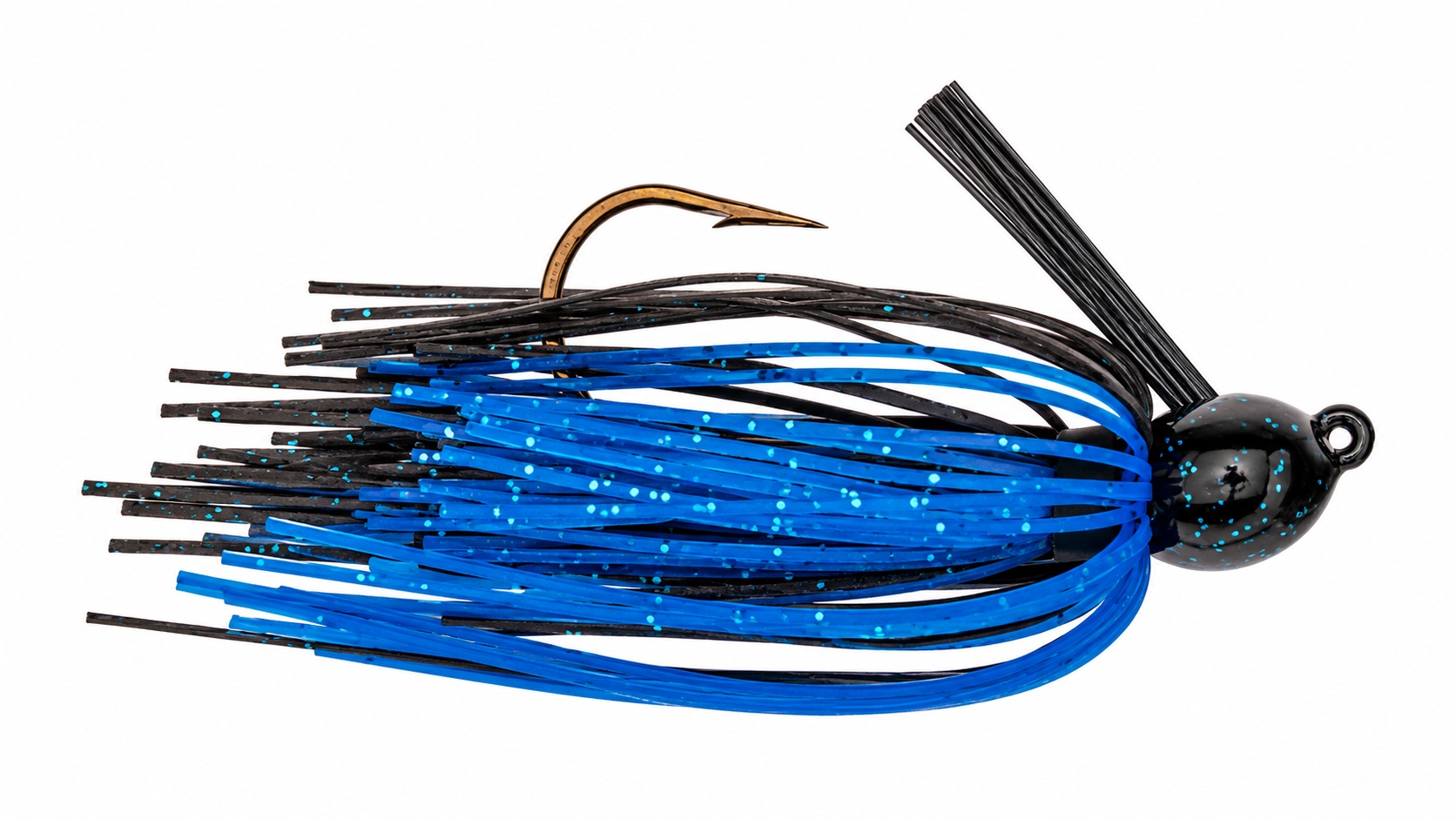
If there is one lure that tournament anglers consistently keep tied on regardless of season, it is the bass jig. A weighted head molded around the hook shank, a collar of silicone strands that pulses and breathes in the water, a weed guard of stiff wire bristles that deflects snags — and a soft plastic trailer that seals the deal. Put it all together and you have something that looks like a crawfish, a baitfish, or whatever a bass decides it wants to eat that day.
The bass jig earns its reputation through versatility. It goes places other lures cannot — into thick grass, under docks, through flooded brush — without hanging up on every piece of wood or stem it touches. That weed guard is not a compromise; it is the whole point. The bristles fold back on a strike but keep the hook protected during the approach.
There are four main styles, and each one has a specific job:
- Arkie jig (also called a flipping jig): The flat bottom and 60-degree line tie stand the jig upright on any surface. This is the workhorse — flip it to docks, pitch it into brush, swim it along the bottom. The all-purpose choice.
- Football jig: Wide, football-shaped head designed to balance upright on rocky or hard bottom and wobble in place under pressure. The dominant choice for dragging main-lake structure.
- Swim jig: Pointed or keel head with a trimmed skirt and a light weed guard, built for a horizontal swimming retrieve through grass, shallow cover, and flooded timber.
- Finesse jig: Smaller head (1/8 to 5/16 oz), smaller profile skirt, lighter wire hook. For clear water, finicky fish, and situations where the full-size jig draws short strikes or none at all.
The setup
The jig itself is the head, hook, skirt, and weed guard — it comes assembled. Your job is adding the trailer and making sure the hook is sharp.
Trailer selection is not optional. The trailer changes the profile, the fall rate, and the action of the whole presentation.
- Craw-style trailer (Zoom Super Chunk, Strike King Rage Craw): Best for flipping and pitching. The clacking claws add sound and bulk. A good imitation of a defensive crawfish.
- Swimbait trailer (Keitech Swing Impact, Z-Man DieZel MinnowZ): Best for swim jigs. The paddle tail kicks on the retrieve and keeps the lure swimming level.
- Chunk or grub trailer (Zoom Chunk, Berkeley Power Chunk): Compact and subtle. Works well on the football jig when dragging in cold water or pressured conditions.
Thread the trailer straight onto the jig hook or pin it to the hook collar using the skirt tie. Keep the trailer centered so the whole package falls straight and true.
Weight selection:
- 3/8 oz: Standard all-purpose weight for most cover and mid-depth situations
- 1/4 oz: Finesse, shallow water, slower fall in light cover
- 1/2 to 3/4 oz: Deep water (12+ feet), wind, thick grass, when you need to stay on the bottom
How to fish it
Flipping and pitching is the most classic application. Target dock pilings, laydowns, flooded brush piles, and matted grass. Flip or pitch the jig to the base of the cover, let it fall on a semi-slack line while watching for the line to jump or twitch (that is a bite on the fall), and if nothing happens, pop the rod tip once or twice to shake the jig in place. If still nothing, lift out and move to the next target. Most strikes come on the initial fall or the first shake.
Dragging deep structure is where the football jig dominates. Cast to the top of a main-lake point, let the jig sink to bottom, and drag it slowly down the slope — rod from 10 o’clock to 2 o’clock, then reel and reset. Feel for the bottom composition changing. The football head rolls and wobbles over rocks, and bass sitting on structure in 12—20 feet of water see that wobble from a distance. Pause longer when the bottom feels harder. Strikes often come as a heaviness or the line moving off to the side.
Swimming the swim jig works like a spinnerbait without the blade — steady retrieve just fast enough to keep the jig off the bottom and running through grass, over submerged wood, and along dock lines. Vary speed and add a brief pause to trigger following fish.
When to use it
The bass jig produces twelve months a year, but its peak windows are reliable:
Spring (pre-spawn and spawn): Flip staging areas and spawning flats. Bass are shallow and aggressive. A black/blue jig pitched into brush piles or dock shadows is a proven big-fish bait in March and April.
Summer (deep structure): When fish push to 12—20 foot main-lake structure, the football jig takes over. Drag it across rocky points, submerged humps, and channel edges during the hottest months.
Fall: Bass move shallow to chase bait. Swim jigs and arkie jigs through shoreline cover and grass edges match the forage.
Winter: Slow down. Drag a finesse jig or small football jig painfully slowly along the bottom. Cold-water bass will eat a jig when they will not touch faster presentations.
Color and weight quick-reference
| Condition | Color | Weight |
|---|---|---|
| Stained or dark water | Black/blue | 3/8 – 1/2 oz |
| Clear water, natural bottom | Green pumpkin | 3/8 oz |
| Rocky areas, crawfish forage | Brown/orange | 3/8 – 1/2 oz |
| Deep structure | Match bottom color | 1/2 – 3/4 oz |
| Finesse/clear water | Watermelon, green pumpkin | 1/4 – 5/16 oz |
Gear setup
Rod: 7’3” to 7’6” heavy power, fast action baitcasting rod. The heavy power drives the hook through the jig head and into the fish. Fast action provides sensitivity for detecting the strike and enough tip flex to load on the cast.
Line: 15—20 lb fluorocarbon for casting jigs and football jigs — the low stretch improves hookset force and bottom feel, and the low visibility matters in clear water. For flipping into thick cover, 50—65 lb braided line handles the hog-it-out hookset and abrasion against wood and rock.
Reel: Baitcasting reel in the 7.1:1 to 8.1:1 gear ratio. High speed helps you reel down and set the hook quickly when a fish picks up the jig and moves toward you.
Brands worth knowing
Strike King Tour Grade and Hack Attack jigs are among the most widely fished in tournament bass fishing — the Hack Attack is specifically built for heavy grass with a brush guard that does not compromise hookups.
Dirty Jigs (No-Jack and Tackle Industries line) have built a strong reputation for quality components and consistent falls, popular on the tournament trail.
Booyah Boo Jig and Buckeye Mop Jig are strong all-around choices at accessible price points with quality skirts and wire weed guards.
Z-Man ChatterBait and Projectile Jig line up well for finesse and swim jig applications, especially when paired with their ElaZtech trailers for a buoyant, slow-fall presentation.