A note about links: If we include links to retail sites like Amazon or Bass Pro Shops, it's because they're relevant to the topic and, as anglers ourselves, we believe they're worth checking out. As an Amazon Associate we earn from qualifying purchases.
Few moments in coastal fishing match the dead-weight thud of a barn-door halibut inhaling a swimbait you’ve been bouncing along the sand. California halibut are ambush specialists, buried to the eyes in the bottom of bays and surf zones from the Bay Area down through San Diego and into Baja, and they grow large enough to fill a cooler and strong enough to smoke a light spinning outfit. They’re not picky fish once you put a bait in front of them, which makes them a perfect target for beginners with modest gear and a willingness to work the bottom. The 67-pound 5-ounce all-tackle world record taken at Santa Rosa Island in 2011 gives you a sense of what’s out there lurking under the sand.
How to identify one
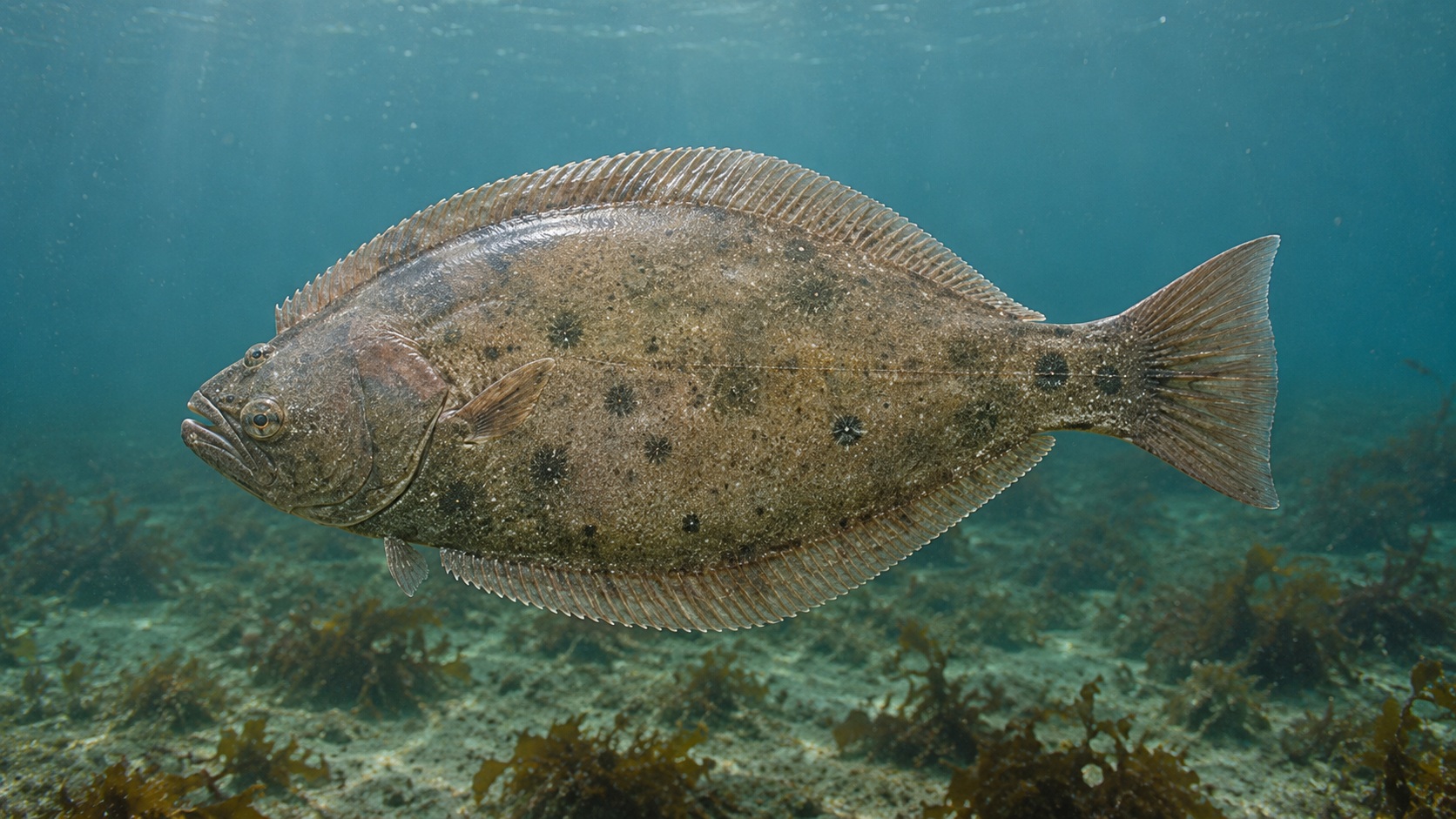
California halibut are flatfish with both eyes on the same side of the head, and unlike most flatfish species, they can be either left-eyed or right-eyed at roughly equal rates. The top (eyed) side is brownish to olive-gray, often mottled with lighter patches that shift to match the surrounding substrate. The blind side is white. The mouth is large and full of sharp teeth, extending well past the eye, which separates them from smaller halibut relatives. The lateral line has a distinctive high arch above the pectoral fin on the eyed side. The most common lookalike is the Pacific halibut (Hippoglossus stenolepis), but Pacific halibut are almost always right-eyed, grow considerably larger, and are found in colder water farther north. Starry flounder and other small flatfish share the same habitat but lack the large toothy mouth and the pronounced lateral line arch.
Where to find them
California halibut are a warmwater species and the core of their range runs from Bodega Bay south through the entire California coast and into northern Baja California. San Francisco Bay holds a solid population and supports productive fishing from shore and boat alike. In Southern California, Mission Bay and San Diego Bay are two of the most reliable spots on the coast, with fish present much of the year. The Santa Barbara Channel and the stretch from Ventura down through Dana Point and San Clemente consistently produce fish in the 5- to 15-pound range, and the Channel Islands are home to the biggest fish on record. Halibut favor sandy or muddy bottoms in water from a few feet deep to around 60 feet, and they set up along the edges of structure: kelp bed drop-offs, breakwaters, jetties, channel edges in bays, and the mouths of estuaries where tidal flow concentrates baitfish. In the surf zone, focus on sandy beach troughs and the calm water just inside breaking waves, especially in spring when fish move into the shallows to feed.
When to go
Spring through early summer is prime time, with May and June consistently producing the best numbers and the largest fish as halibut move into shallow water to feed aggressively before the heat of summer. Fish are accessible in shallow bays and the surf zone from March through September. Come October, most fish slide into deeper water (50 to 150 feet) and become harder to target without a boat. Tidal movement matters more than time of day: halibut feed most actively on a moving tide, either incoming or outgoing. Slack tide tends to slow the bite down significantly. Early morning and late afternoon on a moving tide in May or June is about as dialed-in as the timing gets.
What to throw
Live sardines and live anchovies are the top producers when fish are present and bait is available from local receivers. Pin them through the nose on a size 2/0 to 4/0 hook and fish them on a Carolina rig or three-way swivel rig, keeping the bait no more than a foot off the bottom. A stinger treble hook pinned lightly into the rear of the bait significantly reduces missed strikes from fish that slash at the tail. Live squid are deadly when available, fished the same way. For artificial presentations, a 4- to 5-inch paddle-tail swimbait on a 1/4- to 1-ounce ball-head jig is the workhorse setup. Z-Man SwimmerZ and Keitech Swing Impact in white, chartreuse, or natural anchovy colors on a 3/8-ounce jig head cover most situations. The key is keeping the lure ticking along the bottom with short hops and pauses; halibut rarely chase a bait running mid-column. Spoons such as a Krocodile or Kastmaster in 1/2 to 3/4 ounce worked with a slow lift-and-drop retrieve also produce, especially when drifting over sandy flats. Suspending jerkbaits like a Rapala X-Rap worked slowly along sandy edges can trigger strikes from fish that ignore bottom presentations.
Regulations
California halibut are managed by the California Department of Fish and Wildlife (CDFW). The statewide minimum size is 22 inches total length, and the daily bag and possession limit is 5 fish for most of the state (south of Point Sur, Monterey County). The season is open year-round. Note that regulations vary by region and are updated periodically; the central region north of Point Sur may have different rules, and marine protected area boundaries can affect where you may legally fish. Always confirm current rules before your trip at the CDFW official regulations page or by calling a local CDFW office.
Official regulations: https://wildlife.ca.gov/Fishing/Ocean/Regulations
Handling and release
California halibut have a functional mouth full of sharp teeth, so grip them firmly by the lower jaw or use a landing net and handle them horizontally to protect their spine. They are excellent table fish with firm, white, mild-flavored flesh and are widely considered one of the best-eating fish on the Pacific Coast. If you are releasing a fish, do it quickly: minimize air exposure, keep the fish in the water as much as possible during unhooking, and lower it back gently rather than tossing it. Halibut that have been fought to exhaustion should be held upright and moved slowly through the water to pass oxygenated water over the gills before release. Fish caught from depths greater than about 30 feet may show signs of barotrauma (bulging eyes, distended stomach), and venting or using a descender device to return them to depth improves survival rates significantly.
On the Table
California halibut is widely regarded as one of the best-eating fish on the Pacific Coast, and it is a primary reason anglers target this species with serious intent. The flesh is mild, sweet, and clean-tasting with none of the strong oceanic notes found in oilier fish. It is white to off-white in color, lean, and has a delicate flake that is firm enough to hold up on the grill but tender enough to fall apart beautifully when pan-fried. Compared to its larger cousin the Pacific halibut, California halibut has a slightly more delicate texture and an arguably sweeter flavor profile.
Taste and texture: Mild and subtly sweet with a clean, neutral finish. Flesh is white, lean, and finely flaked — firm enough for high-heat methods but delicate enough to benefit from gentle handling. Fat content is very low, which means it can dry out quickly if overcooked.
Best preparation methods:
- Pan-frying or sauteing: The low fat content and fine flake respond beautifully to a quick sear in butter or olive oil. A light dusting of flour helps develop a golden crust while protecting the delicate interior. This is arguably the most popular preparation.
- Grilling: Works well on a clean, well-oiled grate. The firm texture holds together over direct heat. Thicker fillets grill better than thin ones; using a grill basket reduces the chance of the fillet breaking apart.
- Fish tacos: California halibut is a natural fit for the Baja-style fish taco. Light battering or a simple flour coating followed by a quick fry yields crisp, white, mild fillets that pair perfectly with cabbage slaw and crema.
- Ceviche: The clean, sweet flavor and firm-when-raw texture make halibut an excellent candidate for ceviche. Dice fillets into small cubes and cure in citrus juice; the flesh firms up evenly and absorbs the acid and aromatics well without becoming mushy.
Handling for table quality: California halibut deteriorates quickly after death, so immediate icing is critical. Kill the fish promptly with a spike or sharp blow to the head, then place it directly on ice. Bleeding by cutting the gills helps remove blood from the flesh and improves flavor. Fillet as soon as practical and keep the fish cold throughout. The two large topside fillets and two smaller bottom fillets are easy to remove. Skin-off fillets are standard; the skin is edible but has a slightly stronger flavor that many prefer to remove.
Eating caveats: California halibut are subject to size and bag limits that vary by region and season. Check current California Department of Fish and Wildlife regulations before keeping any fish, as minimum size limits (typically 22 inches total length) and daily bag limits apply and are enforced.