A note about links: If we include links to retail sites like Amazon or Bass Pro Shops, it's because they're relevant to the topic and, as anglers ourselves, we believe they're worth checking out. As an Amazon Associate we earn from qualifying purchases.
There is a reason anglers call it the King. Chinook salmon grow to weights that buckle rods and test the arms of even experienced anglers, and the fight they put up in cold, fast water is unlike anything else in freshwater fishing. Landing a 30-pound king in a strong river current, with the fish running into the deepest slot it can find, is the kind of experience that reshapes what you think fishing can feel like. Whether you are trolling the open Pacific, plunking a tidal flat, or bouncing eggs along a gravel bar deep in the Cascades, the pursuit of Chinook demands that you bring your best setup and your full attention. No Pacific salmon species carries more weight, literally or culturally, in North American angling.
How to identify one
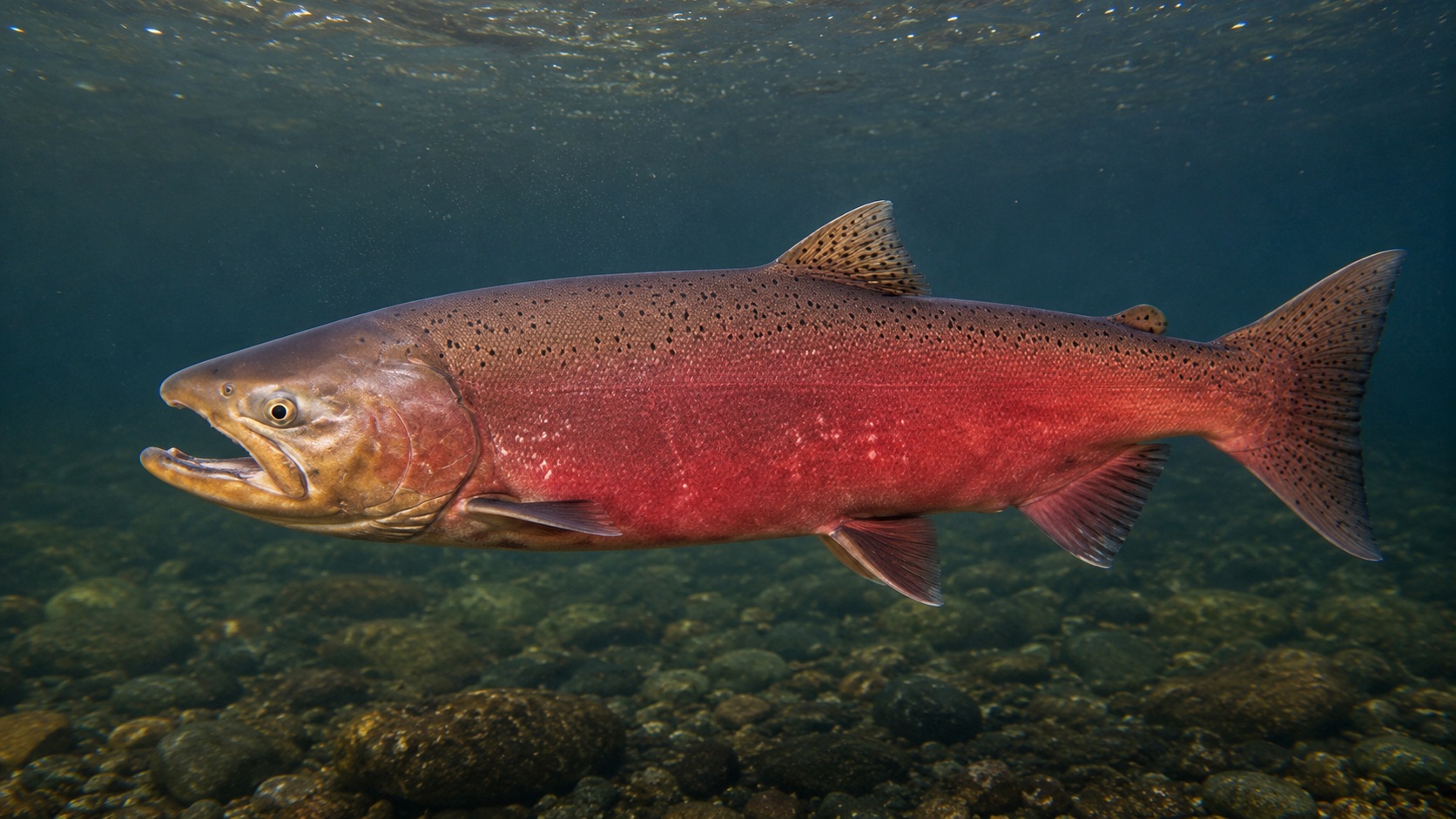
Chinook are built for power: a deep, laterally compressed body with a large, blunt head and a jaw that hooks noticeably on mature males. The back is blue-green to olive with irregular black spotting on both lobes of the tail and across the dorsal fin, which distinguishes them from coho, whose spots appear only on the upper tail lobe. The gum line at the base of the teeth is black, earning them the nickname “blackmouth” in Puget Sound fisheries. That black gum line is the quickest field check when you are trying to sort a Chinook from a coho in a mixed-species tidal area. In spawning condition, males turn deep red to purple with a pronounced kype, while females tend toward a duller olive-red. Ocean-bright fish are silvery with a greenish-blue back and look almost chrome-plated coming out of the water.
Where to find them
Chinook are the largest of the seven Pacific salmon species and require the biggest, deepest rivers to support their size. In the ocean, they hold along the continental shelf in cool, productive nearshore waters, typically at depths of 60 to 150 feet where baitfish concentrations are highest. Major Pacific coast ocean fisheries run from Monterey Bay, California, north through Oregon, Washington, and British Columbia, and throughout coastal Alaska. Named river systems that define the species include the Kenai, Yukon, and Kuskokwim in Alaska; the Columbia and Snake in the Pacific Northwest; the Sacramento in California; and the Rogue and Umpqua in Oregon. In the interior, spring-run fish make some of the longest freshwater migrations of any salmon, traveling hundreds of miles into the mountains before spawning in deep gravel runs with strong currents. In the Great Lakes, stocked populations give inland anglers access to trolling fisheries that produce fish in the 20 to 30-pound class regularly, with Lake Michigan and Lake Ontario being the most productive.
When to go
Timing depends entirely on which run and which fishery you are targeting. In Alaska, the Kenai River spring run peaks in late May through mid-June, with a second, larger run arriving in July. Pacific coast ocean fisheries generally open in April or May and run through September, with peak trolling periods in late spring and early summer as fish stage near river mouths before entering fresh water. In the Columbia River basin, spring Chinook move upstream from March through June, offering some of the most prized river fishing in the country. Fall-run fish, which tend to be heavier and more widely distributed, enter most systems from August through October. In the Great Lakes, July and August are peak months as fish congregate near tributary mouths. Tidal movement matters in estuaries: incoming tides push baitfish and salmon into river mouths, and the first couple hours of an incoming tide are consistently productive for fish staging at tidal boundaries.
What to throw
Trolling with plugs and herring is the most productive method across both ocean and river environments. In rivers, the standard approach is back-trolling: position the boat above a holding pool, then motor slowly backward downstream while Kwikfish, FlatFish, or Mag Lip plugs in sizes K14 to K16 work through the prime holding water. Wrap the belly of the plug with a sardine or herring fillet secured with Magic Thread for added scent. In murky water, go bright with chartreuse or orange. In clear water, use more natural finishes such as crawdad, natural herring, or chrome patterns.
Ocean trolling with downriggers allows you to target the 90 to 120-foot depth range where open-water Chinook hold. Run hoochie squid rigs, spoons such as Coyote or Kingfisher, or candlefish imitations like Coho Killer spoons behind a flasher or dodger. The flasher adds vibration and lateral movement that triggers reaction strikes at distance. Green, chartreuse, black, white, and pink are consistently productive colors across most Pacific fisheries.
Back-bouncing is the technique of choice for deep river pools. Anchor above the target zone, lower a Spin-N-Glo or Jensen Egg above a cluster of cured salmon eggs on an 18 to 24-inch leader, and let the rig bounce along the cobble bottom downstream as the current works it naturally through the slot. Adjust weight until you are ticking bottom without dragging. This is the same general technique that produced the world record on the Kenai.
Drift fishing with cured eggs or shrimp covers shallow to mid-depth runs. Cast upstream at a 30 to 45-degree angle and let the bait bounce along the bottom through the arc of the drift. Use just enough weight to maintain contact with bottom. Sand shrimp, cured king salmon eggs, and herring fillets are all proven producers. Chinook are highly scent-oriented, so fresh or properly cured bait outperforms old or freezer-burned offerings significantly.
Bobber fishing shines in the deep, slow tailouts and back eddies where fish rest between holding lies. Use a large float with enough buoyancy to support a 1 to 2-ounce weight, set depth so the cured egg cluster or shrimp drifts 6 to 12 inches above bottom. Watch for the float to pause, twitch, or suddenly dive sideways before committing to the hook-set.
Mooching (for ocean anglers without downriggers) involves drifting a banana sinker rig with a 4 to 8-foot fluorocarbon leader and double hooks rigged through a whole or plug-cut herring. Allow the boat to drift at current speed and lower the rig to the desired depth. The herring’s rolling, spiraling action does the work.
Regulations
Chinook salmon regulations are among the most complex in North American fishing. They vary by state, region, river system, run, and year, and they change frequently based on annual stock assessments conducted through the Pacific Fishery Management Council under NOAA Fisheries authority.
In Washington State, a general minimum size of 22 inches applies to many areas, and wild Chinook are often required to be released with retention limited to hatchery fish identified by a clipped adipose fin. Daily bag limits commonly run one to two fish. Seasonal closures and emergency rule changes are common and can affect specific river reaches with little advance notice.
In Oregon, similar 22-inch minimums and two-fish daily limits apply in many ocean areas, but river-specific rules vary substantially, and some rivers or reaches may be closed to protect ESA-listed wild stocks.
In Alaska, regulations differ by drainage and are managed through the Alaska Department of Fish and Game on a fishery-by-fishery basis.
Federal management under NOAA Fisheries applies to ocean fisheries in the Exclusive Economic Zone (3 to 200 miles offshore) along the West Coast. Nine West Coast Chinook populations are listed under the Endangered Species Act, and these listings affect where and when you can retain fish.
Always verify current rules before fishing. Regulations change annually and sometimes mid-season. Official sources:
- Washington: wdfw.wa.gov/fishing/regulations
- Oregon: myodfw.com/fishing/regulations
- Alaska: adfg.alaska.gov
- Federal/West Coast ocean: fisheries.noaa.gov/contact/pacific-fishery-management-council
Handling and release
Chinook are physically demanding fish to handle. A 20-pound fish is a genuine two-handed job, and anything over 30 pounds requires a cradle or a large rubberized net to land safely without injuring the fish or yourself. Keep the fish in the water as much as possible during the release process. Support the body horizontally rather than holding it vertically by the jaw, which can dislocate the lower jaw on large specimens. In cold river water, a briefly revived fish needs little more than a minute of support before swimming off under its own power. Avoid releasing fish into fast water directly; steer them toward a slack eddy where they can recover.
Chinook are outstanding table fish, widely regarded as the richest, highest-fat salmon available. Hatchery fish with a clipped adipose fin are legal to retain in most fisheries and are excellent for smoking, baking, or curing into lox. Bleed the fish immediately at the gills and get it on ice. The high fat content that makes them delicious also means they degrade quickly at warm temperatures.
On the Table
Chinook salmon are excellent eating fish and among the most prized of all Pacific salmon for the table, with rich, fatty flesh that holds up well to a wide range of cooking methods. Most anglers who target Chinook keep fish within legal limits specifically to eat them.
Taste and texture: Chinook have a distinctly rich, full-flavored profile with a slightly sweet finish — far more pronounced than coho or sockeye. The flesh ranges from pale pink to deep orange-red depending on diet and run origin, with a moist, moderately firm texture and a higher fat content than other salmon species. That fat content is the key to their table appeal: it keeps the fish moist under heat and carries flavor exceptionally well.
Best preparation methods:
- Grilling or planking: The high fat content prevents Chinook from drying out over direct heat, making grilling on a cedar plank one of the most popular and effective approaches. The fat bastes the flesh from within while the plank adds subtle smoke.
- Smoking: Few fish smoke as well as Chinook. The fat absorbs smoke flavor deeply and the flesh stays moist through the long, low-heat process. Both hot-smoking (for a flaked, cooked product) and cold-smoking (for a lox-style cured product) work exceptionally well.
- Pan-searing: A skin-on fillet seared skin-side down in a hot cast iron pan renders the fat and crisps the skin while leaving the interior just barely cooked through — a technique that highlights the natural richness without masking it.
- Sashimi and crudo: Fresh, sushi-grade Chinook from clean, cold water is a legitimate raw preparation. The fat content gives it a buttery texture that is prized in Japanese cuisine specifically as “king salmon” sashimi.
Handling for table quality: Chinook flesh degrades faster than leaner fish species because of the high fat content — fat oxidizes and goes rancid quickly without proper care. Bleed the fish immediately after landing by cutting the gill arches, then get it on ice as fast as possible. Avoid letting the fish sit in freshwater or warm bilge water. Fillet promptly, remove the bloodline (the dark strip along the lateral midline), and keep fillets cold and dry until cooking.
Eating caveats:
- Worm parasites: Chinook can carry anisakid nematodes (roundworms) in the flesh. Thorough cooking to an internal temperature of 145 degrees F eliminates the risk. For raw preparations (sashimi, gravlax), freeze the fish at -4 degrees F for at least 7 days beforehand to kill any parasites — a step that reputable fish markets perform as standard practice.
- Bag and size limits: Regulations vary significantly by river system, season, and hatchery vs. wild origin. Many coastal rivers have strict quotas or wild-fish release requirements. Check current state regulations before retaining any Chinook.