A note about links: If we include links to retail sites like Amazon or Bass Pro Shops, it's because they're relevant to the topic and, as anglers ourselves, we believe they're worth checking out. As an Amazon Associate we earn from qualifying purchases.
Few fish in freshwater deliver what a coho salmon delivers on a tight line: a white-water run, a full tail-walk clear of the surface, and a second gear you didn’t see coming. Silver salmon earn their nickname not just from their chrome-bright flanks but from the way they fight, fast and flashy and absolutely committed to getting away from you. Whether you’re drifting egg patterns down a mist-covered Pacific Northwest river in October, trolling hoochies off the Oregon coast in summer, or waiting on a Lake Michigan pier for the first dark shape to surge up a tributary, coho fishing carries a seasonal urgency that stops feeling like a hobby and starts feeling like a tradition. This is a species worth planning a trip around.
How to identify one
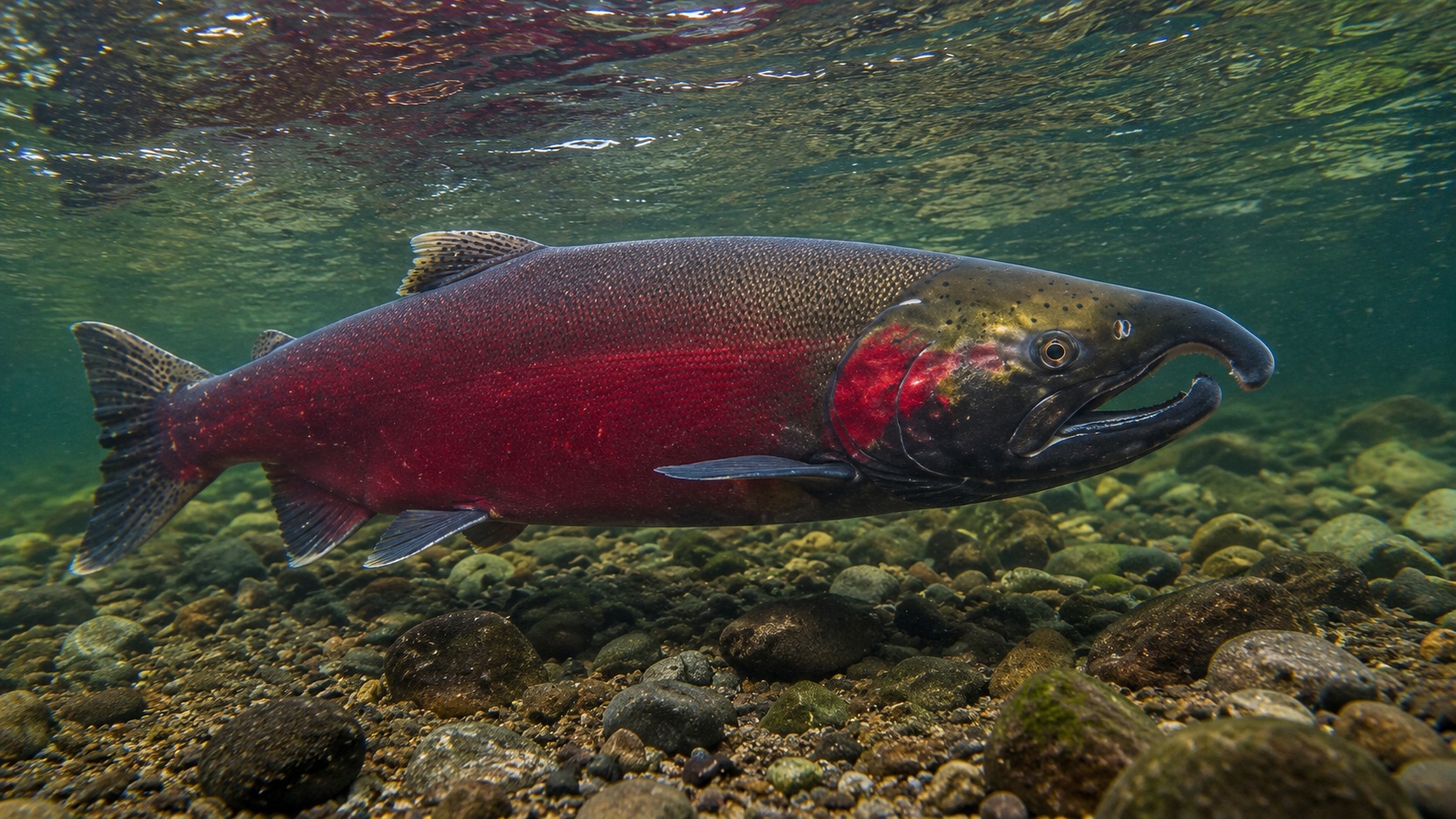
Ocean-fresh coho are unmistakable: metallic dark-blue or greenish backs, brilliant silver sides, and a white belly so clean it almost glows. Spots are visible on the back and the upper lobe of the tail only, not the lower lobe. The lower jaw (gum line) shows white or light gray at the base of the teeth, a field mark that separates coho from chinook, which show black gums. As fish enter freshwater and approach spawning, males develop hooked snouts (kypes), and both sexes shift toward brick-red or maroon flanks with a bluish-green head and back. River-run coho can look dramatically different from their ocean counterparts, but the light gum line and spotted upper tail remain reliable even in spawning colors. Chinook are the most common lookalike: chinook are substantially larger, have spots on both tail lobes, and show black gums throughout.
Where to find them
On the Pacific coast, coho range from Monterey Bay, California north through Oregon and Washington, along British Columbia, and throughout coastal Alaska to the Chukchi Sea. Prime coastal rivers include Oregon’s Rogue, Umpqua, Alsea, and Siuslaw systems, Washington’s Skagit, Snohomish, Quillayute, and the Puget Sound drainages, and Alaska’s Kenai Peninsula streams and Southeast panhandle rivers. In saltwater, coho are targeted in Puget Sound, the mouth of the Columbia River, and in the Pacific Ocean from three miles to beyond 20 miles offshore during the summer feeding season. Ocean fish concentrate around bait schools near temperature breaks and current edges, often holding surprisingly shallow at 6 to 12 feet below the surface.
In the Great Lakes, coho are a fully established introduced species across all five lakes and their tributaries. Lake Michigan draws the largest fishery, with the Pere Marquette, Manistee, Platte, and Betsie rivers in Michigan among the most celebrated fall run destinations. Wisconsin and Illinois Lake Michigan tributaries also receive strong runs. Great Lakes coho are stocking-supported in most systems, but the fishery is robust and well-managed across Michigan, Wisconsin, Indiana, Illinois, New York, and Pennsylvania.
When to go
The timing of coho runs is their defining characteristic as a target species: fall is the season. On the Pacific coast, ocean coho fishing peaks from July through September as fish stage and feed heavily before entering rivers. River runs begin as early as late August in Alaska and early September in the Pacific Northwest, with peak river fishing typically running September through November depending on latitude and specific system. The Salmon River in New York, home of the world record, sees its peak from late September through October. Great Lakes tributaries follow a similar fall arc, with most systems running hot from mid-September through November.
Water temperature drives coho behavior. Fresh ocean fish hit aggressively in cooler water, typically below 58 degrees Fahrenheit. Rising river flows after autumn rains trigger upstream movement and are worth monitoring closely. Low, clear water slows fish down and calls for a more finesse-oriented approach. Early morning and evening hours in clear conditions tend to outproduce midday.
What to throw
For ocean and Puget Sound trolling, hoochies are the most proven coho producer on the water. Use 2.5-inch and 4.75-inch sizes in pink, chartreuse, or white. Rig them with a hard head, a few beads, and a single hook, and tip the hook with a sliver of herring or anchovy. Run a small silver dodger on a 12 to 18-inch leader, or go without a flasher and let the spoon work on its own. Trolling spoons in watermelon, chrome, and glow patterns are equally effective and particularly forgiving for newer anglers. Troll at 3.5 to 6 mph, keep gear shallow at 6 to 12 feet unless fish are marking deeper on the sounder.
In rivers and Great Lakes tributaries, spinners are a top choice. Blue Fox Vibrax in size 4 or 5, or the Steelhead Slammer in brass, are workhorses on Pacific Northwest rivers. Fish them slowly through current seams, letting the blade pulse rather than racing through the run. Twitching jigs have become a go-to technique in many river systems: a 3/8 to 1/2-ounce marabou or rabbit-fur jig worked with an erratic lift-and-drop through a deep pool triggers reaction strikes from fish that won’t move for anything else. Plugs like the Yakima Bait Mag Lip in the 3.5 size work well back-trolled or drifted through holding water. Drift fishing with cured salmon roe under a float is the classic approach and remains deadly in most tributary systems. Use a 2 to 4-foot leader below a slip float and present the roe at holding-depth in slower current.
Color selection tracks water clarity closely: in clear conditions, use natural pinks, purple, black, and copper; in stained or turbid water, switch to chartreuse, orange, and hot pink.
Regulations
Coho salmon management is complex and governed by multiple agencies depending on where you fish. On the West Coast ocean fishery, the Pacific Fishery Management Council and NOAA Fisheries set annual harvest levels in federal waters (3 to 200 miles offshore), with state agencies implementing complementary rules inshore. Off Oregon, the minimum size for ocean coho is 16 inches, and gear is restricted to no more than two single-point barbless hooks per line. Annual bag limits and season dates change each year based on run forecasts.
In Washington state freshwaters and Puget Sound, WDFW manages coho regulations with daily salmon limits typically set at two fish, with restrictions on wild versus hatchery (marked) fish. The 2026-2027 season includes expanded non-mark-selective coho opportunity in Puget Sound marine areas. In the Great Lakes, each state manages its own regulations: Michigan allows up to 5 trout and salmon in combination including coho, with a 10-inch minimum in the Great Lakes. Several Pacific coast coho stocks carry ESA protections (threatened or endangered), which can restrict or close specific river fisheries. Always check current rules before you go.
Verify current regulations before fishing:
- Pacific coast and federal waters: Pacific Fishery Management Council
- Washington: WDFW Fishing Regulations
- Oregon: ODFW Oregon Sport Fishing Regulations
- Great Lakes states: consult your state DNR or fish and wildlife agency directly
Handling and release
Coho are excellent table fish: firm, orange-red flesh with moderate fat content and a clean flavor. Ocean-bright fish are prime eating, and quality is noticeably better the sooner fish are bled and iced after landing. A quick bleed at the gills followed by placement in an ice slurry yields noticeably superior meat. Coho freeze well vacuum-sealed and can hold quality for six to nine months at 0 degrees Fahrenheit.
For release, coho fight hard and can exhaust themselves, especially in warm water or after a prolonged battle. Keep the fish in the water as much as possible, support the body horizontally, avoid squeezing the sides, and do not hold fish vertically by the jaw. Minimize air exposure to under 30 seconds. In river situations, face the fish into the current and allow it to kick free under its own power before letting go. On a hot late-summer day when water temperatures are pushing 60 degrees Fahrenheit or above, a released coho faces real mortality risk, so check regulations for mandatory retention rules in some fisheries.
On the Table
Coho salmon is excellent table fare and one of the more sought-after Pacific salmon for the dinner plate, sitting just a step below king (chinook) salmon in richness but offering a cleaner, more versatile flavor that suits a wide range of cooking methods.
Taste and texture: Coho flesh is a medium to deep orange-pink, with a flavor that is moderately rich, mildly sweet, and far less oily than king salmon. The texture is firm yet finely grained, and it flakes cleanly without the heavy fat striations that can make chinook feel buttery to some and heavy to others. Ocean-bright coho caught in salt water or shortly after entering a river eat best; fish taken late in a spawning run develop softer, paler flesh and a noticeably earthier taste.
Best preparation methods:
- Grilling or broiling: The moderate fat content keeps coho moist over direct high heat without the flare-ups that come with fattier king salmon. A simple olive oil and herb rub lets the natural flavor come through.
- Smoking: Coho’s firm texture holds up beautifully in a smoker, producing a finished product that is less greasy than smoked king salmon. Both cold- and hot-smoking work well; brine-to-smoke ratio can be adjusted to taste.
- Pan-searing skin-on: The skin crisps well in a cast-iron or stainless pan, and a quick sear with a butter baste finishes the fillet without overcooking the center.
- Ceviche or crudo (fresh-caught, sushi-grade handling only): Ocean-caught coho with confirmed parasite-free handling can be used raw; the clean flavor holds up under citrus or light seasoning.
Handling for table quality: Coho quality drops faster than most people expect if the fish is not handled well. Bleed the fish immediately at the wrist of the tail, then place it in an ice slurry (ice plus a small amount of water) rather than dry ice alone, which can freeze-burn the flesh. Avoid letting the fish flop and bruise on deck. Fillet promptly, remove the pin bones with pliers, and trim the dark brown lateral line meat if you prefer a milder flavor — that strip carries a stronger, more pronounced taste.
Eating caveats: Worm parasites (anisakis nematodes) are present in wild Pacific salmon, including coho. Thorough cooking to an internal temperature of 145 degrees F eliminates the risk entirely. If preparing raw preparations (ceviche, crudo, gravlax), freeze the fish at -4 degrees F for at least 7 days beforehand to kill any larvae. Late-run or “dark” coho taken near or in spawning streams are safe to eat but noticeably inferior in flavor and texture; most anglers release these fish or use them for crab bait rather than the table.