A note about links: If we include links to retail sites like Amazon or Bass Pro Shops, it's because they're relevant to the topic and, as anglers ourselves, we believe they're worth checking out. As an Amazon Associate we earn from qualifying purchases.
Few fish command the kind of devotion that steelhead inspire. Anglers wake before dawn, stand chest-deep in icy December rivers, and cast for hours without a strike, then do it all again the next day because one pull from a chrome-bright steelhead justifies every frozen hand and skunked morning. These are sea-run rainbow trout that have spent one to three years in the Pacific Ocean or the Great Lakes, building the size and power that makes them the most sought-after river fish in North America. Whether you are swinging a wet fly through a summer-low pool on the Deschutes or drift-fishing roe through a blown-out winter run on the Hoh, steelhead fishing is as much a way of life as it is a technique.
How to identify one
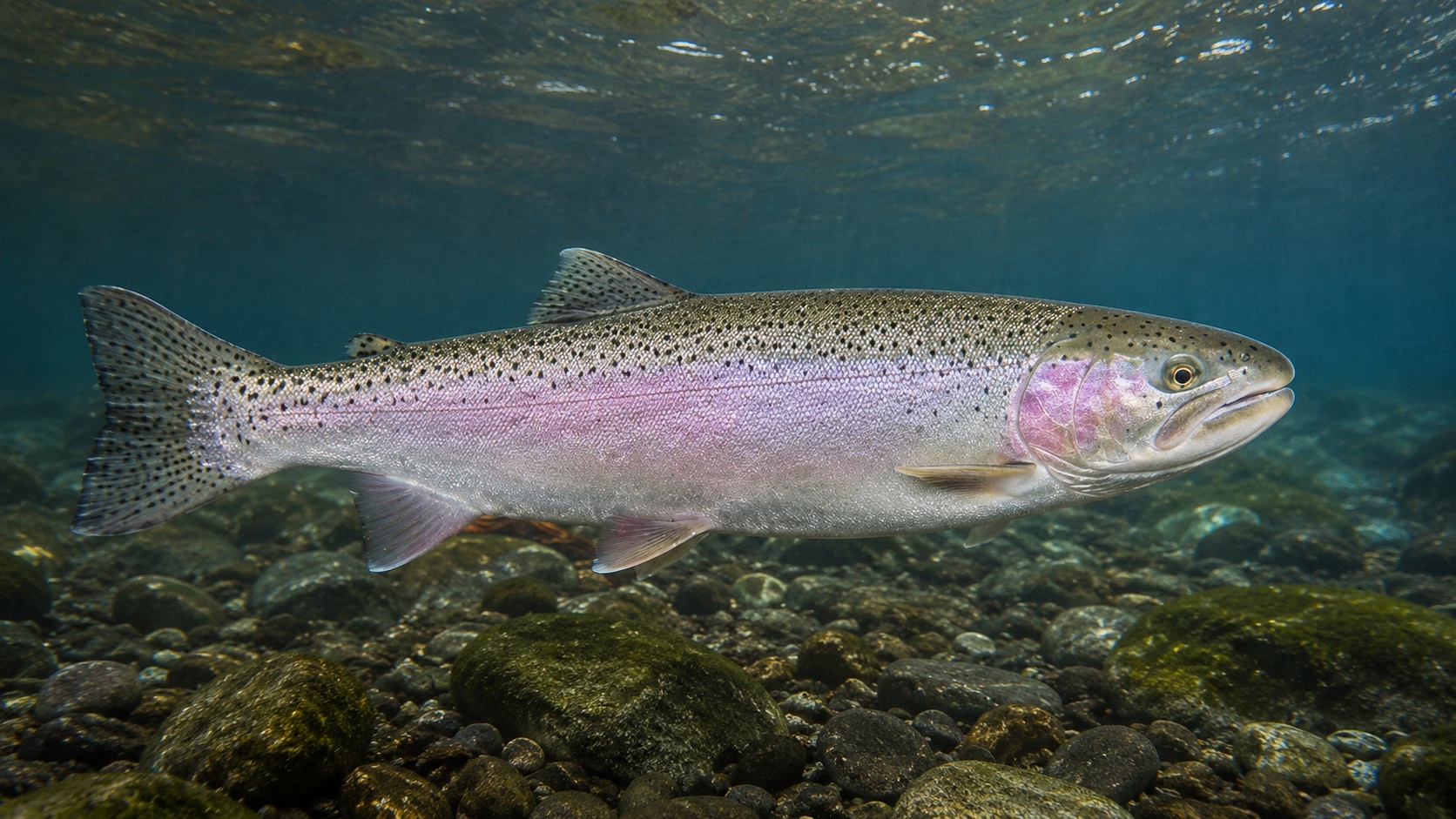
Fresh-run steelhead are unmistakable: bright silver flanks, a faint pink or magenta lateral stripe, and a body shaped like a torpedo. Fish that have been in the river for weeks begin to show more color, darkening toward the olive-green and red tones of a spawning rainbow trout. The adipose fin is intact on wild fish; hatchery fish have this small fin clipped as a mark. Steelhead are larger and more robust than resident rainbows, with a thicker caudal peduncle built for ocean life. Adults commonly run 24 to 36 inches and 5 to 15 pounds, with trophy fish pushing 20 pounds or more.
Where to find them
On the Pacific coast, premier steelhead water includes the Hoh, Sol Duc, and Quillayute systems on Washington’s Olympic Peninsula; the Rogue, Deschutes, Umpqua, and coastal streams like the Nestucca and Wilson in Oregon; and Trinity and Klamath tributaries in Northern California. Idaho’s Clearwater and its tributary the Selway draw anglers willing to drive deep into the Rockies for summer fish. In British Columbia, rivers like the Skeena, Bulkley, and Dean carry legendary status among fly anglers worldwide.
In the Great Lakes region, the Salmon River and Oswego River in New York, the Pere Marquette, Muskegon, and Manistee in Michigan, and the string of Lake Erie feeders from Cleveland to Buffalo known as Steelhead Alley all produce strong runs of fish. Great Lakes steelhead are non-native but fully established, running on similar instinct to their Pacific counterparts.
Look for steelhead in deep tailouts, along seams where fast and slow water meet, in long glassy runs just above riffles, and in the soft inside edges of bends. Moving fish hold briefly in deep pools and push upstream through the shallower tailouts. Winter fish in cold, colored water tend to hug the bottom in slower runs; summer fish in clear, low conditions hold in shadow lines, deeper slots, and the heads of pools.
When to go
Steelhead fishing has two primary seasons that overlap across their range. Summer runs enter Pacific rivers from roughly May through November, traveling hundreds of miles inland before spawning the following spring. These fish are leaner at entry, hold in rivers for months, and tend to be more aggressive on swung flies. The Deschutes, Grande Ronde, and Clearwater are the defining summer-run fisheries.
Winter runs enter rivers between November and March sexually mature and moving fast. Coastal Oregon and Washington rivers, including the Rogue, Hoh, and Humptulips, see their best action December through February. Winter fish are heavier and hit harder but often require more persistence and slower presentations.
In the Great Lakes, fall runs peak October through December as water temperatures drop into the optimal 45 to 58 degree Fahrenheit range. Spring runs and spawning activity carry action through March and April, and drop-back fish heading back toward the lake offer a final window into May.
What to throw
Drift fishing with roe or beads under a float is the most proven technique for winter steelhead, especially in high or colored water. Suspend a cluster of cured salmon eggs or a single 8 to 10 mm plastic bead in a natural color a foot or two off the bottom and let it drift through holding water at the speed of the current. Jigs under a float work the same presentation with less mess. Spinners and inline spinnerbaits excel when fish are actively moving. Pulling or side-drifting plugs from a drift boat covers water efficiently and puts the lure in front of resting fish.
For fly anglers, swinging wet flies and intruders on a two-handed rod through the tail of a run is the signature method on summer fish. Use a floating or intermediate tip in low clear water; drop down to a full sink tip and a large fly when water is cold or off-color. Winter fly anglers often use heavy sink tips, large articulated patterns in black, purple, or pink, and slow swings through deep inside seams. Indicator-and-nymph rigs work well when fish are holding deep and tight to structure. An 8.5 to 9.5 foot rod rated for 8 to 12 pound test, or a 12 to 15 foot two-handed rod for fly, are common choices.
Regulations
Steelhead regulations are among the most complex in freshwater fishing. Rules vary by river, by run (summer vs. winter), by fish origin (wild vs. hatchery), and by year, with emergency closures common when returns fall below escapement goals. Wild steelhead must be released in the vast majority of open rivers across Washington and Oregon. Hatchery fish, identified by a clipped adipose fin, may be retained where open seasons allow, typically with a daily limit of one to two hatchery fish.
Washington (WDFW): Coastal steelhead seasons generally run December through March, with specific dates, closures, and gear rules set river by river. Single-point barbless hooks are required in most rivers, and selective gear rules prohibiting bait apply on many systems. Emergency closures can cancel or shorten seasons with little notice when wild returns are poor. Check the current rules before each trip at wdfw.wa.gov/fishing/regulations or the Fish Washington app.
Oregon (ODFW): Winter steelhead seasons on coastal rivers typically run December through April; summer steelhead on eastern Oregon rivers runs through fall. A Combined Angling Tag is required in addition to a fishing license. The Columbia River Basin Endorsement applies to Columbia and Snake River tributaries. Current rules by zone are at myodfw.com.
Idaho (IDFG): Clearwater system seasons for hatchery steelhead open in late summer and run through winter; wild steelhead are catch-and-release only. Check idfg.idaho.gov for current rules.
Great Lakes (Michigan, New York, Ohio): Rules vary by tributary. Michigan recently reduced daily limits on the Pere Marquette, Muskegon, and other key rivers to one hatchery steelhead per day. New York applies Great Lakes and Tributaries Special Regulations to designated streams, including seasonal tackle restrictions and a prohibition on snagging. Check michigan.gov/dnr or dec.ny.gov for current tributary-specific rules.
Always verify current regulations directly with your state or provincial agency before fishing. Steelhead rules change frequently and the consequences of retaining a wild fish or fishing a closed stretch are serious.
Handling and release
Wild steelhead are a conservation priority across nearly their entire range, and proper handling matters. Keep the fish in the water as much as possible; a quick wet-hands photo is fine but extended air exposure is not. Do not grip a steelhead vertically by the lower jaw as you would a bass. Support the fish horizontally, one hand behind the pectoral fins and one near the tail. Use a rubber net or cradle for fish you plan to photograph. Barbless hooks are required on many rivers and make release significantly faster and less damaging. If a fish is sluggish, face it into the current and hold it gently until it kicks free on its own. In winter when water temperatures drop below 40 degrees Fahrenheit, fight times stress fish quickly, so use appropriate tackle to land fish without an extended battle.
On the Table
Steelhead is genuinely good eating — a step below the top-tier Pacific salmon species but well worth keeping where regulations allow, offering rich, flavorful flesh that rewards most cooking methods.
Taste and texture: Steelhead flesh ranges from pale pink to deep orange-pink depending on diet and run timing, with ocean-bright fish showing the richest color and flavor. The taste is mild-to-rich with a slightly sweet finish, closer to rainbow trout than Chinook salmon but with more fat than typical freshwater trout. Texture is firm and moderately flaky, holding together well during cooking without turning mushy.
Best preparation methods:
- Grilling: The moderate fat content keeps steelhead moist over direct heat without constant basting. Skin-on fillets work best; the skin crisps and holds the fillet together as it releases from the grate.
- Pan-searing: A hot cast-iron pan with butter or oil produces a golden crust on the flesh side while keeping the interior just translucent. The fat in the fish bastes from the inside, making overcooking difficult within reason.
- Smoking: Steelhead takes a brine-and-smoke preparation exceptionally well. The fat absorbs smoke flavor evenly, and a light apple or alder wood smoke complements the natural sweetness without overwhelming it.
- Baking en papillote (in parchment): The enclosed steam-bake method suits steelhead well when paired with citrus, herbs, and a splash of white wine; it preserves the delicate flavor of fresher, lighter-run fish.
Handling for table quality: Steelhead quality drops fast in warm water. Bleed the fish immediately by cutting the gill arch, then pack in ice or an ice slurry. Avoid letting the fish sit in meltwater — rinse and re-ice. Fillets are cleaner when the fish is cold; the pin bones run along the lateral line and pull easily with needle-nose pliers once identified.
Eating caveats:
- Legal status: Many wild steelhead runs in the Pacific Northwest and Great Lakes tributaries are classified as threatened under the Endangered Species Act. Regulations vary widely by river and run; in numerous waters, wild steelhead must be released immediately and only adipose-fin-clipped hatchery fish may be kept. Always check state regulations for the specific water you are fishing before keeping any steelhead.
- Worm parasites: Anadromous steelhead can harbor Anisakis roundworm larvae in the flesh. Cooking to an internal temperature of 145 degrees F kills the parasite completely. If preparing sashimi or cured preparations that do not reach that temperature, freeze the fish at -4 degrees F (-20 C) for at least 7 days to render the larvae nonviable before serving raw.