A note about links: If we include links to retail sites like Amazon or Bass Pro Shops, it's because they're relevant to the topic and, as anglers ourselves, we believe they're worth checking out. As an Amazon Associate we earn from qualifying purchases.
Picture yourself knee-deep in the Kenai River on a bright July morning, rod tip twitching as thousands of sockeye push upstream past your legs in a crimson parade. Few fishing experiences on the continent match a peak sockeye run for sheer visual spectacle and non-stop action. These are fish worth chasing: pound for pound they fight with a stubborn, bulldogging energy that surprises anyone who expects them to come in easy. And when the fight is over, the reward in the cooler rivals anything that swims in the ocean.
How to identify one
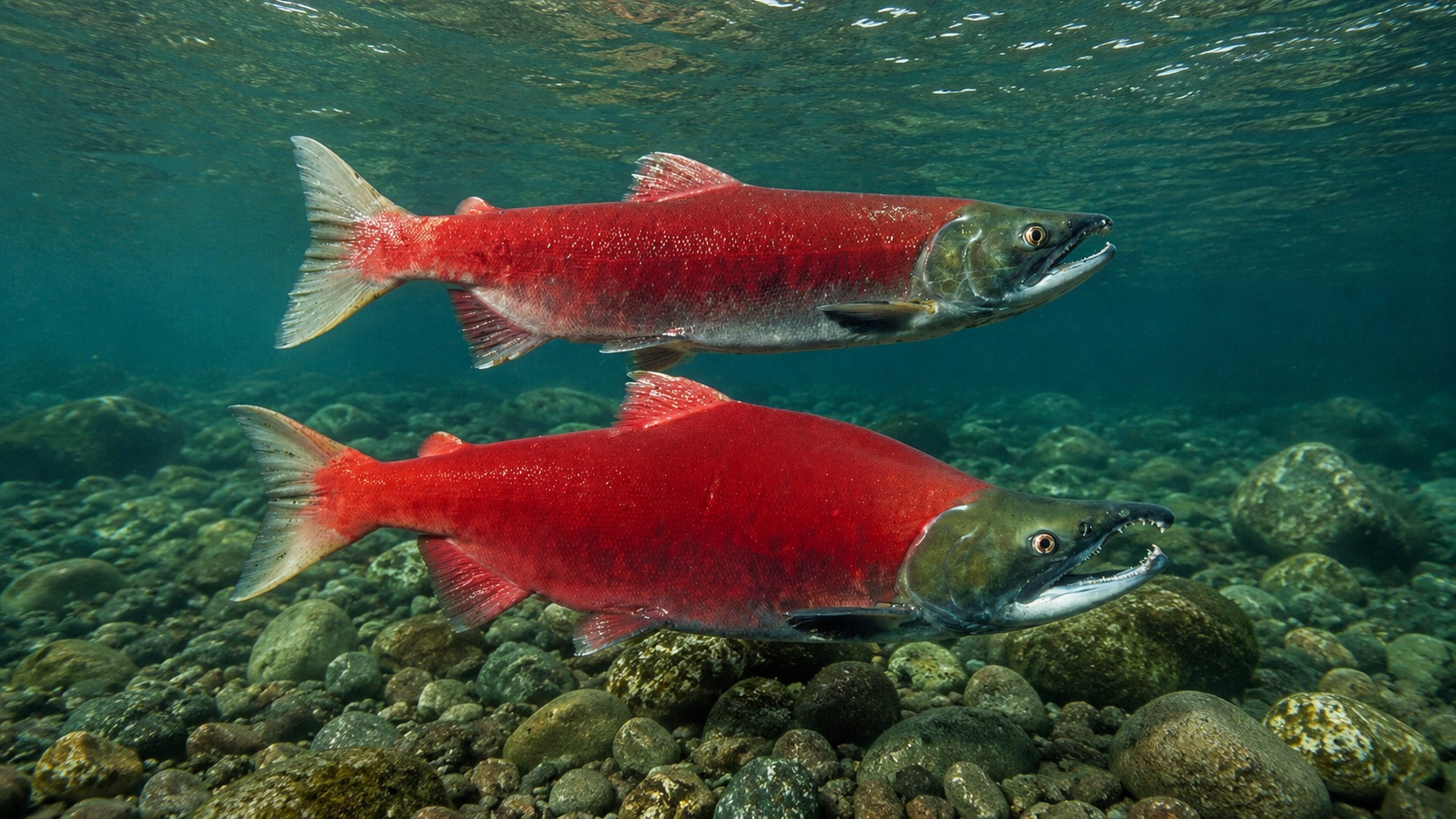
Ocean-fresh sockeye are sleek and silver with a metallic blue-green back, fine black speckling, and no large spots, which sets them apart immediately from chinook and coho. As they enter rivers and approach spawning, males transform dramatically: the body flushes deep crimson-red, the head turns olive-green, and breeding males develop a humped back and hooked jaw called a kype. Females show similar coloring but with less pronounced body changes. In freshwater, there is no mistaking a school of sockeye for any other salmon.
Where to find them
Alaska holds the beating heart of the sockeye fishery. The Kenai River on the Kenai Peninsula is world-famous for back-to-back runs that push millions of fish through a single corridor every summer. The Russian River, a tributary of the Kenai, hosts one of the most accessible fly-fishing-only sockeye fisheries in Alaska. Further out, the Naknek River near King Salmon and the rivers draining into Bristol Bay collectively support the largest sockeye run on the planet. The Copper River delivers some of the highest-fat, most prized sockeye in the commercial world, and sport anglers who time a trip there are rewarded accordingly.
In Washington state, Lake Wenatchee opens for sockeye when run strength allows, with fish accessible by trolling and casting from shore. The Okanogan River near Oroville sees sockeye pushing into the upper Columbia system through summer. In Oregon and Washington, the Columbia River between Astoria and Pasco opens for sockeye retention during the peak summer run when returns are sufficient, typically bracketing the Fourth of July holiday.
Sockeye rely heavily on lake-dominated river systems. Juvenile fish spend one to four years rearing in a nursery lake before migrating to sea, which is why finding a sockeye river usually means there is a lake somewhere upstream.
When to go
July is the core month across most of Alaska. The Kenai River sees two distinct runs: an early run peaking in late June and early July, and a larger second run that peaks from mid-July through mid-August. The Russian River runs June through August. Bristol Bay fisheries peak in late June and early July. In Washington, Lake Wenatchee typically opens in mid-to-late July when escapement goals are confirmed. Columbia River sockeye windows generally fall in late June and early July. Timing is everything with sockeye, and run forecasts from ADF&G and WDFW are published well ahead of season, so check them before booking a trip.
What to throw
The standard Kenai and Russian River technique is called flossing, and understanding it is the key to consistent success. Because sockeye stop actively feeding once they enter freshwater, anglers drift a weighted leader with a small, bright fly such as a Russian River pattern or a chartreuse or pink single-hook fly through the current. The goal is to let the line sweep downstream through the school, allowing the current to slide the line across the fish’s mouth until the hook finds the corner. When you feel contact, sweep the rod downstream toward the bank and keep the tip low.
A 7- to 9-weight fly rod in the 9- to 10-foot range paired with a smooth drag reel handles the job. Use a 15- to 25-pound fluorocarbon leader. Nail down two key positioning rules: stay close to shore because sockeye travel the shallow seams near the bank, and keep your rod tip down throughout the drift. Wading out too deep pushes fish off their travel lanes and kills your numbers.
In lake environments like Lake Wenatchee, trolling small spinners and spoons in pink, red, and chartreuse at slow speeds near river inflows and drop-offs is productive. Dipnetting with a legal net during personal-use seasons in Alaska is a separate and efficient harvest method available to Alaska residents on specific rivers.
Regulations
Regulations for sockeye salmon are highly location-specific and change in-season based on run strength. Always verify current rules before you go.
Alaska (Kenai River): The 2026 Southcentral Alaska Sport Fishing Regulations govern the Kenai River system. From the river mouth upstream to Skilak Lake, the bag limit from June 20 through August 15 is six sockeye per day with a 12-fish possession limit. Specific gear restrictions apply on the Russian River and other tributaries, including fly-fishing-only sections and single-hook requirements. Check current Emergency Orders at the ADF&G website at adfg.alaska.gov before each trip, as in-season adjustments are common.
Managing agency for Alaska: Alaska Department of Fish and Game, adfg.alaska.gov
Washington (Lake Wenatchee): When open, the daily limit is four sockeye with a 12-inch minimum size. Only artificial flies or lures with barbless single-point hooks are allowed, and bait is prohibited. The season and bag limits are confirmed each year based on run returns. Visit wdfw.wa.gov for the current regulation pamphlet and any emergency rule changes.
Washington/Oregon (Columbia River): Sockeye retention is allowed during authorized windows, typically late June to early July, with a daily adult salmon bag limit of two fish. The specific open areas extend from Astoria to the Highway 395 bridge at Pasco with certain closures near hatcheries. Check WDFW at wdfw.wa.gov and ODFW at myodfw.com for the current season schedule, as Columbia River salmon seasons are set jointly and adjusted in-season.
Handling and release
Sockeye are a retention fishery in most cases, so proper handling for harvest matters as much as live-release technique. If you are keeping fish, bleed them immediately in the water by cutting the gill arch, then get them on ice as fast as possible. The orange flesh that makes sockeye the most sought-after salmon for the table starts degrading quickly in warm conditions.
For catch-and-release situations or when you have reached your limit and are managing a foul-hooked fish, keep the fish in the water as much as possible. Use wet hands or a rubber-mesh net, remove the hook quickly with forceps, and point the fish upstream in moderate current until it kicks away on its own. Avoid squeezing the body, and never hold a sockeye vertically by the jaw. In a fast river run, a fish that drifts belly-up is done, so support it horizontally and give it time.
On the Table
Sockeye salmon rank among the finest eating fish in the Pacific Northwest and are actively sought by anglers specifically for the table. Their deep, rich flavor and striking red flesh make them a culinary standout even among salmon species.
Taste and texture: Sockeye have a bold, full salmon flavor — more pronounced than coho or king — with a natural richness that comes from their high oil content. The flesh is a vivid deep red-orange, firmer than Atlantic salmon, and holds together well under heat. The texture is dense yet flaky, with a satisfying bite that suits a wide range of cooking methods. That pronounced flavor is the signature of the species and exactly what fans prize about it.
Best preparation methods:
- Grilling: The high fat content bastes the flesh from within, preventing dryness and creating excellent char marks. Simple seasoning — salt, pepper, lemon — lets the natural flavor lead.
- Cedar plank roasting: A classic Pacific Northwest technique. The plank imparts subtle woody smoke while the fish steams gently, preserving moisture and highlighting the rich color.
- Hot smoking: Sockeye’s firm texture and oil content make it one of the best candidates for hot smoking. It holds its structure throughout the process and takes smoke flavor beautifully.
- Sashimi and crudo: Fresh, sushi-grade sockeye — particularly bright ocean-caught fish — has a clean richness that works well raw. Use only fish handled with strict cold-chain discipline if serving raw.
Handling for table quality: Sockeye flesh degrades faster than leaner fish. Bleed the fish immediately at the gill plate and submerge it in an ice slurry (ice plus water) within minutes of landing. Avoid letting the fish flop and bruise on a hot deck — bruised flesh turns soft and loses the vibrant color that makes sockeye visually and culinarily distinctive. Fillet and portion as soon as possible, keeping fillets skin-on until cooking to protect the flesh. For smoking or longer storage, vacuum sealing whole fillets extends freezer quality significantly.
Eating caveats: Wild sockeye — especially those caught late in spawning runs — undergo dramatic physical changes as they approach freshwater. River fish that have been in freshwater for an extended period develop the characteristic red body and hooked jaw, and their flesh loses the oil content and flavor quality of ocean-bright fish. Prioritize ocean-caught or early-run fish for the table. Farmed sockeye is rare; most commercial and sport-caught fish are wild Pacific stock, primarily from Alaska and British Columbia.