A note about links: If we include links to retail sites like Amazon or Bass Pro Shops, it's because they're relevant to the topic and, as anglers ourselves, we believe they're worth checking out. As an Amazon Associate we earn from qualifying purchases.
There is a moment on a salmon river that no amount of description quite prepares you for. The line tightens, the rod loads hard, and then a fish the color of chrome and sea-salt launches itself clear of the water not ten feet in front of you. Atlantic salmon have been doing this to anglers for centuries, which is exactly why people still book river beats in Scotland a year in advance, fly to Reykjavik for a week on the West Ranga, or rise before dawn on the Miramichi in New Brunswick chasing the same fish that once crowded rivers from Long Island Sound to Labrador. These are not easy fish. They enter fresh water and stop feeding, responding to flies through reflex or aggression rather than hunger, which means every take is a negotiation and every landed fish is something earned.
How to identify one
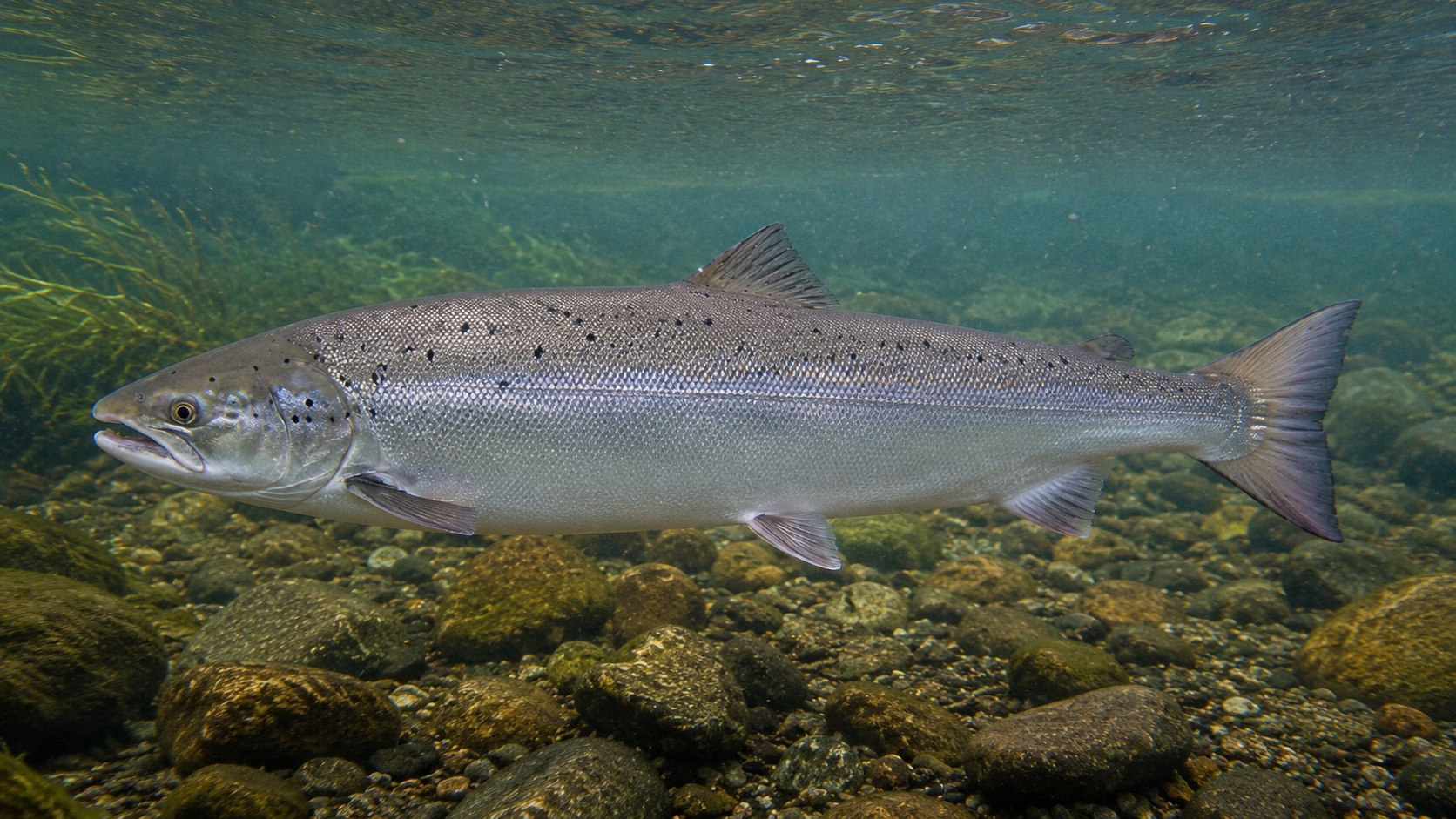
Sea-run Atlantic salmon arriving from the ocean are unmistakable: bright silver flanks, small black X-shaped spots scattered above the lateral line, a slightly forked tail, and a muscular, streamlined body built for distance travel. Fresh fish averaged between 8 and 15 pounds in most Canadian rivers, though double-digit fish are common and fish topping 20 pounds show up every season on premier beats. As fish spend time in fresh water they darken, males developing hooked lower jaws called kypes and taking on bronze-red coloring by fall. Landlocked Atlantic salmon (called “sebago salmon” in Maine) are a smaller, lake-adapted form of the same species, reaching 3 to 6 pounds in most waters. The key distinction from Atlantic salmon relatives is the X-spot pattern and the non-forked, squared tail that sets them apart from trout.
Where to find them
The center of accessible Atlantic salmon fishing in North America is the Miramichi River system in New Brunswick, Canada, considered the most productive and most accessible salmon river on the continent. The Miramichi drains roughly 20,000 square kilometers, and its main branch, Northwest Miramichi, and Southwest Miramichi offer hundreds of named pools that have held salmon for as long as records exist. The Restigouche River on the New Brunswick-Quebec border holds some of the largest Atlantic salmon in Canada. Quebec’s Grand Cascapedia and Matapedia rivers are legendary big-fish destinations, and Newfoundland’s Gander and Humber rivers offer excellent sport with more accessible access than the trophy Quebec beats. In Iceland, the West Ranga and the Laxa i Leirarvogi systems are world-class, with guides reporting anglers averaging four or five fish per day in peak season. Scotland’s rivers, including the Spey, Tay, Dee, and Tweed, are the birthplace of the double-handed rod and the Spey cast. In the United States, anadromous Atlantic salmon are critically endangered and found in only a few Maine rivers; fishing for them is prohibited.
When to go
In New Brunswick and Quebec, the salmon season opens April 15 and runs through mid-October, with the best fresh-fish action coming from June through August as summer runs push upriver. Fall fishing in September and October produces large, dark, pre-spawn fish. In Iceland, the peak season runs June through mid-September, with high summer bringing the best numbers. Scottish rivers peak in spring (April-May) and again in fall (September-October) depending on the system. Water temperature and flow are everything: salmon move most aggressively when rivers are at moderate height with temperatures between 50 and 65 degrees Fahrenheit. During warm spells, activity slows and fish seek cold-water refuges in deep pools.
What to throw
Atlantic salmon fishing is almost exclusively a fly fishing pursuit. Modern North American anglers favor sparsely dressed wet flies and tube flies fished on a floating or intermediate line with a long leader on a single or double-handed rod between 12 and 15 feet. Classic patterns like the Green Highlander, Blue Charm, and Rusty Rat have decades of proven production on Canadian rivers. Dry fly fishing with bombers and skaters is highly effective in low summer flows and low water, and many anglers consider a salmon taken on a waked surface fly the pinnacle of the sport. The smaller the fly on which you land a large salmon, the more prestigious the take, a tradition that gave rise to the “16/20 Club” for anglers who land a 20-pound fish on a size 16 hook. Spey casting, in which the angler uses a two-handed rod to sweep long casts across wide runs without backcast room, is the dominant technique on big water like the Miramichi and Restigouche, and mastering the cast is part of the education every salmon angler goes through. Non-resident anglers in New Brunswick are required by law to hire a licensed guide, which is a real advantage for newcomers learning to read salmon water for the first time.
Regulations
United States: Recreational and commercial fishing for wild Atlantic salmon is completely prohibited. The Gulf of Maine Distinct Population Segment is listed as endangered under the Endangered Species Act. It is illegal to fish for, catch, or retain Atlantic salmon in U.S. waters. Managing agency: NOAA Fisheries and U.S. Fish and Wildlife Service. Reference: https://www.fisheries.noaa.gov/species/atlantic-salmon/protected
Canada (New Brunswick): The season on the Miramichi and most New Brunswick rivers runs April 15 through October 15. All fishing must use a single barbless artificial fly. On the Miramichi and Restigouche rivers, anglers may catch and release up to 2 salmon per day during the main season (5 per day during the spring fishery April 15 to May 15). No retention of wild Atlantic salmon is permitted. Non-resident anglers must hire a licensed guide. A Warm Water Protocol applies when river temperatures exceed 22 degrees Celsius; anglers must stop fishing and avoid disturbing cold-water refuge pools. Managing agency: Fisheries and Oceans Canada (DFO), Gulf Region. Reference: https://www.glf.dfo-mpo.gc.ca/en/atlantic-salmon-recreational-fishing-gulf-region-2026
Canada (Nova Scotia): Most rivers are catch-and-release only with single barbless hook and fly-fishing-only rules. Nearly all Salmon Fishing Areas are closed to angling due to conservation concerns; only three rivers in SFA 19 (Cape Breton East) were open as of 2026. Managing agency: Fisheries and Oceans Canada, Maritimes Region.
Iceland and Scotland: Both countries allow salmon fishing under national licensing frameworks; individual rivers operate under beat licenses or lottery systems, many of which sell out a year or more in advance. Iceland’s season runs roughly May through September. Scottish rivers are governed by District Fishery Boards and the Scottish Government. Rules vary by river and season.
Handling and release
Atlantic salmon are a conservation priority everywhere they exist and deserve the most careful handling you can give them. Keep the fish in the water whenever possible. Use a rubber-mesh or knotless net if you net the fish at all; many experienced salmon anglers simply tail the fish by hand. Do not lift the fish horizontally out of the water by the tail for photos. If you must photograph the catch, cradle it horizontally with one hand under the belly and one near the tail, hold it just above the water surface, and return it within seconds. For revival, face the fish into current and hold it gently until it kicks free under its own power. During warm water conditions above 22 degrees Celsius, minimize fight time as much as possible and avoid fishing altogether if temperatures are critically high. On New Brunswick rivers, mandatory catch reporting forms are required and must be submitted at season’s end regardless of whether fish were caught. A fish that fights hard and swims away clean is worth more than any photo.
On the Table
Atlantic salmon is a respected table fish with rich, distinctly flavored flesh — though wild Atlantic salmon is now so rare and heavily regulated in most of its native range that nearly all fish encountered by anglers are either landlocked wild fish, hatchery-stocked fish, or escapees from aquaculture. Anglers who do keep legal fish are rewarded with one of the more flavorful salmonids available.
Taste and texture: The flesh ranges from pale pink to deep coral depending on diet and origin, with farmed and sea-run fish typically showing the richest color. The flavor is full and moderately rich — more pronounced than rainbow trout, with a buttery, slightly savory quality. The texture is firm yet yielding, with medium-sized flakes that hold together well during cooking. Fat content is high relative to most freshwater species, which contributes to both flavor and forgiveness on the grill.
Best preparation methods:
- Grilling or cedar-plank grilling: The high fat content bastes the flesh from within, preventing drying out over direct heat. Skin-on fillets hold together cleanly on the grate.
- Pan-searing: A hot cast-iron pan renders the skin crispy while leaving the interior just barely cooked through — a classic preparation that lets the natural flavor carry the dish with minimal seasoning.
- Cold smoking or hot smoking: Atlantic salmon’s fat content makes it ideal for smoking. Cold-smoked “lox-style” preparations and hot-smoked fillets both work extremely well.
- Baking or broiling: Simple preparations with lemon, dill, or a mustard glaze complement the fish without overwhelming its natural richness. Works well for larger fillets.
Handling for table quality: Atlantic salmon flesh degrades quickly once dead. Bleed the fish immediately at the gills after landing, then submerge in an ice slurry. Avoid letting the fish sit in plain water, which leaches flavor and waterlogs the flesh. Fillet as soon as practical, removing the skin before freezing if not cooking same-day. The pin bones run along the lateral line of each fillet and should be removed with pliers before cooking.
Eating caveats:
- Legal status is critical: Wild Atlantic salmon are listed under the Endangered Species Act in the US. Possession of wild-caught Atlantic salmon is prohibited in most US waters. Confirm local regulations before keeping any fish — hatchery fish in stocked waters may be legal to keep, but rules vary widely by state and water body.
- Worm parasites: Like most salmonids, Atlantic salmon can harbor anisakis roundworms. Thorough cooking to 145 degrees F eliminates the risk entirely. For any raw preparations, freeze at -4 degrees F for at least 7 days first.