A note about links: If we include links to retail sites like Amazon or Bass Pro Shops, it's because they're relevant to the topic and, as anglers ourselves, we believe they're worth checking out. As an Amazon Associate we earn from qualifying purchases.
Few fish inspire the kind of loyalty that yellow perch do. On a frozen February morning on Green Bay or Lake Erie, anglers drill holes before sunrise and settle in over 20 feet of water, jigging tiny teardrops until the sonar lights up with a school and the rod loads every cast for the next hour. During open water, drifting a worm-tipped jig along a Finger Lakes weedline or bouncing a small spoon off a Great Lakes reef produces the same frantic, keep-counting-your-fish pace. The reward at the end of the day is one of the finest-eating freshwater fish anywhere: sweet, white, firm fillets that need nothing more than a hot pan and a little butter.
Perch are a cultural institution across the Great Lakes states. Friday fish fries from Milwaukee to Cleveland to Buffalo are built on perch. Charter captains on Lake Erie’s Ohio and Michigan shores fill coolers for anglers who travel hours for the privilege. Ice fishing for perch on Green Bay, Lake Winnebago, and the Michigan shorelines is a full winter tradition — towns, festivals, and tackle shops organized entirely around the season.
How to identify one
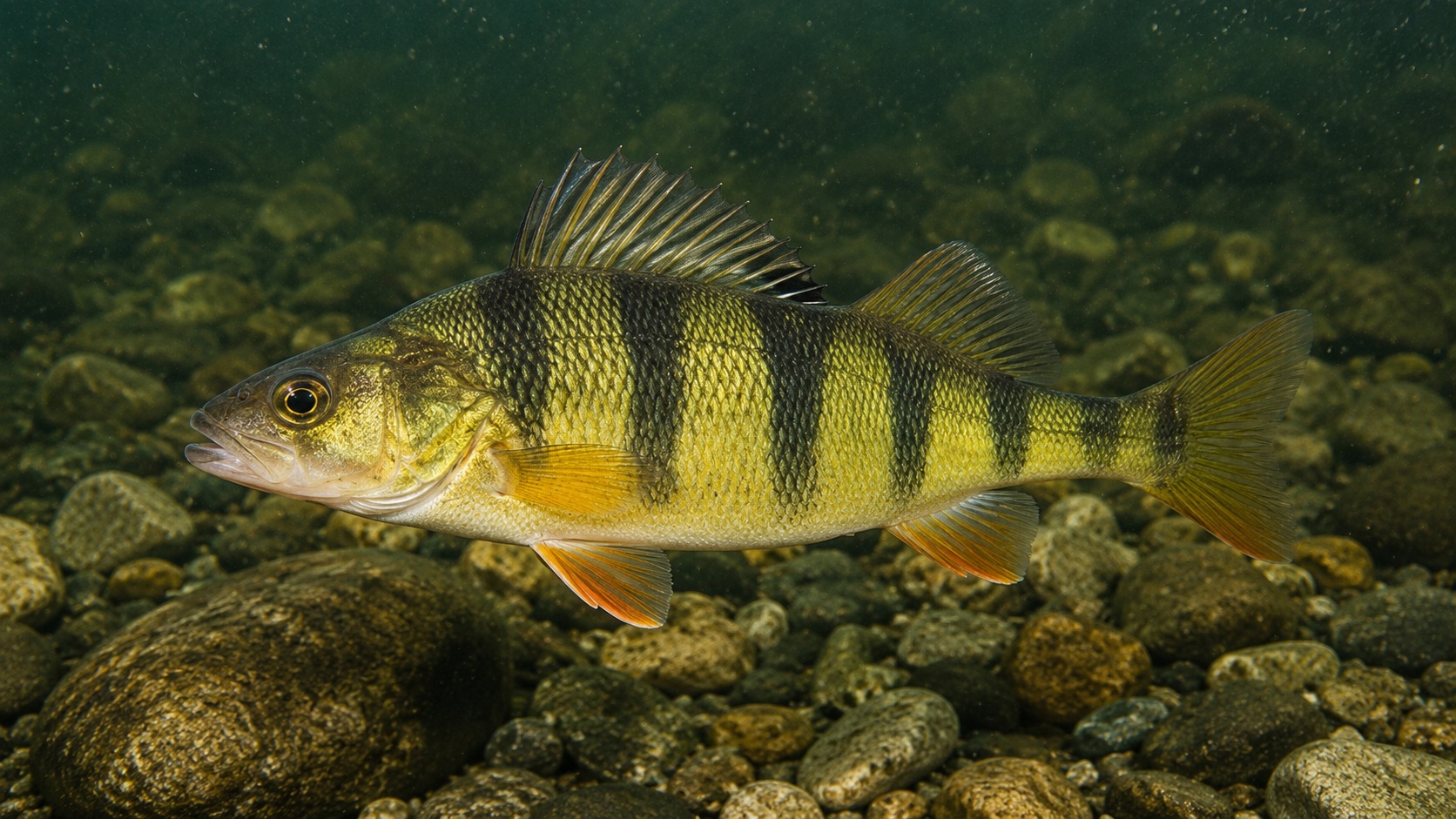
Yellow perch are hard to mistake. The body is golden-yellow to olive on the back, fading to a pale cream belly, and crossed by six to eight dark vertical bars that run from the dorsal fin down the sides. Two separate dorsal fins divide neatly, the forward one spiny and the rear one soft-rayed. The belly and lower fins often flush orange or red during spawning. Adults typically run 7 to 10 inches and weigh under a pound, though fish over 12 inches are prized on Great Lakes waters and the occasional 14-to-16-inch specimen exists in fertile, lightly pressured lakes.
Where to find them
Yellow perch are schooling fish with a strong preference for structure. In lakes, target the edges of weed beds, docks, submerged points, and rocky reefs at depths from 10 to 30 feet. Under the ice, they concentrate over harder bottom in 15 to 25 feet along the edges of basins, often stacked tight on the sonar. In rivers, look for them in slow pools and backwater flats rather than heavy current. Specific waters with outstanding perch populations include Lake Erie (especially the Ohio and Michigan shores), Green Bay on Lake Michigan, Oneida Lake in New York, Leech Lake and Lake of the Woods in Minnesota, and Lake Winnebago in Wisconsin. Perch school by size class, so when you start catching small fish, move your presentation to the outside perimeter of the school or drop a little deeper to find larger ones.
When to go
Yellow perch are among the few freshwater species that fish well in all four seasons, but winter and early spring are the standout windows. Ice fishing from January through March is prime time across the Great Lakes states, when perch school up tightly in predictable depths and bite aggressively through the ice. Spring, just after ice-out, is the next peak as perch run shallow to spawn and feed hard along weedlines and gravel shoals. Fall offers another strong bite as fish stack up in deeper water before ice-over. Summer fishing is productive early morning and at dusk when water temperatures are cooler, but midday summer action tends to slow compared to cold-weather seasons.
What to throw
Light tackle is the rule: a 6- to 7-foot light or ultralight rod with 4- to 6-pound monofilament or a 4-pound fluorocarbon leader on light braid. For ice fishing, a 24- to 36-inch ice rod in light action paired with 4-pound mono or fluorocarbon on a small spinning or inline reel is the standard setup. The most consistent ice presentations are teardrop jigs and small tungsten jigs in sizes 1/64 to 1/16 oz, tipped with a wax worm, spike, or small minnow head. Horizontally-oriented small spoons like a Swedish Pimple or small blade baits draw perch from a distance and trigger strikes by flutter and flash. For open water, a 1/8-oz jig tipped with a small minnow or piece of nightcrawler accounts for the majority of perch caught. Drift fishing with a live minnow under a slip bobber is an effective approach for covering structure along weed edges. Perch are not shy and will hit a wide variety of artificials, but live or cut bait is more consistent, especially when fish are finicky.
Regulations
There is no federal minimum size or bag limit for yellow perch. Rules are set entirely at the state and sometimes the individual-water level, and they vary considerably.
Michigan (Michigan DNR, 2026-2027): The statewide daily limit is 25 yellow perch with no size minimum and an open year-round season. Lake Erie is an exception with a higher limit of 50 per day. Lake Gogebic has a limit of 25 with a sub-rule of no more than 5 fish at or above 12 inches. Verify current rules at michigan.gov/dnr/fishing.
Wisconsin (Wisconsin DNR, 2026): Yellow perch are included in the statewide combined panfish daily bag limit of 25 fish total (combined with bluegill, crappie, and sunfish). Lake Michigan waters outside of Green Bay carry a more restrictive limit of 5 yellow perch per day. The season on Lake Michigan tributaries runs June 16 to April 30. Verify current rules at dnr.wisconsin.gov.
Minnesota (Minnesota DNR, 2026): The statewide daily and possession limit for yellow perch is 10. Mille Lacs Lake carries a reduced limit of 5 yellow perch per day (February 9 through November 30, 2026). Some waters have had emergency reductions in past seasons, so check the current year’s booklet at dnr.state.mn.us/fishing/regs.html before heading out.
New York (NYSDEC, effective April 1, 2026): Yellow perch may be taken all year statewide with no size minimum and a daily limit of 50. Special regulations apply to specific waters. Verify at dec.ny.gov.
Regulations are updated annually and water-specific rules can differ significantly from statewide defaults. Always check your state’s current regulation guide and confirm rules for your specific lake or river before fishing.
Handling and release
Yellow perch are commonly kept for the table and are well-suited for harvest within legal limits. If you choose to release fish, they are hardy and handle quickly with wet hands. Avoid holding them up vertically by the lip as the mouth is small and the jaw can stress, though perch are not as lip-hold sensitive as bass. Support the body horizontally for any photo. Because perch caught from deeper water (below 20 feet) can show signs of barotrauma with a distended swim bladder, releasing those fish to deeper water quickly gives them the best chance. Perch from shallow presentations release immediately and swim off without issue. Keeping a legal limit of perch for the table is a perfectly sound practice on productive fisheries, and most state agencies manage populations to support harvest.
On the Table
Yellow perch are one of the most prized freshwater table fish in North America, consistently ranked alongside walleye and crappie by anglers who fish specifically to eat. Their reputation as exceptional eating is well-earned and widely held across the Great Lakes region and the upper Midwest.
Taste and texture: The flesh is white, fine-grained, and very mildly sweet — closer to a lean saltwater fish than most freshwater species. It has virtually no muddy or grassy off-flavor, even in fish from warmer, weedy lakes. The texture is delicate but holds together well in the pan; fillets are thin, so they cook quickly and evenly without drying out.
Best preparation methods:
- Pan-frying with a light breading: The classic treatment, and for good reason. A cornmeal or seasoned flour dredge lets the mild, sweet flesh come through without overwhelming it. The thin fillets develop a crispy crust in just a few minutes per side.
- Beer batter frying: The sweetness of the fish pairs well with a crisp, lightly bitter beer batter. This is the preparation associated with traditional fish fries across Wisconsin and Michigan.
- Butter-basted sautee: Because the flesh is so clean and mild, a simple sautee in browned butter with lemon and fresh herbs showcases the flavor without masking it. This works best with larger perch where fillets have some substance.
- Ceviche or crudo: Perch from cold, clean water have a clean enough flavor profile to hold up in a citrus cure. This is a less traditional use but highlights the quality of fresh, well-handled fish.
Handling for table quality: Yellow perch are best eaten fresh — the delicate, flaky flesh deteriorates faster than denser species. Keep them alive on a stringer or in a livewell as long as possible, then kill and ice them immediately at the end of the trip. Don’t let them sit in warm water or a dry basket. Filleting is straightforward: the rib cage is small, the skin peels easily, and pin bones are minimal. Some anglers prefer to skin the fillets to remove any possibility of a fishy edge taste, though the skin is not strong-flavored.
Eating caveats: No ciguatera risk (freshwater species). Mercury levels in yellow perch are generally low given their small size and short lifespan; they are widely considered a safe, low-mercury option for regular consumption, including for children and pregnant women in most jurisdictions. Check local advisories for your specific water body, as some industrially impacted lakes carry contaminant warnings.