A note about links: If we include links to retail sites like Amazon or Bass Pro Shops, it's because they're relevant to the topic and, as anglers ourselves, we believe they're worth checking out. As an Amazon Associate we earn from qualifying purchases.
Ghost just inside a shadow line under a dock, study your offering with visible skepticism, then dart back to cover the instant something looks off — that is the mangrove snapper’s defining move, and it plays out the same whether you are fishing a North Carolina tidal creek, a Louisiana marsh canal, or a Texas jetty. This species combines the kind of wide availability that keeps beginners busy with the kind of finicky leader-shyness that keeps experienced anglers humble. They fight hard for their size, they are found from the Carolinas all the way through the Gulf to Texas, and they are among the finest table fish in their range.
How to identify one
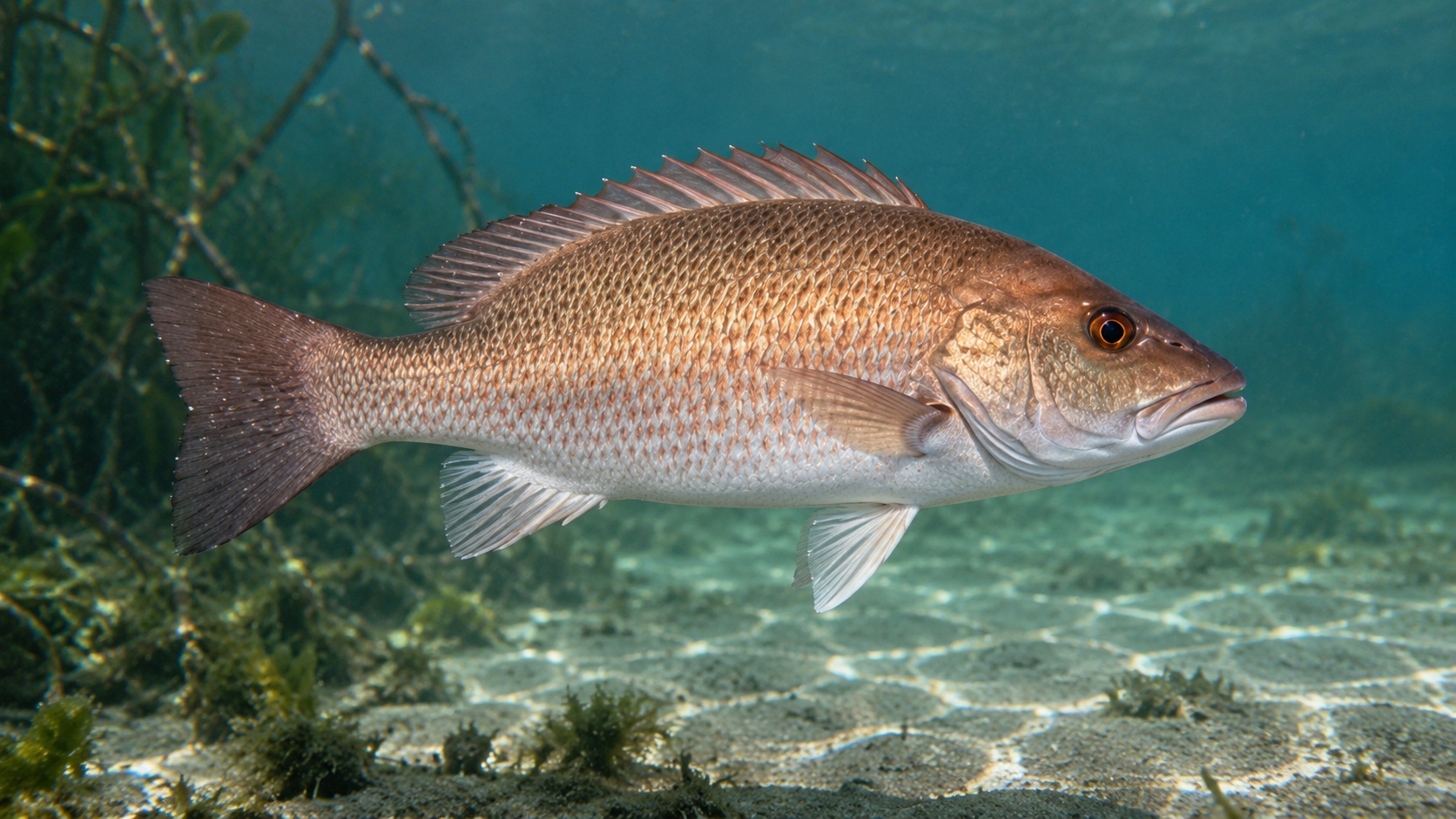
Mangrove snappers are a medium-sized, laterally compressed fish with a sloping profile, a pointed snout, and a large mouth armed with two prominent canine teeth in the upper jaw. The body color runs from gray to olive-green with a reddish or copper tinge, and the fins are darker than the body, often appearing brownish-red. A dark stripe running from the snout through the eye is visible on juveniles and helps with ID on smaller fish. Adults can look almost charcoal-black when sitting in deep shadow. The closest lookalike is the schoolmaster snapper, but schoolmasters show distinct yellow fins and clearer vertical banding. Cubera snapper share the canine-tooth feature but are far larger and found mostly in deeper water. In hand, the mangrove snapper feels stocky and solid for its length.
Where to find them
Few species in the southeast and Gulf Coast occupy as wide a range of structure as the mangrove snapper. Juveniles settle into seagrass beds and oyster bars. As they grow, they claim territory under docks, along seawalls, in the root tangles of red mangroves, and beneath bridges. Adults also move onto nearshore patch reefs, wrecks, and artificial reef systems, and larger fish are regularly taken on offshore ledges and hard bottom in 60 to 120 feet of water.
Along the Atlantic coast, mangrove snapper appear regularly from North Carolina southward through South Carolina and Georgia, becoming increasingly abundant in warmer months as water temperatures rise. The species is common throughout the South Atlantic Bight estuary system, where tidal creeks, bridge pilings, and nearshore ledges all hold fish. In the Gulf of Mexico, the Mississippi Delta marshes, the backwater bays of Louisiana, and the inshore structure of the Texas Gulf Coast from Corpus Christi to Galveston all hold reliable populations. The Florida Keys and backcountry mangrove systems are among the most productive fisheries for the species anywhere in the U.S., and the Everglades backcountry is justifiably legendary. Offshore, the species is taken on the Gulf’s artificial reef systems and on natural hard bottom throughout the South Atlantic.
The species tolerates brackish water and has been documented well up into tidal rivers. Fish found in fresh or low-salinity water tend to run smaller, but they are catchable on the same presentations used in full-salt environments.
When to go
Summer is the prime season across the species’ range. Spawning activity intensifies when water temperatures climb into the upper 70s to low 80s Fahrenheit, typically peaking during full moons from June through August. Fish feed aggressively in the weeks leading up to and following a full moon, and night fishing during this window can be exceptional regardless of location.
Timing shifts by latitude. In the Gulf Coast states and south Florida, mangrove snapper are available and cooperative for most of the year, slowing noticeably only when water temperatures drop below 60°F during winter cold fronts. Along the upper South Atlantic coast — the Carolinas and Georgia — the fishery is more seasonal, with fish moving inshore as waters warm in late spring and retreating to deeper offshore structure or moving south as temperatures fall in autumn.
Tidal movement matters more than time of day for dock and bridge fishing. The hour before and after the tide change, when baitfish get flushed through structure, consistently produces. For reef and offshore fish, early morning and late afternoon are the strongest windows, though low-light and nighttime fishing on nearshore reefs can deliver the largest specimens. Bridge anglers often do their best work well after dark, when snapper move out from under the bridge decking to feed in the tidal current.
What to throw
Live shrimp is the gold standard for mangrove snappers of all sizes. Hook a live shrimp through the horn or tail on a light wire hook (size 1 to 1/0) with enough weight to drift it naturally into structure. The presentation should look like a shrimp that has lost its way. Any tension or unnatural movement sends dock fish back to cover immediately.
Live pilchards and sardines are the preferred bait when fish are keyed on baitfish. Free-lined or lightly weighted on a 1/0 to 2/0 circle hook, a lively small baitfish drifted under a dock or alongside a mangrove edge will draw strikes from fish that won’t touch a shrimp.
Cut bait including pinfish, ladyfish chunks, and fresh squid works well on bridge pilings and reef structure. For bridge fishing, a small egg sinker above a barrel swivel with 12 to 18 inches of fluorocarbon leader and a 1/0 J-hook fished tight to the pilings is a proven rig.
Small jigs in the 1/4 to 1/2 oz range with paddle-tail soft plastics in white, chartreuse, or natural baitfish colors produce on nearshore reefs and during tide changes. A 3-inch paddle-tail grub or swimbait profile bounced along the bottom near structure is a reliable option.
The leader is not optional. Mangrove snappers are among the most leader-shy fish in their range. In clear water, step down to 15 to 20-pound fluorocarbon. In gin-clear conditions on shallow flats, 10 to 12-pound fluorocarbon will noticeably increase bites. Monofilament leader is serviceable but fluorocarbon’s lower visibility and abrasion resistance near barnacle-covered structure make it the better choice.
Regulations
Regulations for mangrove snapper vary by state and by whether you are fishing state or federal waters. Each coastal state from North Carolina through Texas sets its own minimum size limits, bag limits, and open seasons for state waters. Federal waters are managed by NOAA Fisheries through the Gulf of Mexico Fishery Management Council and the South Atlantic Fishery Management Council, and federal rules may differ from state rules.
Before every trip, check the current rules with your state fish and wildlife agency. Do not rely on memory or secondhand information — bag limits, size limits, and seasonal closures change. If you are fishing federal waters, verify current federal rules at fisheries.noaa.gov or through the relevant regional council.
Special regulations apply in National Park waters such as Biscayne National Park. If you are fishing near any marine protected area or sanctuary, verify those site-specific rules as well.
Handling and release
Mangrove snappers are robust fish that handle well. Wet your hands before touching any fish you intend to release, and avoid squeezing the body. A lip grip or a gloved hand works fine. If you are releasing a fish caught from depth on a reef, note that snapper brought up from more than 40 feet can suffer barotrauma. A release tool or weighted descender device will help the fish return to depth and survive.
For the table, mangrove snapper is outstanding. The flesh is white, firm, and mild with a slightly sweet flavor. Whole fish under 12 inches grill exceptionally well. Larger fillets are excellent pan-fried, blackened, or in a fish taco. Bleed fish immediately after harvest by cutting the gill arch, and keep them on ice for best flavor.
On the Table
Mangrove snapper is one of the most prized table fish in the snapper family, and anglers who catch them rarely need convincing to keep a few for the dinner table. The combination of mild, sweet flavor and versatile firm flesh makes them a consistent favorite from the Carolinas through the Gulf Coast and throughout the Caribbean.
Taste and texture: The flesh is white to pale pink, fine-grained, and moderately firm with a slightly sweet, clean flavor that sits on the milder end of the snapper spectrum. It lacks the pronounced richness of red snapper but has more character than a generic white fish, with a pleasant sweetness that holds up well to bold seasonings without being overwhelmed by them. Fat content is low, which keeps the flavor clean and the texture moist when properly cooked.
Best preparation methods: Pan-frying whole small mangrove snappers (10-14 inches) is a classic approach — the thin skin crisps beautifully and the bones make the fish easy to eat around. Blackening suits the firm flesh well because the texture holds together over high heat and the mild sweetness pairs naturally with Cajun spice profiles. Ceviche is an excellent option for fresh-caught fish: the clean, mild flesh cures evenly and absorbs citrus and aromatics without turning mushy. Grilling works best with larger fillets, ideally skin-on to protect against sticking and retain moisture over direct heat.
Handling for table quality: Mangrove snapper are delicate once out of the water and benefit from quick handling. Bleed the fish immediately by cutting the gills or the throat, then get them on ice promptly — warm flesh softens quickly and the flavor degrades within hours if not chilled. Skin the fillets only if needed for the recipe; skin-on fillets hold together better during cooking. The pin bones in larger fish should be pulled with pliers or trimmed out before serving.
Eating caveats: Mangrove snapper caught inshore and in shallow nearshore waters carry a low ciguatera risk, but fish taken from deeper reef structure — particularly larger specimens over 15 inches from tropical waters — carry a moderate risk consistent with other reef-dwelling snapper species. Ciguatera toxin is not destroyed by cooking and cannot be detected by smell or appearance. Anglers fishing in ciguatera-endemic zones (South Florida, the Keys, the Caribbean) should be aware that larger, older fish from known reef areas carry higher risk. Bag and size limits vary by state and federal waters; always check current regulations with your state agency or NOAA before keeping fish.