A note about links: If we include links to retail sites like Amazon or Bass Pro Shops, it's because they're relevant to the topic and, as anglers ourselves, we believe they're worth checking out. As an Amazon Associate we earn from qualifying purchases.
Few saltwater species command as much devotion, frustration, and pure angling satisfaction as the red snapper. Drop a bait anywhere near a rock pile or wreck in the Gulf of Mexico and these fish will find it. They pull hard, they show up in numbers, and they are among the finest eating fish in the ocean. The season is short and tightly managed under federal authority, which means every open day counts, and the anglers who put in the time to locate good structure get rewarded with some of the best bottom fishing the Gulf and South Atlantic have to offer.
How to identify one
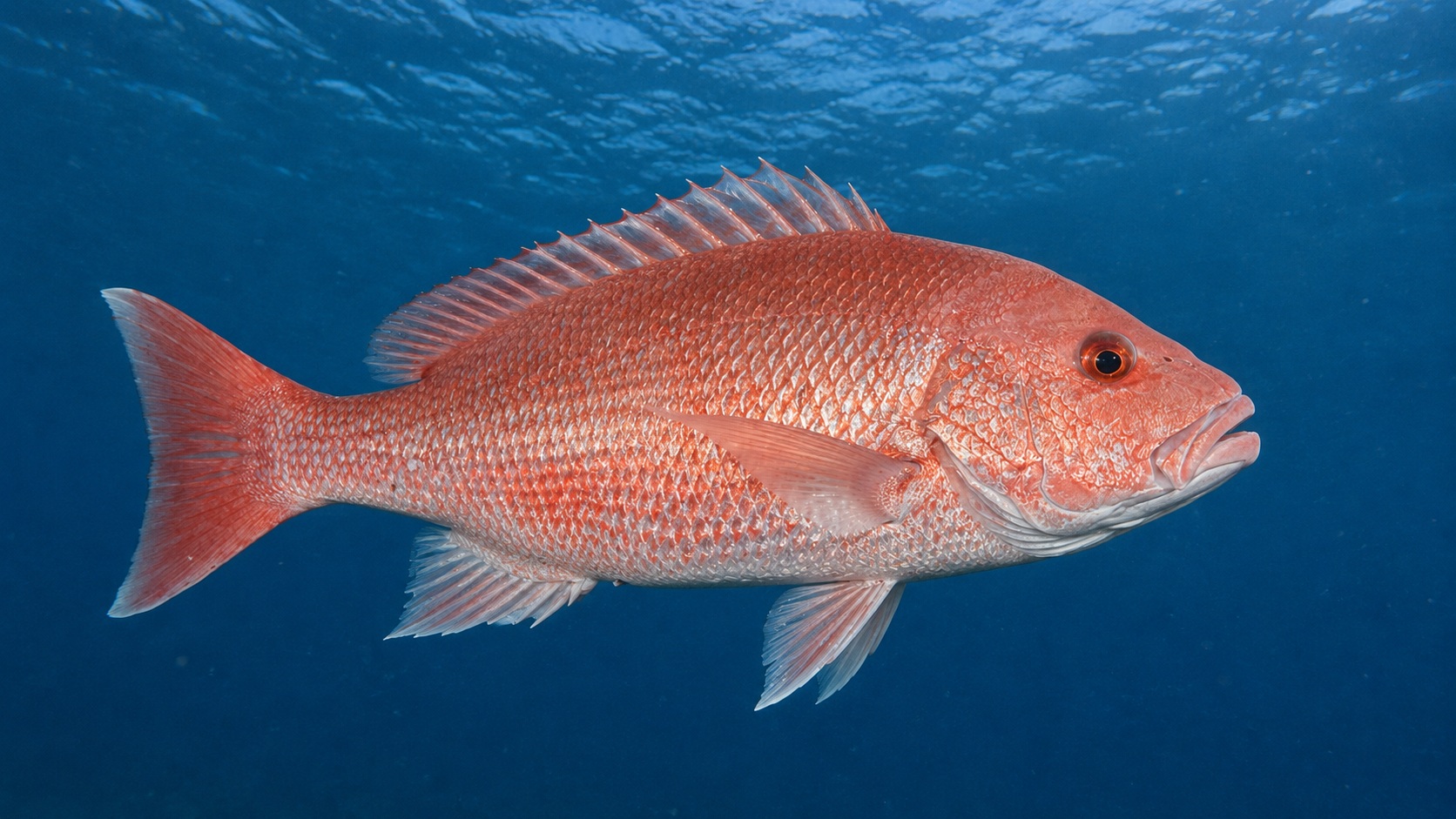
Red snapper are hard to mistake once you know what to look for. The body is a vivid pinkish-red on the back fading to a pale white belly, and the eye is distinctly red. The snout is triangular and pointed, more angular than most other snappers. Adults lack the dark lateral spot found on younger fish and on several lookalike species. The tail is lunate, meaning it has a noticeable fork, distinguishing it from lane snapper and mutton snapper at a glance. Vermilion snapper (beeliners) are the most common mix-up offshore: they are smaller, brighter red-orange, and have yellow streaks along the sides. On a federal trip, knowing the difference matters because only red snapper count toward your bag limit.
Where to find them
Red snapper live their adult lives on and around hard bottom: natural ledges, limestone outcroppings, rocky reefs, artificial reefs, shipwrecks, and offshore oil platforms. In the Gulf of Mexico they are most concentrated between 60 and 300 feet, though fish stack up on shallower artificial reefs in 30 to 80 feet of water, especially near structure placed by state reef programs.
The Gulf Coast states — Texas, Louisiana, Mississippi, Alabama, and Florida — all hold significant snapper populations, and each has developed extensive artificial reef networks that concentrate fish and bring them within reach of smaller boats. The oil platform infrastructure off Louisiana and Texas is particularly prolific, providing enormous amounts of hard structure in open water. The northern Gulf shelf off Alabama and Mississippi is well known for dense concentrations over artificial reefs, and Alabama’s reef program in particular draws anglers from across the region. Florida’s Panhandle from Pensacola to the Big Bend region offers consistent natural and artificial structure across a productive stretch of the Gulf shelf.
On the South Atlantic coast, red snapper are present but managed separately from Gulf stocks. Fish are found along rocky ledges and reef systems off the Carolinas, Georgia, and northeast Florida, generally in deeper water than their Gulf counterparts. Federal Atlantic red snapper regulations and season structure differ from the Gulf; check current NOAA guidance for Atlantic-specific rules before planning a trip on that coast.
When to go
Red snapper are most active when water temperatures are in the upper 60s to mid-70s°F and above, and fishing picks up across the range as waters warm through spring into summer. In the Gulf states, this typically means productive fishing from late spring through fall, with peak activity during the summer spawn from June through October — fish concentrate predictably on structure during this window, making them accessible and consistent.
Because seasons are federally managed and closely monitored, the calendar window varies year to year based on quota allocations. Federal for-hire and private-angling seasons in the Gulf are announced annually by NOAA and often open in late May or June. Some Gulf states negotiate additional state-water seasons under exempted fishing permits; these dates vary by state and year.
On the Atlantic coast, timing follows a similar pattern — warm-water months are most productive — but consult current NOAA and state agency announcements for open seasons, as federal Atlantic red snapper waters have historically had more restrictive access than the Gulf.
Within any open season, mornings and evenings tend to produce the best bite in shallower water; in deeper structure the bite is steadier throughout the day. Slack tide transitions are the most productive windows on any given day.
What to throw
Dead or cut bait is the foundation of red snapper fishing. Chunks of squid, cigar minnows, pogies, and cut bluefish all produce. Fresh bait consistently outperforms frozen. Drop directly to the bottom and come up a foot or two, letting the bait hang just off the structure.
Jigs are highly effective and sort out larger fish. Vertical jigs in the 2 to 6 oz range in white, chartreuse, or pink dropped to the bottom and worked with short sharp lifts draw vicious strikes. Diamond jigs and butterfly jigs both work. Brands like Williamson and Shimano Butterfly are proven choices.
Knocker rigs are the go-to bottom rig for bait fishing: a sliding egg sinker rides directly against the hook, eliminating drop-back slack and producing solid hooksets. Use a 3/0 to 6/0 circle hook in heavier fluorocarbon leader (40 to 80 lb) for clean releases on undersized fish.
Soft plastics rigged on heavy jig heads (2 to 4 oz) in white or pink are growing in popularity and are particularly effective for sorting quality fish out of schooling fish. The Hogy Pro Tail paddle tail and similar swimbaits rigged on a 3/4 to 1 oz head fished slowly off bottom produce consistent strikes in shallower reef water.
Heavier rod and reel setups handle the depth and current: a 6.5 to 7.5 foot medium-heavy conventional rod paired with a 30 to 50 class reel and 50 to 65 lb braid is the standard. The terminal leader should be 40 to 80 lb fluorocarbon depending on depth and water clarity.
Regulations
Red snapper are managed primarily by NOAA Fisheries under the Gulf of Mexico and South Atlantic Fishery Management Councils. Federal regulations govern season dates, bag limits, and minimum size in federal waters, and these are announced annually based on stock assessments and quota monitoring. State waters regulations vary by state and may differ from federal rules.
Key points that apply broadly:
- A federal minimum size of 16 inches total length applies in Gulf federal waters; Atlantic federal waters have separate rules
- Bag limits in Gulf federal waters are typically 2 fish per person per day, but verify current annual announcements from NOAA
- For-hire (charter and headboat) vessels operating under federal permits follow separate season and bag limit rules from private recreational anglers
- Several Gulf states negotiate state-water seasons that may extend beyond the federal window; these vary year to year
What to check before you go:
- NOAA Fisheries (fisheries.noaa.gov/species/red-snapper) for current federal Gulf and Atlantic seasons, bag limits, and size rules
- Your state fish and wildlife agency for state-water regulations, which may differ from federal rules in your zone
- Regulations can change mid-season based on quota monitoring, so verify close to your trip date
Descender devices are required equipment for snapper-grouper species in the South Atlantic federal management zone and are strongly recommended throughout the Gulf; carry one on every offshore trip.
Handling and release
Red snapper are susceptible to barotrauma when brought up from depth, a condition where expanding gases in the swim bladder cause the fish to float helplessly at the surface. Descender devices are mandatory for snapper-grouper species in the South Atlantic and are strongly recommended in the Gulf. A weighted clip descender or inverted-hook release tool gets the fish back down quickly and dramatically improves survival rates. Use a lip gripper or wet hands to handle the fish; avoid squeezing the body. For fish that are being kept, a swift ike jime spike through the brain behind the eye produces the highest quality meat. Red snapper are exceptional table fish, widely considered the benchmark for Gulf bottom fish, with firm white flesh that holds up well to grilling, broiling, and pan searing.
On the Table
Red snapper is one of the most prized table fish in the Gulf of Mexico and Atlantic waters, widely sought for its clean, sweet flavor and firm white flesh. Anglers keep it eagerly when regulations allow, and it commands premium prices at restaurants for good reason.
Taste and texture: The flesh is white to pale pink, firm yet moist, with a mild, slightly sweet flavor and just enough richness to stand up to bold seasoning. It is not fishy or gamey. The texture is dense enough to hold together on a grill but flaky enough to eat cleanly off the bone. Fillets have a moderate fat content that keeps them forgiving during cooking.
Best preparation methods:
- Whole roasted or baked: Red snapper’s firm skin crisps beautifully and the bone-in presentation retains moisture. Stuffing the cavity with herbs and citrus before roasting at high heat is a classic Gulf Coast approach.
- Blackening: The mild, sweet flesh contrasts perfectly with a heavy Cajun spice crust seared in a screaming-hot cast iron pan. The fat content prevents the fillet from drying out under aggressive heat.
- Grilling: Thick fillets or a butterflied whole fish hold together well over direct flame. The skin acts as a natural barrier; cook skin-side down most of the way to prevent sticking and falling apart.
- Ceviche or light pan-searing: The clean, sweet flavor shines when minimally treated. A quick sear with butter and lemon, or a lime-based ceviche, lets the fish’s natural quality carry the dish without masking it.
Handling for table quality: Red snapper degrades faster than many anglers expect once out of water. Bleed the fish immediately by cutting the gill arch, then put it on ice whole. Avoid letting it sit in a dry livewell or on a hot deck. When filleting, the skin is worth leaving on for most cooking methods — it holds the fillet together and renders down nicely. Remove the bloodline along the lateral line for the cleanest flavor, especially on larger fish.
Eating caveats:
- Ciguatera risk: Red snapper is a reef-associated species in tropical and subtropical waters. Larger, older fish carry a moderate ciguatera risk, particularly those caught in South Florida, the Caribbean, and the Gulf south of the Keys. There is no way to detect ciguatoxin by smell or taste, and cooking does not destroy it. Fish under 10 pounds from known lower-risk areas carry minimal risk; exercise caution with large fish from reef areas with known ciguatera history.
- Bag limits and size rules: Federal Gulf red snapper regulations are strictly enforced and seasons are short. Verify current season dates, bag limits, and minimum size with NOAA and your state agency before keeping fish. Gulf and Atlantic regulations differ, and state-water rules vary by state.