A note about links: If we include links to retail sites like Amazon or Bass Pro Shops, it's because they're relevant to the topic and, as anglers ourselves, we believe they're worth checking out. As an Amazon Associate we earn from qualifying purchases.
Spot a double-digit mutton snapper sliding across a turtle-grass flat in the Florida Keys and you will understand instantly why serious anglers rank this fish among the most exciting inshore targets in the Atlantic. Muttons are spooky enough to demand the patience of a permit hunter, powerful enough to smoke drag on light tackle, and good-looking enough to get framed on a wall. From backcountry flats to offshore reefs, they occupy nearly every saltwater environment South Florida has to offer, and they do not give themselves up easily. Add world-class table fare to the equation and it becomes clear why the mutton snapper holds a place at the top of the Keys fishing bucket list.
How to identify one
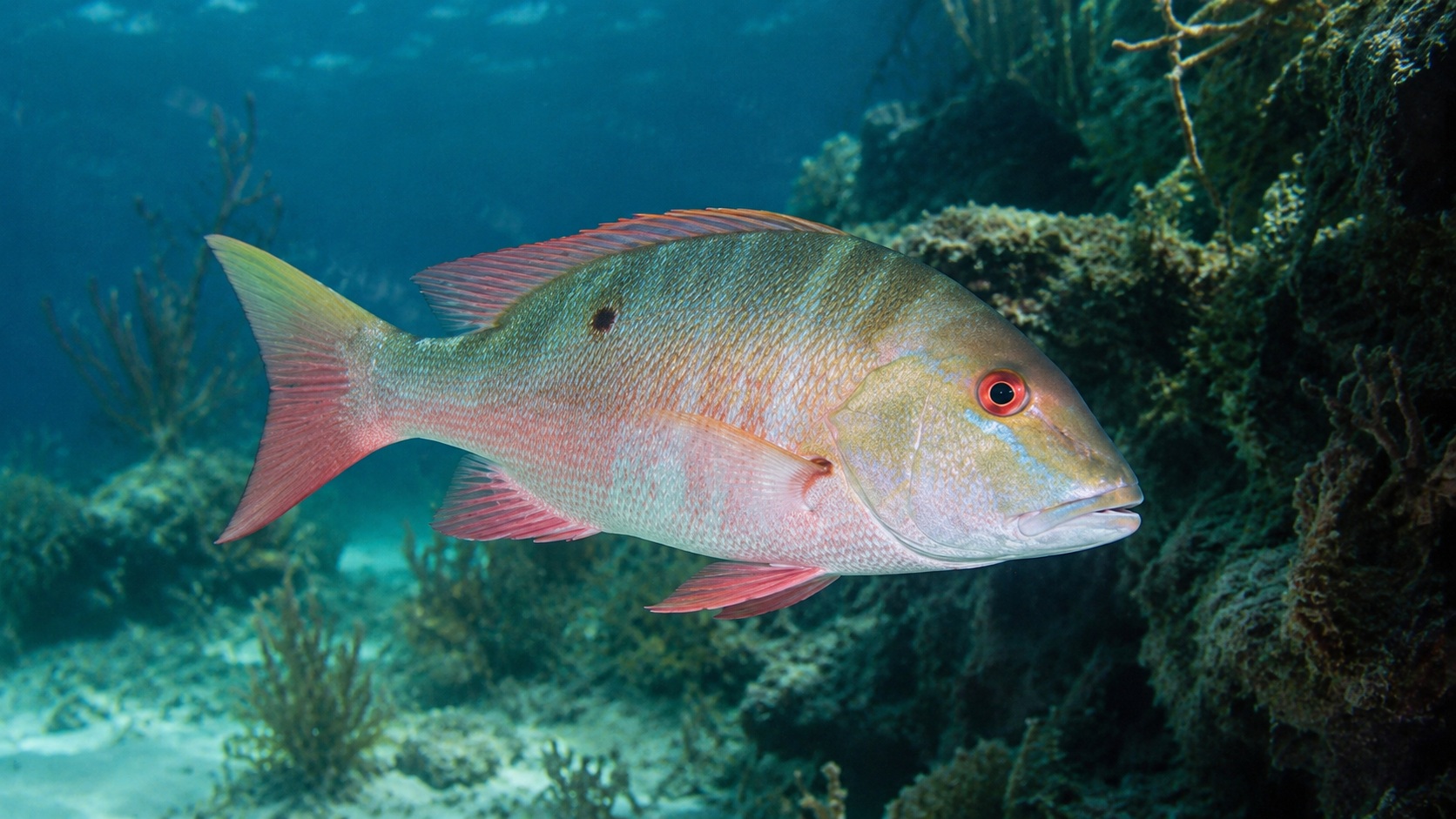
The mutton snapper’s field marks are distinctive once you know what to look for. The body is olive-green across the back, fading to a reddish or pinkish tone along the sides and belly. The single most reliable ID feature is a solid black spot on the upper back, just below the dorsal fin and above the lateral line. That spot does not disappear with age or stress the way color sometimes does. Look also for thin blue lines running below the eye and across the cheek, and for the pointed anal fin that separates muttons from the rounder-finned lane and yellowtail snappers. The tail is distinctly crescent-shaped. When a mutton is resting or nervous on the flats, it can show vertical bars across the sides, which fade as the fish relaxes or swims off. Juveniles can be confused with lane snapper, but the black spot combined with the blue facial streaks is a reliable separator.
Where to find them
Mutton snapper use different habitats at different life stages, which makes them uniquely accessible to anglers fishing everything from a kayak in the backcountry to a center console over offshore structure. Juveniles grow up in mangrove creeks, seagrass bays, and protected tidal channels throughout South Florida and the Keys. Adults establish home ranges on patch reefs, hard-bottom ledges, and offshore wrecks, but they also push onto shallow grass flats and sand-mud bottom to feed, especially in the spring months.
In the Florida Keys, the best sight-fishing for muttons happens on the oceanside flats from Islamorada down through the Lower Keys and the Marquesas. The Dry Tortugas is legendary for large fish on both the reefs and the surrounding sand bottom. Biscayne National Park holds good numbers as well, though special regulations apply there. On the Atlantic side, South Florida’s patch reefs from Miami to the Keys produce consistent action for bottom fishermen. On the Gulf side, the shallow backcountry of Florida Bay and the Ten Thousand Islands can hold surprising numbers of muttons working the edges of grass and mud.
When to go
Spring is the peak season for sight fishing muttons on the flats, roughly March through June, when fish push shallow to feed aggressively before the summer spawn. The full moons of June and July draw large spawning aggregations to well-known reef sites in the Keys and at the Tortugas, concentrating fish in numbers that can produce explosive bottom fishing. These aggregations are predictable and dependable year after year.
Summer sees fish split between the spawn sites and the reef, with reef fishing staying solid through fall. Winter fishing is slower in shallow water, but deep-reef and wreck fishing holds up year-round because larger adults tend to stay on structure in cooler months. Tidal movement matters throughout the year. A strong outgoing tide pushing bait off the flats into the deeper edge is a reliable feeding trigger, and dawn and dusk windows almost always outproduce midday.
What to throw
Live pilchards are the go-to bait across virtually every mutton scenario, whether you are drifting the reef or casting to a fish on the flat. Hook them lightly through the back and let them swim freely. Live pinfish are a top choice for bigger fish on the reef, as their erratic movement draws strikes from fish that have seen every bait in the box. Threadfin herring and live shrimp fill the same role when pilchards are not available.
For bottom fishing on the reef, a knocker rig or Carolina rig with a 1 to 3 oz egg sinker keeps the bait pinned near the bottom where muttons feed. The critical detail is leader length: run 30 to 50 feet of 30 lb fluorocarbon between your sinker and the hook. That distance gets the bait away from the weight and lets it move naturally, which matters because muttons are sharp-eyed and leader-shy.
On the flats, live pilchards or live crabs cast to a sighted fish on light spinning tackle give you the best shot at a eat. Approach with a trolling motor or push pole, keep your shadow off the fish, and place the bait slightly ahead of the direction of travel. Slow-pitch metal jigs in the 1 to 3 oz range are effective over the reef and can trigger reluctant fish that refuse natural bait. Bucktail jigs tipped with a strip of cut squid or fish belly have a long track record on muttons around patch reef and rubble edges.
Regulations
Florida state waters (both Atlantic and Gulf of America coasts):
- Minimum size: 18 inches total length
- Daily bag limit: 5 per person, within the 10-snapper aggregate bag limit
- Season: Open year-round
- Special rules apply when fishing in Biscayne National Park
Federal waters (South Atlantic, NOAA Amendment 41):
- Minimum size: 18 inches total length
- Recreational bag limit: 5 per person per day, within the 10-snapper aggregate
- Commercial trip limits are reduced to 5 fish per day during April through June to protect spawning aggregations
These rules are managed jointly by the Florida Fish and Wildlife Conservation Commission (FWC) and NOAA Fisheries. Always verify current rules before heading out, as regulations can change. The authoritative source for Florida state waters is MyFWC.com/Fishing/Saltwater/Recreational/Snappers. Federal regulations are at NOAA Fisheries.
Handling and release
Mutton snapper are excellent table fish with firm, white, mildly sweet meat. They rank among the best-eating snappers in the Atlantic, which is saying something. If you are keeping fish, a clean kill and immediate icing preserves that quality. Fillets are versatile for grilling, frying, or preparing ceviche.
For fish you intend to release, particularly anything caught from a depth greater than about 30 feet, watch for signs of barotrauma: a bulging stomach, the fish floating on its side, or eyes that appear inflated. Use a descending device such as a weighted release clip to return the fish to the depth where it was caught rather than releasing it at the surface. Muttons released properly from reef depths recover well. Sight-caught fish from the flats rarely need anything beyond a quick, gentle unhook and a moment held upright before they kick away on their own.
On the Table
Mutton snapper is excellent table fare and one of the most prized eating fish in the snapper family — anglers who target them in South Florida and the Keys almost universally keep their limit when the opportunity arises.
Taste and texture: The flesh is white with a slight pink tint, firm, and finely flaked. The flavor is mildly sweet with a clean, savory finish and faint shellfish notes — richer and more pronounced than red snapper but never heavy or gamey. It holds moisture well during cooking, which keeps the fillets tender even over high heat.
Best preparation methods:
- Grilling on the half-shell: Leaving the scales on and grilling skin-side down over direct heat is a Florida Keys staple. The scales act as insulation, basting the flesh in its own fat and preventing the fillet from drying out. The result is moist, lightly smoky meat that lifts cleanly off the skin.
- Blackening: The firm texture stands up to a screaming-hot cast iron skillet. A crust of smoked paprika, cayenne, thyme, and garlic seals in moisture and balances the fish’s natural sweetness without overwhelming it.
- Whole roasting or steaming: Smaller mutton snapper (under 5 lbs) cook beautifully whole — the bones add flavor and the thin skin crisps in a hot oven or yields silky texture when steamed with ginger and scallion.
- Ceviche: The firm, lean flesh holds its structure during acid cure and pairs naturally with citrus, making it a strong candidate for raw preparations when the fish is very fresh.
Handling for table quality: Bleed the fish immediately at the gills and get it on ice as fast as possible — mutton snapper held at ambient temperature degrades quickly in warm tropical conditions. Keep the fish in a slurry of ice and saltwater rather than dry ice. When filleting, the skin is thick and easy to work; a sharp, flexible knife separates it cleanly. Remove the bloodline from larger fish for the mildest flavor.
Eating caveats:
- Ciguatera risk: Mutton snapper is a reef-associated species in tropical and subtropical waters, which puts it in the ciguatera risk category. Risk is low compared to species like great barracuda or amberjack, but increases with fish size. Toxin concentrates in the liver, roe, and viscera — discard these parts and avoid eating large individuals (over 10 lbs) caught in known ciguatera-endemic areas such as the Caribbean. Cooking does not destroy ciguatoxin.
- Bag and size limits (Florida): The minimum size is 18 inches total length and the recreational bag limit is 5 fish per day (counted within the aggregate snapper limit). Size limits effectively filter out the smallest, leanest fish, so legal-sized fish are generally at peak eating quality.