A note about links: If we include links to retail sites like Amazon or Bass Pro Shops, it's because they're relevant to the topic and, as anglers ourselves, we believe they're worth checking out. As an Amazon Associate we earn from qualifying purchases.
Few things in saltwater fishing match the sight of a four-foot barracuda accelerating from a dead stop, covering thirty yards in less than a second to destroy a lure at the surface. The great barracuda is all teeth and attitude, a fish that will stare you down from fifty feet away before making a decision that leaves your heart pounding. It is also one of the most accessible targets in tropical saltwater fishing: no special tackle, no charter boat required, and the fish are present year-round across an enormous swath of warm ocean. From the shallow flats of the Florida Keys and the Bahamas to the reef systems of the Caribbean and the Indo-Pacific, the great barracuda is the perfect introduction to the saltwater flats and reef game for any angler willing to get into the tropics.
How to identify one
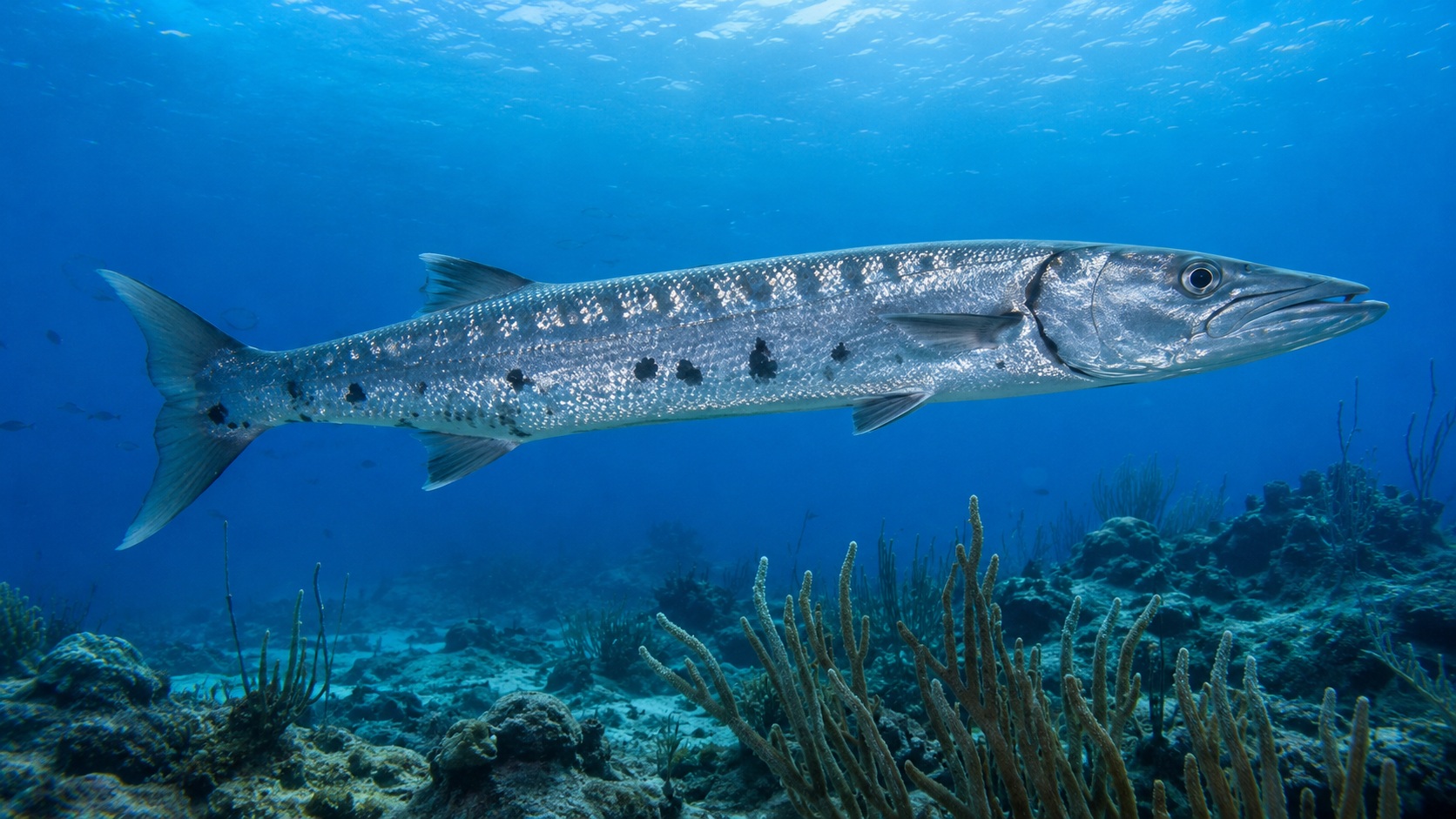
The great barracuda is hard to confuse with anything else once you have seen one. The body is long, cylindrical, and silverish, with a greenish or bluish-gray back that fades to a pale silver belly. The lower jaw juts forward past the upper, and the mouth is filled with two rows of teeth: small, razor-edged slicers in front, and larger stabbing fangs behind. Look for the irregular black blotches along the lower sides and the diagonal dark bars on the upper flanks. The tail is deeply forked and dark, with distinctive white tips. Adults are most often solitary. The Pacific barracuda, found along the California coast, is a smaller, more schooling species and lacks the prominent dark blotches on the lower flanks that mark the great barracuda.
Where to find them
Great barracuda occupy an enormous range across tropical and subtropical oceans worldwide, including the Atlantic, Indian Ocean, and Western Pacific, though they are absent from the Eastern Pacific. In the United States, the primary fishery runs from South Florida through the Keys, with additional fish along the Gulf Coast as far west as Texas in warmer months. Beyond the US, the Caribbean basin — including the Bahamas, Belize, Cuba, Puerto Rico, and the US Virgin Islands — holds some of the world’s most productive barracuda fishing. Indo-Pacific destinations such as the Maldives, Seychelles, Christmas Island, and the Great Barrier Reef region regularly produce large fish.
Juveniles live in inshore seagrass beds and mangrove edges, while adults spread across reef systems, sandy flats, grass flats, wrecks, channel edges, and the open nearshore zone. The most famous fishery style is the shallow-water flats game: sight-fishing to individual fish resting or patrolling over white sand and seagrass in a few feet of clear water. Deeper reef edges, channel mouths, and nearshore wrecks also hold fish consistently across the species’ range. In the Caribbean, barracuda are a near-constant presence around any significant reef structure.
When to go
Great barracuda are present year-round wherever water temperatures stay consistently warm — roughly above 72°F. In the tropics and southernmost US waters, productive fishing is possible in every month. At the northern edges of the range, such as along the upper Gulf Coast or the Atlantic coast of the southeastern US, barracuda are most reliably encountered from late spring through early fall, when inshore and nearshore water temperatures climb into the upper 70s and 80s. In South Florida and the Florida Keys, winter is often the peak flats season: resident fish remain active while other flats species become less accessible, and cooler, clearer water improves visibility for sight-fishing. As a rule, the farther north you fish, the later in the year the bite peaks.
Within any given day, early morning and late afternoon are the most productive windows on the flats, where low-angle sunlight helps you spot fish from the surface. Tidal movement matters most when fishing channel edges, passes, and reef cuts: the hour before and after a tide change concentrates bait and triggers feeding. Midday sun is actually useful on the open flats because the high light angle lets you see fish from farther away and make a more accurate cast.
What to throw
Tube lures are the classic great barracuda bait for a reason. A simple soft-plastic tube in bright yellow, chartreuse, or pink, rigged on a single hook through the nose and retrieved at high speed, triggers strikes from fish that ignore everything else. Rip it as fast as you can wind. Topwater walking baits like the Heddon Super Spook or Yo-Zuri Surface Cruiser work well from the flats and around structure. Use a walking-the-dog retrieve with occasional speed bursts. Crankbaits and jerkbaits in the 5 to 7 inch range, including the Rapala X-Rap and Yo-Zuri Crystal Minnow, are productive on reef edges and in deeper cuts. Work them with aggressive rips and short pauses. Wire leader is mandatory: barracuda teeth will cut through monofilament and fluoro in an instant, so use 30 to 60 lb single-strand wire or heavy coated wire of at least 12 inches. For fly fishing, large streamer patterns on a fast-strip retrieve are effective; a Clouser minnow or a needlefish pattern in white, chartreuse, or pink on a 1/0 to 4/0 hook presented on a floating line and stripped as fast as your hands can move will draw strikes from fish that otherwise follow without committing.
Regulations
Regulations for great barracuda vary by location and jurisdiction. In US waters, each state sets its own size and bag limits; Florida has specific slot and bag-limit rules that differ by region (check myfwc.com for current details). In federal waters, separate rules may apply. Across the Caribbean and internationally, local fishery regulations govern the species differently from island to island and nation to nation. Always verify current rules with the relevant state fish and wildlife agency or national fisheries authority before you fish. If you are fishing US waters beyond the 3-mile state line, check NOAA Fisheries for applicable federal regulations.
Handling and release
Great barracuda are built for catch and release. The combination of ciguatera risk in larger fish and the legal restrictions on sale make most anglers practice release by default. Ciguatera is a toxin that accumulates up the food chain; because barracuda are apex predators, large individuals can carry significant concentrations. Health authorities in Florida, the Caribbean, and the Pacific all advise caution or avoidance when it comes to eating barracuda. If you do keep fish for eating, small to medium specimens from non-reef areas carry lower risk, though risk is never zero.
For release, use long-nose pliers to back out the hook without handling the fish’s body if possible. If you must handle a barracuda, grip it firmly behind the head with a wet hand or use a lip-gripping tool. Keep fingers away from the teeth at all costs: the bite is severe. Get the fish back in the water quickly. Barracuda that have been fought hard should be held upright in the water and moved forward and back to pass water over the gills until they kick free on their own.
On the Table
The great barracuda is not recommended for eating due to a serious and unpredictable health risk: ciguatera fish poisoning. While barracuda flesh is edible in a technical sense, the species ranks among the highest-risk fish for ciguatoxin accumulation, and consuming it — especially larger individuals — carries a genuine danger that most anglers and health authorities advise avoiding entirely.
Taste and texture: Barracuda flesh is firm and white with a mild, slightly sweet flavor not unlike wahoo or kingfish. The texture holds up well to heat and does not fall apart easily. On pure culinary merit, it is a decent-eating fish. The problem is not flavor; it is what may be invisibly present in the meat.
Why anglers release them: Most experienced saltwater anglers practice catch-and-release with barracuda specifically because of ciguatera. The toxin is produced by microscopic algae (Gambierdiscus toxicus) that grow on reef surfaces. Small reef fish eat the algae, larger fish eat those fish, and apex predators like barracuda bioaccumulate the toxin to high concentrations over their lifetimes. Ciguatoxin is odorless, tasteless, and heat-stable — cooking does not destroy it. There is no field test to determine whether a given fish is safe.
Ciguatera risk — high: Great barracuda is one of the species most consistently associated with ciguatera poisoning cases in tropical and subtropical regions, including Florida, the Caribbean, and the Pacific. Symptoms include gastrointestinal distress, neurological effects (tingling, numbness, the classic reversal of hot and cold sensation), and can persist for months or years. Larger, older fish carry far greater toxin loads than juveniles, but even small barracuda in high-risk areas have caused illness. There is no antidote.
Legal note: Possession of great barracuda is not federally prohibited in the United States, but Florida and various other jurisdictions have size restrictions and bag limits. The health risk, not a legal prohibition, is the primary reason for the not-recommended rating. Health departments and coastal health agencies in Florida, the Caribbean, and Pacific island territories broadly advise against consuming barracuda.
Bottom line: Release great barracuda. They are spectacular predators and exceptional sport fish. The ciguatera risk makes them genuinely dangerous table fare, and no preparation method, marinade, or cooking technique neutralizes the toxin.