A note about links: If we include links to retail sites like Amazon or Bass Pro Shops, it's because they're relevant to the topic and, as anglers ourselves, we believe they're worth checking out. As an Amazon Associate we earn from qualifying purchases.
What just bit your line?
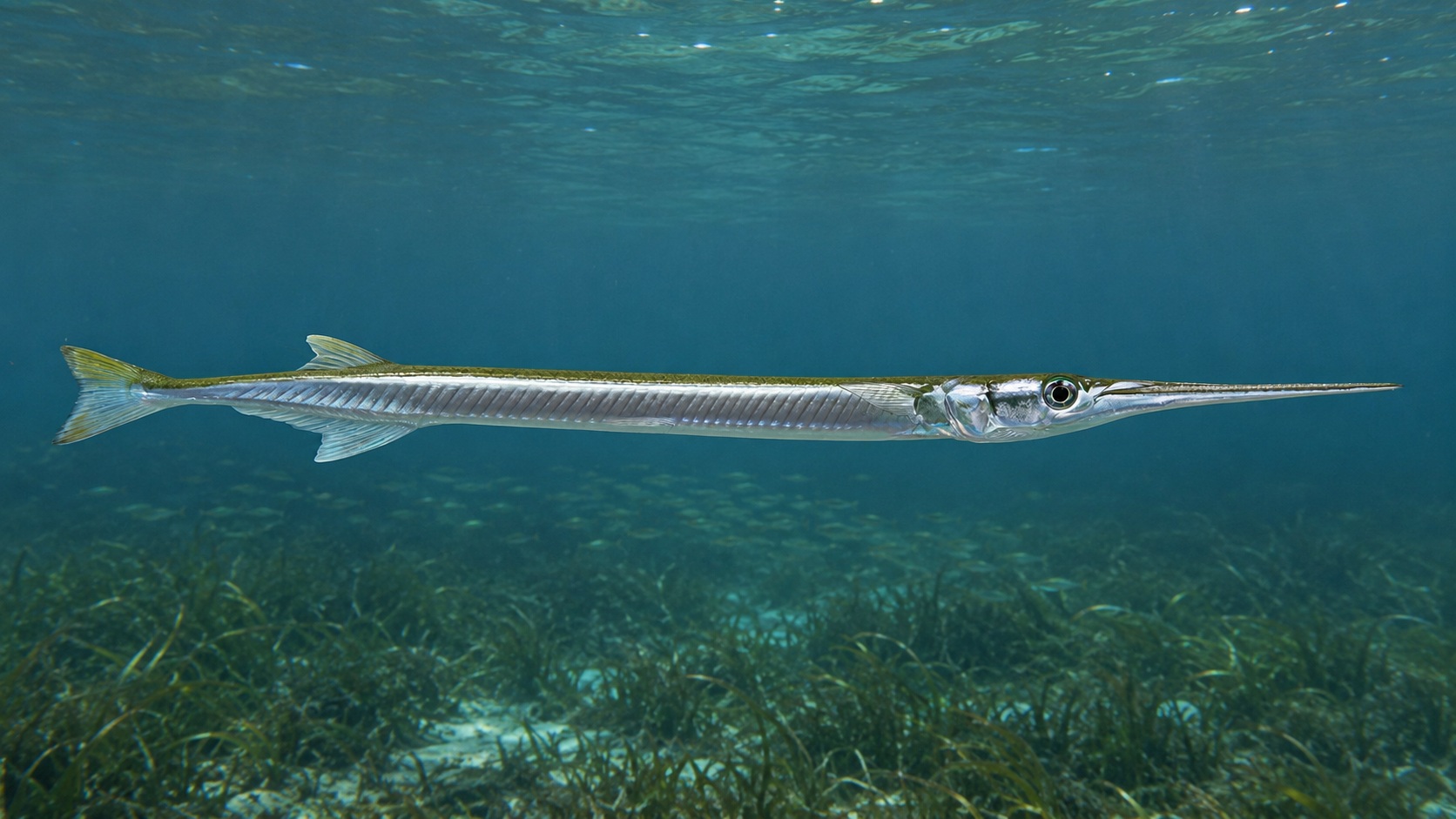
If you just pulled up a pencil-thin silver fish with a beak longer than your hand and it started thrashing and snapping at everything in sight, you caught an Atlantic Needlefish. This thing looks prehistoric, and the first reaction most anglers have is some version of “what on earth is that?” The answer is one of the most common and least welcome guests along the Atlantic coast and Gulf of Mexico. They show up on light tackle in the flats, around dock pilings, near bridges, and even in freshwater rivers - often when you were targeting something else entirely. The beak is the giveaway: both jaws are elongated into a flat, pointed bill lined with tiny, needle-sharp teeth. Nothing else you are likely to catch inshore looks quite like it.
How to identify one
The Atlantic Needlefish is hard to mistake once you know what you are looking at. The body is long and cylindrical - like a pencil with fins - and can reach about 24 inches (60 cm) in larger adults, though most you will catch run 12 to 18 inches. The back is greenish-blue to iridescent green, and the sides and belly are bright silver. A faint silver-blue lateral stripe runs along the flank. The dorsal and anal fins are set far back near the tail, which is forked. Both jaws are drawn out into a long, flat beak that may be a third or more of the fish’s total body length. The jaws are lined with small but very sharp teeth.
The most startling thing you will notice if you cut one open - or even look closely at a broken bone - is that the skeleton is bright green. This is not a sign of disease or contamination. It is caused by biliverdin, a pigment produced during normal metabolism that has a strong affinity for bone protein in this family of fish. It is completely harmless, just deeply unsettling the first time you see it.
What you might confuse it with:
- Redfin Needlefish (Strongylura notata): Very similar, but has reddish or orange fin tips. Range overlaps in Florida and the Caribbean. Treated the same way for handling purposes.
- Houndfish (Tylosurus crocodilus): Larger and beefier, with a more rounded body cross-section. Usually offshore or in deeper nearshore water. Can grow to over four feet.
- Florida Gar or Longnose Gar: Completely different fish (family Lepisosteidae), covered in hard, diamond-shaped scales with a much thicker body. If yours has those scales, it is a gar, not a needlefish. Gar are freshwater and brackish; needlefish overlap into those same environments but look sleek and scaleless by comparison.
If the fish is silvery, slender, has a long flat beak on both jaws, and was near the surface when you caught it, it is almost certainly a needlefish.
Is it dangerous?
Yes, and this is worth taking seriously. The Atlantic Needlefish has no venom, no stingers, and no spines to speak of - but it makes up for all of that with its beak and its behavior.
The beak: Both jaws are elongated and come to a fine point, reinforced with hard bone and lined with sharp teeth. A large needlefish has enough jaw pressure and structural integrity in that beak to cause a serious puncture wound. They thrash violently when hooked, and if you are holding one carelessly, that beak can whip around and drive into your hand, wrist, or forearm. The wound is narrow but deep.
Jumping behavior: This is where needlefish go from annoying to genuinely hazardous. When startled, Atlantic Needlefish launch out of the water and skim across the surface at high speed, sometimes for 10 to 15 feet. They are attracted to artificial light, which makes dock fishing and night fishing near bridges a particular risk. A needlefish coming toward you at speed is essentially a foot-long, beak-first projectile. Injuries from needlefish impalement have been documented worldwide, including cases where the beak penetrated the neck, skull, or eye socket. These are not common events, but they are real. The risk is higher when fish are concentrated near lights at night and something spooks them.
The teeth: Sharp enough to draw blood easily on fingers. A large Atlantic Needlefish can cut you if you grip it carelessly around the beak area.
What needlefish do NOT have: No venomous spines, no tetrodotoxin, no ciguatera risk in this species in most of its range, and no electrical charge. The flesh is not toxic. The green bones are not toxic. The hazard is purely mechanical - the beak and the jumping.
Handle it like you would a small, angry, pointy animal. Keep the beak pointed away from your face and body. Do not hold it loosely where it can thrash freely.
Where it comes from
The Atlantic Needlefish ranges from Massachusetts south through the Gulf of Mexico, the Caribbean, and down to Rio de Janeiro, Brazil. It is year-round in Florida and the Gulf states, and migrates northward along the Atlantic coast in warmer months, showing up in Chesapeake Bay tributaries, Delaware, and New Jersey from spring through fall.
This fish lives in the top few inches of the water column. It is a surface predator through and through - you will see them skimming the shallows around grass flats, near dock pilings, under bridges, along seawalls, and at the edge of inshore channels. Despite being thought of as a saltwater fish, Atlantic Needlefish move readily into brackish estuaries and even fully fresh water; they have been recorded well up freshwater rivers and have established populations in freshwater areas of Tennessee and Alabama.
Their preferred habitats are shallow, vegetated areas with good surface visibility - grass flats, tidal creeks, and the margins of estuaries - because they hunt by sight. They feed on small fish, particularly silversides, killifish, and similar schooling baitfish, using their long jaws to slash through a school and grab stunned or fleeing prey. Juveniles also eat shrimp, mysids, and small crustaceans. Their habit of feeding right at the surface makes them regular bycatch on any light tackle or float rig fished near the top of the water column, and they will strike at small lures, flies, cut bait, and live bait with equal enthusiasm.
They are most active and most visible in spring, summer, and early fall when water temperatures are warmest. In Florida they remain active year-round. You are most likely to encounter them in numbers near dock lights or bridge lights at night, when they congregate to pick off baitfish attracted to the light.
On the Table
Atlantic Needlefish are edible, but “edible” is doing a lot of work in that sentence.
The flesh is white and mild. If you get past the bones - and that is a big if - the flavor is acceptable. The problem is the skeleton. The bones are green. Not slightly off-white, not yellow-tinged: bright, vivid green, because of the biliverdin pigment that saturates the bone tissue in all members of the Belonidae family. The color is completely harmless and has no effect on flavor, but it is visually alarming and a serious psychological barrier to eating the fish.
Beyond the color, the bone structure is a practical headache. The fish is narrow and the pin bones are numerous and fine. Filleting a small needlefish is tedious and the yield is low relative to the effort. Larger fish give a better return but are still not efficient table fish by any measure.
In parts of the Caribbean and Pacific, needlefish are eaten regularly, particularly when grilled whole or fried. If you want to try it, the most practical approach for a larger fish is to gut and clean it, score the sides, and grill or pan-fry it whole - then eat around the bones rather than trying to pick them all out in advance. Accept the green bones as part of the deal.
For most anglers, the honest answer is: it is not worth keeping. The eating quality does not reward the effort, and the fish is far more valuable in the water for the ecosystem and for the experience of encountering it again. There are no significant regulations restricting keeping Atlantic Needlefish in most states, but there is also no compelling reason to keep one unless you are genuinely curious about the table quality or subsistence fishing.
What to do with it
Getting the hook out: Needlefish have tough, hard mouths and the hook is usually set near the front of the beak. Use long-nose pliers - do not put your fingers inside that beak to fish out a hook. The fish will thrash, and even if it cannot get significant leverage from that position, the teeth will draw blood. If the hook is deep and you cannot get it out safely with pliers, cut the leader as close to the hook as possible and release the fish; the hook will typically work its way out.
How to hold it: Grip the fish firmly around the body behind the pectoral fins, keeping the beak pointed away from you. If the fish is larger or particularly active, wrap it in a wet towel or use a glove. Keep the beak away from your face at all times. Do not hold it loosely and do not lay it across your lap or let it flop near your feet on the deck - a needlefish flopping at your ankles can still catch you off guard.
Releasing it: Lower the fish to the water and open your hand. These fish recover immediately and do not need reviving. They are hardy and do well when released.
If you get stabbed: A needlefish puncture wound is narrow and clean but can be surprisingly deep. Rinse the wound thoroughly with clean water immediately. Apply antiseptic if you have it. The main risk is infection, particularly if you are in brackish or estuarine water. If the beak or a piece of it breaks off inside the wound - which can happen with a hard strike - seek medical attention to have it removed; do not dig around in the wound yourself. Tetanus status is worth considering if you have not had a booster recently. For most minor punctures, thorough cleaning and monitoring for signs of infection (redness spreading from the wound, warmth, swelling over 24-48 hours) is the appropriate response.
Night fishing note: If you are dock or bridge fishing at night and you see needlefish schooling near the lights, be aware of where they are and what direction they might jump. Keep your face and neck away from the water’s edge if you are leaning over. It is not a reason to stop fishing, but it is worth the ten seconds of situational awareness.