A note about links: If we include links to retail sites like Amazon or Bass Pro Shops, it's because they're relevant to the topic and, as anglers ourselves, we believe they're worth checking out. As an Amazon Associate we earn from qualifying purchases.
You were fishing for bass, or catfish, or maybe crappie, and something bit that does not look like any fish you have seen before. It is long. Its snout is absurdly thin, like a knitting needle. Its scales look like chain mail. It opened its mouth and you are not entirely sure how to unhook it, or whether it is dangerous, or whether you should just cut the line and move on. Welcome to the longnose gar, and welcome to one of the most ancient lineages of fish in North America.
Longnose gar have been here for roughly 100 million years. They predate most of what we think of as “normal” fish. The fact that they look strange is because they are: a product of an era long before modern bony fish dominated freshwater systems. Once you know what you are dealing with, they are fascinating, easy to release safely, and an experience worth having.
What You Are Looking At
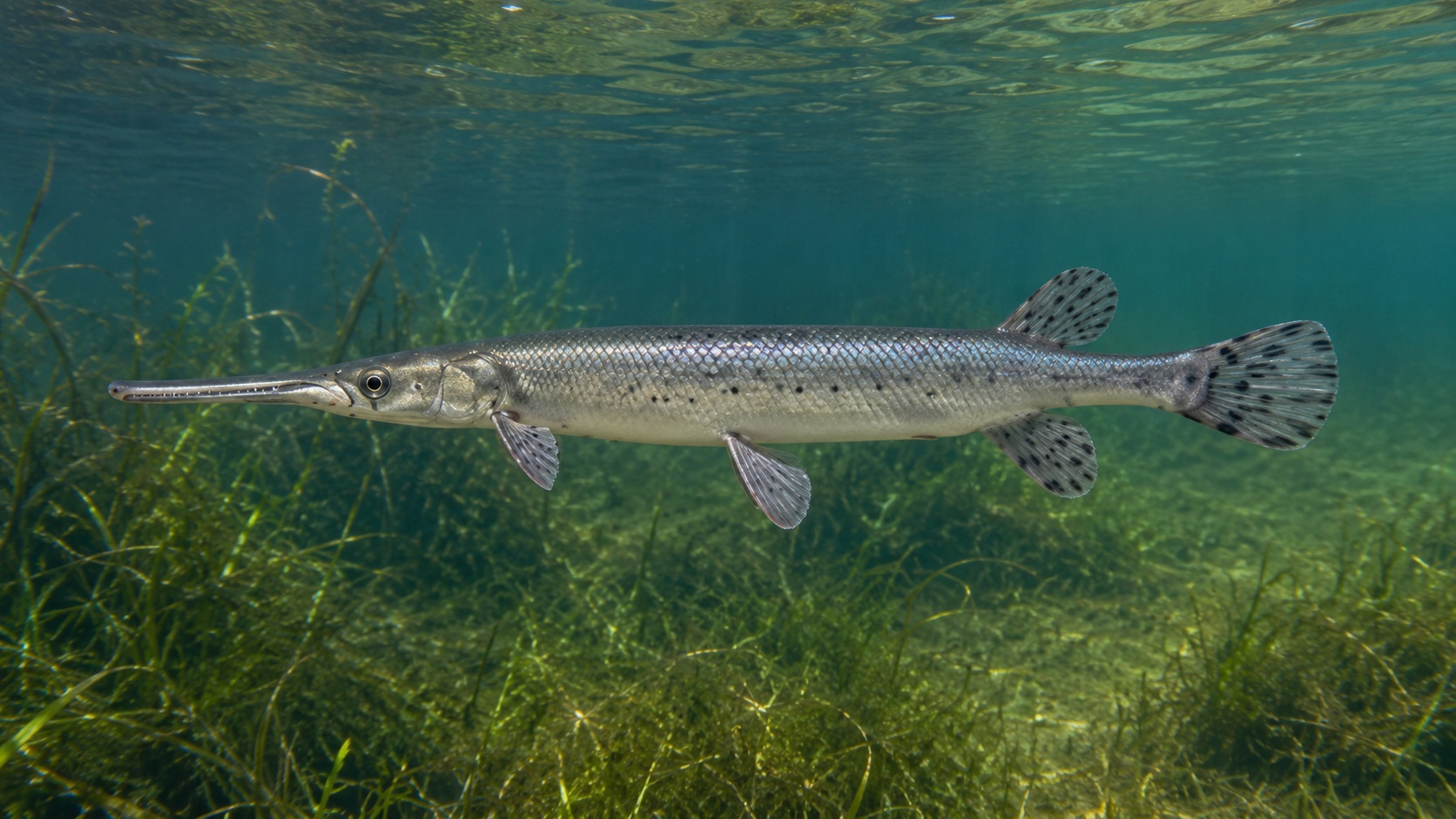
The longnose gar is identifiable from across the water. That snout is the key feature: exceptionally long and narrow, nearly the length of the rest of the head, lined with small, sharp teeth. The body is cylindrical, covered in hard, diamond-shaped ganoid scales that interlock like tiles and are genuinely difficult to penetrate — these scales were used historically as arrowheads by Indigenous peoples, and some were tested as breastplates by early Spanish explorers.
The coloration is typically olive to brownish-green on the back, fading to a yellowish-white belly. Adults often show scattered dark spots along the sides and on the unpaired fins, though the spots are less bold and organized than on the spotted gar.
One distinguishing behavior: longnose gar regularly surface and gulp air. If you see a torpedo-shaped fish rising to the surface and rolling, making an audible snap or gulp at the waterline, that is a gar using its swim bladder as a primitive lung. This is an actual adaptation, not distress behavior, and it means gar can survive in low-oxygen water that would suffocate most other species.
Where They Live
Longnose gar occupy a huge range. They are found from southern Quebec and the Great Lakes region south through the entire Mississippi drainage, east to the Atlantic-draining rivers of the Carolinas and Mid-Atlantic, and west into Kansas, Oklahoma, and the Texas river systems. Along the Gulf and lower Atlantic coasts, they regularly enter brackish estuaries.
Within any given waterbody, longnose gar favor the shallow, weedy edges of rivers, lakes, and reservoirs. They are ambush predators: they hold nearly motionless in the surface film or near aquatic vegetation, then strike sideways with a quick twist of the head. They are most active on warm, sunny days, particularly in spring and early summer when water temperatures rise.
Look for them near boat docks, along grass lines, over shallow flats, and in the calm backwater arms of reservoirs. In rivers, slow current and woody debris concentrate them.
How to Hook One (and Why It Is Hard)
Here is the problem: that long, bony snout is almost all bone, cartilage, and teeth. A standard hook set drives the point into a hard surface and pops straight out. This is why most gar encounters end in frustration for the angler — the fish took the bait, the angler set the hook, and the gar is gone.
Two approaches actually work. The first is a rope or frayed nylon lure: a short section of nylon rope or a specialized gar lure with unraveled fibers that the gar’s teeth become tangled in when it bites. No hookset required. The second is wire leaders and patience: let the gar hold the bait (a whole live or cut shad, sucker, or mullet) for a full 30 to 60 seconds before setting the hook, allowing time for the fish to position the bait for swallowing. A long-shank wire hook fished in the back third of the bait body, rather than the head, gives the point a better chance of landing somewhere the jaw can close over it.
Light wire leaders are important in any case — gar teeth will cut monofilament quickly.
How to Handle One Safely
Longnose gar are not dangerous to handle if you respect the teeth. Those rows of needle-like teeth are forward-facing and designed for grabbing fish, not clamping down on hands, but they will cut you if you are careless. Use a pair of long-nose pliers or a de-hooking tool rather than reaching into the mouth bare-handed.
The ganoid scales are rough and can scrape skin. Heavy gloves help. When lifting for a photo, support the fish horizontally — do not hang it vertically by the jaw. If you are releasing it (which is common since the flesh is bony and the fish is hard to fillet), simply lower it back into the water and let it swim off on its own terms.
Can You Eat It?
Longnose gar is edible, but it is a project. The flesh is white, mild, and reasonably flavorful. The problem is the skeleton: gar bones are numerous, thin, and interspersed throughout the flesh in ways that make clean filleting difficult. Many anglers who keep gar score the meat and fry it whole in sections, then pick through it at the table. Others use the meat for fish cakes or patties, which sidesteps the bone problem.
Critical safety note: gar eggs (roe) are toxic. The eggs of all gar species contain ichthyotoxin, a protein that is poisonous to humans and to most mammals including dogs. Eating gar roe can cause severe nausea, vomiting, and in large quantities, more serious symptoms. If you clean a female gar, do not taste the eggs, do not let pets eat discarded eggs, and dispose of the roe well away from the water. This is not a gray area — the toxicity is well-documented. The flesh is fine; the eggs are not.
A Fish Worth Knowing
Most anglers who encounter longnose gar for the first time want nothing to do with them. By the second or third time, curiosity takes over. Gar occupy a genuinely unique place in the North American freshwater ecosystem: they are top-level ambush predators that have changed remarkably little in millions of years, they can breathe air, they are armored in ways that make most predators avoid them, and they are found across an enormous range in waters most people fish every year without realizing it.
They are not the fish you were after. But they are worth a moment before you send them back.