A note about links: If we include links to retail sites like Amazon or Bass Pro Shops, it's because they're relevant to the topic and, as anglers ourselves, we believe they're worth checking out. As an Amazon Associate we earn from qualifying purchases.
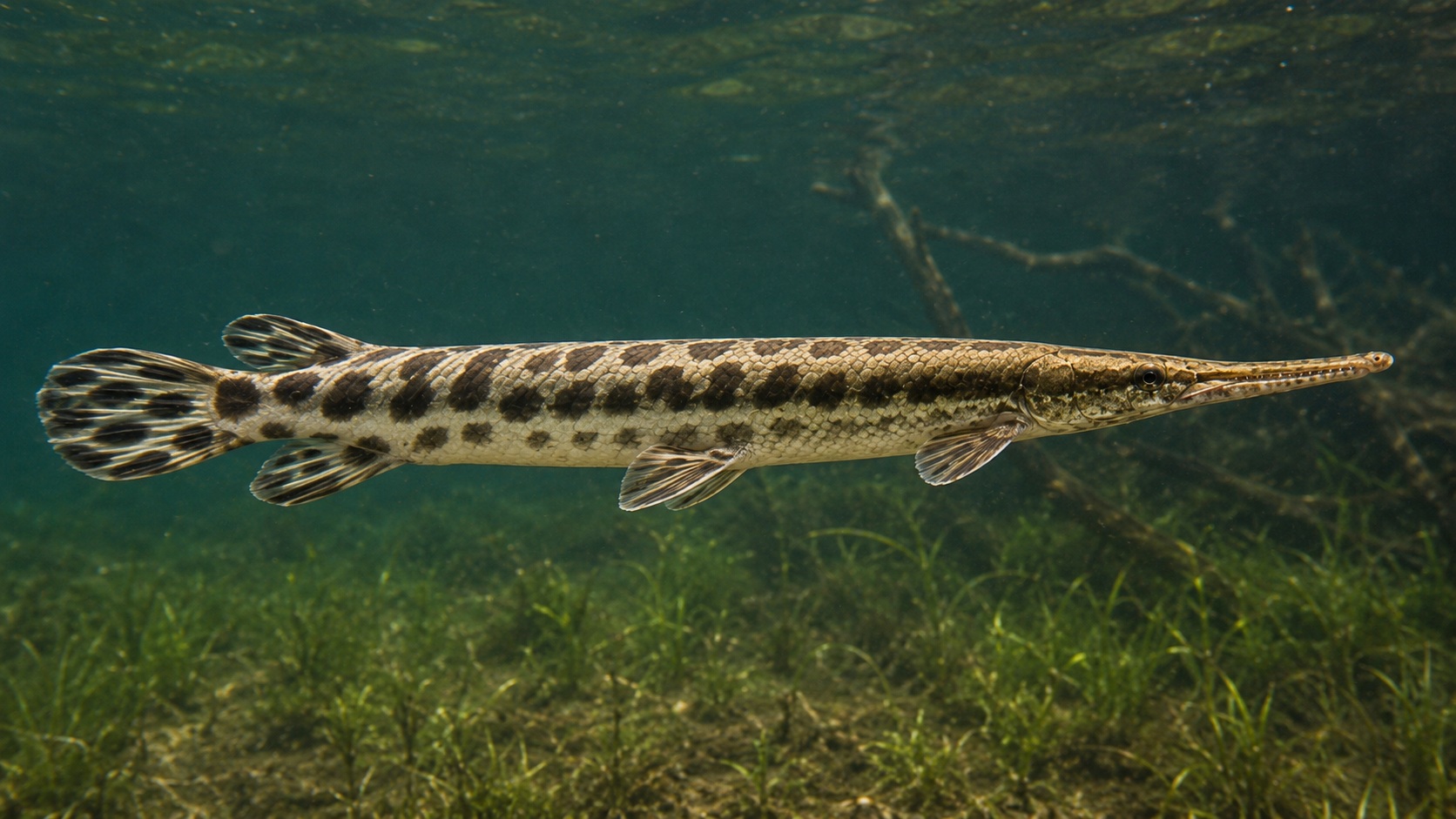
Most anglers who catch a spotted gar assume at first that it is just a longnose gar — they are both roughly the same size, both have the same prehistoric look, and both tend to show up unexpectedly on the end of a line in weedy, warm-water habitat. The difference becomes obvious as soon as you get a close look: spotted gar are covered in bold, round, dark spots that run not just along the body but across the head, the snout, and the fins. In good light, it looks almost like someone splattered dark paint across the fish with a brush. Once you see it, the ID is instant.
Spotted gar are a common bycatch across the Gulf Coast, through the Mississippi and Ohio drainages, and up into the lower Great Lakes. Most people fishing for bass, crappie, or catfish will encounter them eventually. Here is what to know.
What You Are Looking At
The body shape follows the basic gar blueprint: long, cylindrical, armored with hard interlocking ganoid scales, with a moderately elongated snout that is noticeably shorter and broader than a longnose gar’s but still distinctly pointed. The snout of a spotted gar is typically shorter than the distance from the eye to the back of the head — on a longnose gar, the snout is longer than that distance, often dramatically so. That snout-length ratio is the quickest way to separate the two species when the spots are ambiguous.
The spots are the real field mark. Dark, round, and bold, they cover the top of the head, the entire length of the body, and extend onto the dorsal, anal, and caudal fins. Young gar of many species have spots that fade as they mature; in spotted gar, the spots remain vivid throughout the fish’s life and extend to the head and fins in a way that other gar species do not replicate.
Coloration is olive to brownish-green on the back, paling to a yellowish-white on the belly. The scales, even on a modestly sized fish, have a distinctly armor-like quality that sets gar apart from any other fish you will encounter in freshwater.
Where They Live
Spotted gar prefer calm, vegetated water. While longnose gar will use everything from fast rivers to large open lakes, spotted gar are more consistently associated with slow-moving or still water: backwater sloughs, oxbow lakes, weedy coves in reservoirs, and the quieter side channels and backwaters of larger rivers. They are tolerant of low-oxygen conditions because, like all gar, they can breathe air directly by surfacing and gulping.
Aquatic vegetation is central to their habitat use. Spotted gar use thick beds of emergent and submerged plants both as ambush cover and as structure for spawning. In summer, they are often found holding just below the surface at the edge of a grass line or partially concealed in emergent vegetation near a bank.
In rivers, spotted gar avoid fast current and concentrate in eddies, backwater bends, and slack water below islands or fallen timber. In lakes and reservoirs, look for them in shallow, weedy arms with warm, clear to lightly turbid water.
Their range runs through the Gulf Coast states — from east Texas and Louisiana through Mississippi and Alabama — north through Arkansas and Missouri into Illinois and Indiana, and into the Lake Erie drainage in Ohio and southern Michigan. The Mississippi River’s backwater lakes and oxbows, from the Missouri Bootheel down through Louisiana’s Atchafalaya Basin, are strongholds for the species. In Texas, they are found in the eastern river drainages including the Sabine, Neches, and Trinity systems. In the northern portions of their range, spotted gar are less common and may have legal protections — check regulations before retaining any gar.
When to Go
Spotted gar are most active when water temperatures are in the 65–80°F range. That window arrives earliest in the Gulf Coast states, where fish begin moving into shallow vegetated areas by late winter or early spring. In the central states — Arkansas, Missouri, Illinois — peak activity typically runs from late spring through summer. At the northern edge of the range in Ohio and the Lake Erie drainage, spotted gar are most accessible from early summer into early fall.
Spawning activity, which concentrates fish in shallow grass beds and makes them comparatively easy to find and observe, occurs when water temperatures climb into the upper 60s to low 70s. After spawning, fish scatter back to their summer holding areas and become more dependent on early morning and late evening feeding windows during the hottest part of the year. On very warm days, you will often see gar rolling and surfacing in still backwaters in the early morning — they are gulping air, and that rolling behavior is a reliable sign of where to target them.
Gear and Tactics
Spotted gar are not a deliberately targeted species for most anglers — they come in as bycatch on bass, crappie, and catfish setups. Live minnows, small shiners, and cut bait all produce incidental gar. If you are targeting spotted gar intentionally, a small live shiner suspended under a float near a grass edge is a reliable approach.
The challenge with gar is hook-setting. Their bony mouths are hard to penetrate with a conventional hook set, and their elongated snouts mean they often grab bait crossways before swallowing. Many dedicated gar anglers use rope lures — a short piece of nylon rope frayed at one end — that tangles in the gar’s teeth without requiring a hook penetration. Others use treble hooks on live or cut bait and give the fish extra time to turn and swallow before setting. Medium spinning or baitcasting gear in the 8–12 lb class handles spotted gar comfortably.
How to Handle One Safely
Spotted gar are the same basic animal as all other gar species: a fish with needle-like teeth oriented for grabbing prey, covered in scales rough enough to scrape skin. They are not aggressive toward people but will writhe and thrash when lifted from the water.
The practical approach: use long-nose pliers or a de-hooking tool to remove the hook rather than reaching into the mouth. If you need to hold the fish for a photo, grip it firmly around the body behind the gill plate — do not attempt to palm or squeeze the fish from above. The scales can abrade bare hands. Wet hands and a pair of lightweight rubber gloves both help.
Release is straightforward. Lower the fish to the water’s surface, support it horizontally until it is oriented and calm, and let it go. Spotted gar are hardy and recover quickly from catch-and-release.
Regarding bycatch situations — if you catch a spotted gar on a crankbait or spinner meant for bass, the fish often swallows the bait more deeply, which complicates removal. Long-handled pliers and patience, or cutting the leader close to the hook and letting the fish go (hooks rust out quickly in soft tissue), are both acceptable solutions.
Can You Eat It?
Spotted gar is edible, in the same category as longnose gar: mild white flesh, moderately good flavor, and genuinely difficult to clean because of the numerous fine bones distributed through the meat. Anglers who keep spotted gar typically score the flesh and fry it in sections, or grind the meat into fish cakes or patties to manage the bone issue.
Critical safety note: gar roe is toxic. The eggs of all gar species, including spotted gar, contain ichthyotoxin — a protein-based poison that causes severe gastrointestinal illness in humans and is harmful or fatal to dogs and other mammals. Do not eat the eggs. Do not allow pets to eat discarded roe or organs. If you clean a female spotted gar and find eggs, dispose of them away from the water and away from animals. The flesh of the fish is safe. The eggs are not.
Regulations
Regulations for spotted gar vary by state. There is no federal management of this species. In Gulf Coast states such as Texas and Louisiana, spotted gar are generally unregulated or subject only to a basic possession limit — consult your state fish and wildlife agency for current rules. In the northern portions of the range, including Ohio and parts of Illinois and Indiana, spotted gar may be protected or subject to special restrictions given lower population densities. Always check with your state fish and wildlife agency before keeping any gar.
A Note on Conservation
Spotted gar have a smaller range than longnose gar and are considered vulnerable or uncommon in the northern portions of their distribution, including Ohio and parts of the Great Lakes drainage. Some states have restrictions on keeping spotted gar. Before retaining any gar for the table, check your state’s current regulations — in many areas, catch-and-release is the expected practice.
For most anglers who encounter spotted gar unexpectedly, the best outcome is an unhurried look at an interesting and ancient fish, a clean release, and a story about the thing that came out of the water that you did not expect.