A note about links: If we include links to retail sites like Amazon or Bass Pro Shops, it's because they're relevant to the topic and, as anglers ourselves, we believe they're worth checking out. As an Amazon Associate we earn from qualifying purchases.
There are fish, and then there are living relics. The Atlantic sturgeon has been patrolling the rivers and coastlines of eastern North America for more than 120 million years, outlasting the dinosaurs and surviving the rise and fall of entire ecosystems. Indigenous peoples harvested them long before European contact. Colonial settlers called the Hudson River fish “Albany beef” because they were once so abundant they fed entire communities. Then came the caviar rush of the late 1800s. By 1901 the commercial fishery had collapsed, reduced from a species that once numbered in the millions to scattered remnants that have struggled to recover ever since. Today, encountering an Atlantic sturgeon, whether you see one breach clear of the water in the Hudson or feel the sudden dead weight of one mouthing your bottom rig on the Delaware, is a genuinely rare event, a brush with deep time that most anglers never experience. These fish can live 60 years and grow to 14 feet. They do not belong to us to keep. They belong to the river.
How to identify one
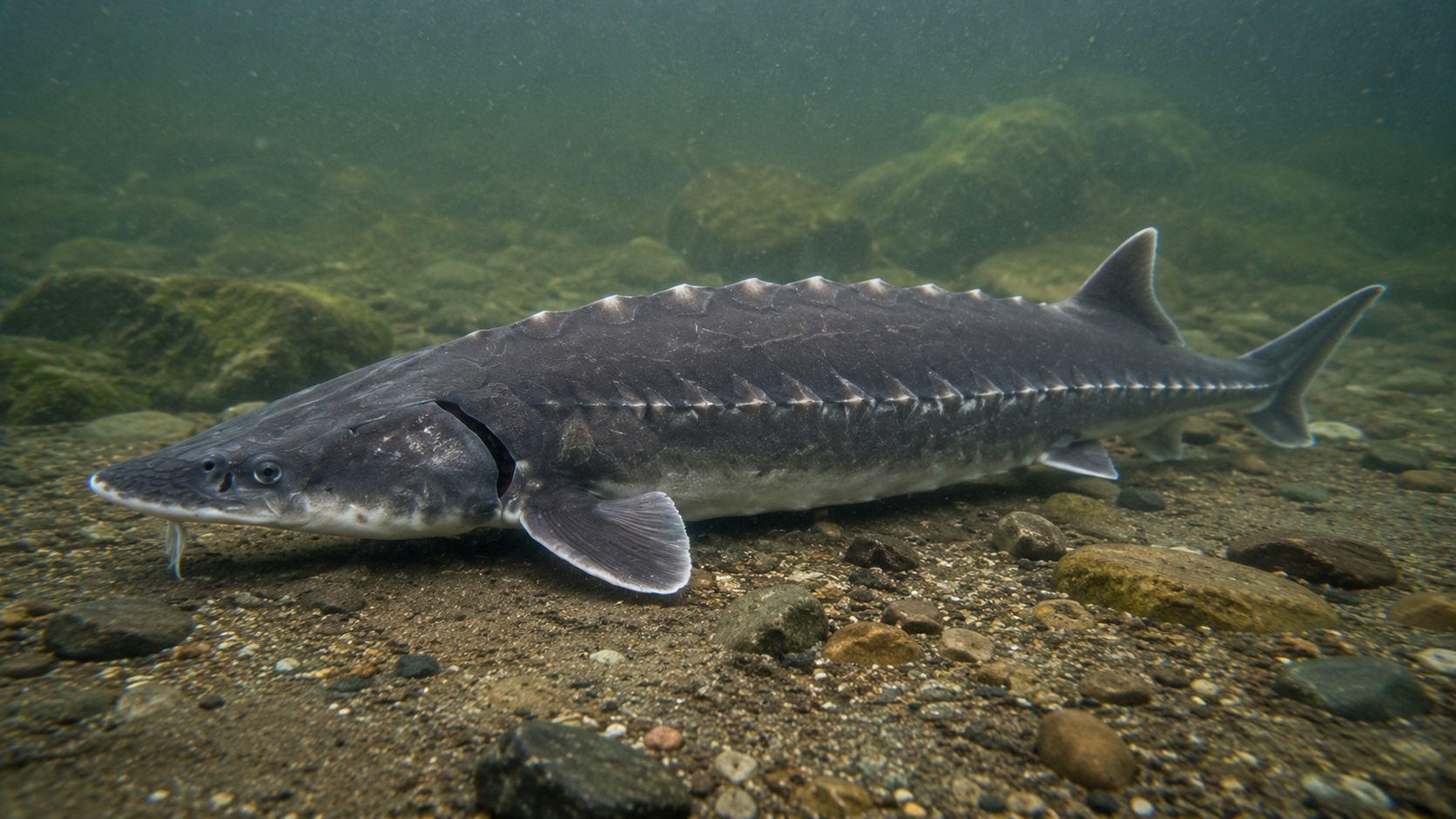
Atlantic sturgeon are unmistakable once you know what you are looking at. They are long, roughly cylindrical fish with a flattened, shovel-like snout and a distinctive heterocercal tail, with the upper lobe is longer than the lower, giving it a shark-like silhouette from below. Instead of scales, the body is armored with five rows of bony, plate-like projections called scutes: one row along the back, two rows along the sides, and two rows along the belly. The coloration is typically bluish-black to olive-brown along the back, fading to pale sides and a white belly. Four barbels hang beneath the snout ahead of the toothless, protractile mouth, which the fish extends downward to vacuum up invertebrates from the bottom. Adults in coastal waters regularly exceed 6 feet and 100 pounds; a fish over 200 pounds is not unusual. The related shortnose sturgeon (Acipenser brevirostrum) shares the same rivers and looks similar but is noticeably smaller, rarely exceeding 4 feet, and has a proportionally wider snout.
Where to find them
Atlantic sturgeon are anadromous: they spend most of their adult lives in saltwater but return to the freshwater rivers where they were born to spawn. Juveniles may linger in the brackish transition zones of river estuaries for one to five years before moving into nearshore coastal waters. Adults range widely along the Atlantic coast from Canada south to Florida, typically holding close to the bottom in relatively shallow coastal waters over sandy or muddy substrates. The major spawning rivers on the U.S. East Coast include the Hudson in New York, the Delaware (shared by Pennsylvania and New Jersey), the Susquehanna and its Chesapeake Bay tributaries in Maryland and Virginia, the James and Rappahannock rivers in Virginia, the Cape Fear and Roanoke rivers in North Carolina, and the Savannah, Edisto, and Santee-Cooper systems in South Carolina and Georgia. Anglers most commonly encounter Atlantic sturgeon incidentally while fishing the bottom of these river systems during spring and fall migratory runs, or while fishing nearshore coastal waters. Ship channels, deep river bends, and tidal flats adjacent to deep water are the most likely contact zones.
When to go
Atlantic sturgeon movements are strongly tied to water temperature and spawning cycles. In northern rivers such as the Hudson and Delaware, adult fish move upriver in spring, typically March through June, when water temperatures climb into the 50s Fahrenheit, then drop back downstream and return to coastal waters as temperatures rise through summer. A secondary run of pre-spawn and post-spawn adults may occur in fall. In southern river systems, including the Savannah and the Santee-Cooper, spawning movements tend to shift later, with activity documented through late summer and fall. The spring window is the prime period for incidental encounters by anglers fishing traditional bottom rigs for other species. If you are fishing heavy bottom tackle for catfish, carp, or striped bass in a major East Coast tidal river during April or May, there is a genuine chance that a sturgeon will find your bait.
What to throw
There is no legal targeted fishery for Atlantic sturgeon anywhere in the United States. Any encounter you have with one will be incidental: the fish picking up bait intended for something else. Atlantic sturgeon are benthic vacuum feeders. They cruise along the bottom with their sensitive barbels trailing ahead of them, detecting worms, amphipods, clams, snails, crayfish, and small crustaceans, then extend their protractile mouths to suck prey from the substrate. Bottom rigs using worm or cut bait fished directly on the riverbed in known migratory corridors are the most common point of accidental contact. Heavy Carolina rigs, soaker rigs, and three-way rigs fished in 15 to 40 feet of tidal river water during spring runs in the Hudson, Delaware, and Chesapeake Bay tributaries produce the most incidental encounters. Circle hooks, which are recommended for all bottom fishing in sturgeon habitat, dramatically reduce deep-hooking rates and make release safer.
Regulations
Atlantic sturgeon are fully protected under the federal Endangered Species Act. It is illegal to fish for, catch, possess, harass, harm, pursue, or kill Atlantic sturgeon anywhere in U.S. waters. NOAA Fisheries listed the species across five distinct population segments in 2012. Four are listed as endangered: the New York Bight DPS, the Chesapeake Bay DPS, the Carolina DPS, and the South Atlantic DPS. The Gulf of Maine DPS is listed as threatened. These protections apply in all U.S. federal waters and in all states along the Atlantic coast. If you accidentally hook one, your legal obligation is immediate, careful release. Do not attempt to land, lift, or weigh the fish. Do not remove it from the water unless absolutely necessary to free the hook. Report any incidental encounters to NOAA Fisheries or your state fish and wildlife agency. In the Hudson River, contact the NYSDEC at 845-256-3073. Verify current ESA protections and reporting requirements at fisheries.noaa.gov/species/atlantic-sturgeon.
Handling and release
If you accidentally hook an Atlantic sturgeon, keep the fish in the water at all times. Do not drag it onto shore or into a boat. Use needle-nose pliers or a dehooking device to remove the hook while the fish remains submerged alongside the boat or bank. If the hook is deeply embedded, cut the line or leader as close to the hook as possible and leave it. If you must briefly support the fish to free a snag, use both wet hands to cradle the belly, keep the fish horizontal, and return it to the water within seconds. Never hold a sturgeon vertically by its head or tail: this stresses the spine and can cause fatal internal injury. Once free, hold the fish upright and facing into any current until it kicks away on its own. After release, record the approximate size, location, date, and any tag numbers visible on the fish and report the encounter to NOAA Fisheries. Tagged fish contribute directly to population surveys that inform recovery planning for one of the most imperiled fish species in North America.
On the Table
Atlantic sturgeon are not recommended for the table — not because of poor eating quality, but because possessing one is a federal crime. This is a legally protected species, and no harvest is permitted anywhere along the U.S. Atlantic coast.
Legal status — do not keep: Atlantic sturgeon are listed as endangered or threatened under the Endangered Species Act (ESA), with five distinct population segments all carrying protected status. Harvest, possession, or sale of Atlantic sturgeon is prohibited in U.S. federal waters and in every Atlantic coastal state. Anglers who hook one must release it immediately and with care. There is no size, season, or bag limit exception — the prohibition is total.
Historical context: Sturgeon were once prized as premium table fish and a major commercial fishery along the Atlantic seaboard. Their flesh is dense, mild, and meaty — more similar to pork or veal in texture than to typical fish — and their roe was harvested as American caviar. Overfishing through the 19th and early 20th centuries, combined with habitat loss and dam construction blocking spawning migrations, caused catastrophic population collapse. Commercial harvest was closed in the 1990s, and ESA listings followed in 2012.
If you hook one: Use tackle heavy enough to avoid exhausting the fish. Keep the sturgeon in the water if at all possible during hook removal. Atlantic sturgeon can reach six feet or more and may require two anglers to handle safely at the surface. Do not lift large fish fully out of the water — their internal organs can be stressed by their own body weight. Barbless hooks or crushing barbs before fishing in sturgeon habitat speeds release. Report encounters to your state fish and wildlife agency; population monitoring relies in part on angler data.
Bottom line: Atlantic sturgeon are a catch-and-release-only species by law, with no exceptions. Appreciating them as a living link to prehistoric fish fauna — they predate the dinosaurs — is the only appropriate response to landing one.