A note about links: If we include links to retail sites like Amazon or Bass Pro Shops, it's because they're relevant to the topic and, as anglers ourselves, we believe they're worth checking out. As an Amazon Associate we earn from qualifying purchases.
The moment a California yellowtail decides to run, your reel screams, your arms burn, and every other species you have ever caught suddenly feels like warm-up practice. These fish are built like torpedoes, schooling around kelp beds and rocky structure from San Diego all the way down through Baja California, and on a good summer morning at Catalina Island or San Clemente Island you can find them crashing bait on the surface in water you can almost see bottom through. They fight dirty, diving for the kelp, wrapping your line around anything they can reach, and that is exactly why Southern California anglers plan entire seasons around them. If you want to understand why West Coast sportfishing culture is what it is, catch a yellowtail and you will never need another explanation.
How to identify one
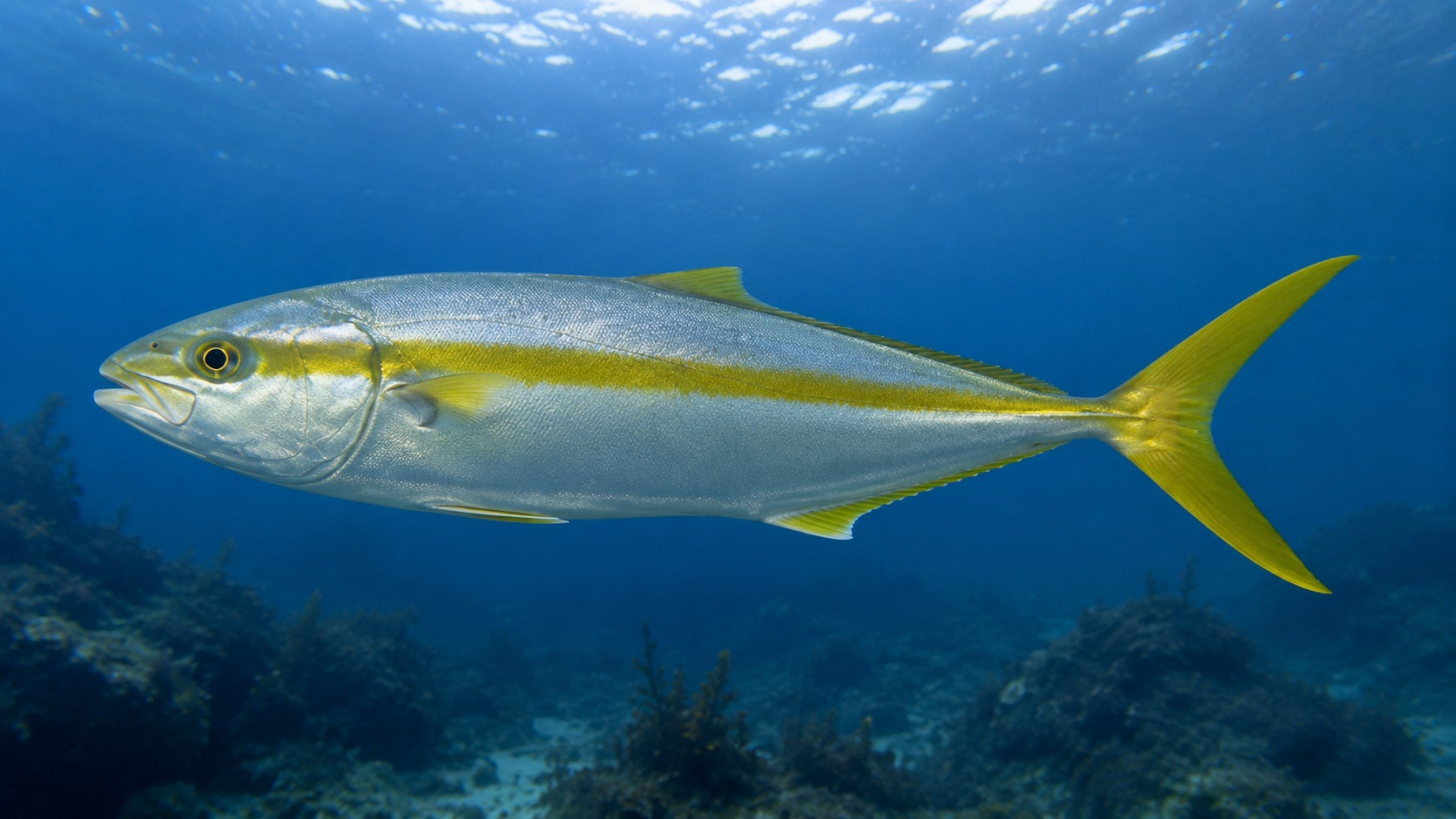
California yellowtail are hard to mistake once you know the pattern. The back runs metallic blue to green, the belly is bright silver, and a bold brassy or yellow stripe runs from the eye straight back to the tail, which is deeply forked and unmistakably yellow. The fins share that same warm yellow tone. The body is thick through the shoulders and tapers to a narrow, powerful caudal peduncle built for burst speed. The closest lookalike is the Almaco jack (Seriola rivoliana), which shares similar coloring but has a deeper, more compressed body and a longer second dorsal fin. Florida anglers familiar with greater amberjack (Seriola dumerili) should note that the California yellowtail is a distinct species: it is smaller on average, found only in the Pacific, and behaves differently enough that tactics developed in Florida do not translate directly.
Where to find them
California yellowtail live where the structure is hard and the bait is thick. Kelp forests are the signature habitat along the Southern California coast, and the fish use the canopy edges and rocky bottom beneath for ambushing prey. Offshore islands are the most consistent producers: Santa Catalina Island holds resident “homeguard” fish year-round, particularly around the backside kelp forests and rocky points on the windward side. San Clemente Island produces trophy-class fish along its kelp-lined eastern shore. For boats running out of San Diego, the Coronado Islands just across the Mexican border are a short run and a reliable early-season target. Farther south, Cedros Island on the Pacific side of Baja California is where genuinely large fish live. Yellowtail also stack over underwater structure including the 14-Mile Bank, offshore pinnacles, and fish havens sitting in 60 to 200 feet of water. La Jolla’s kelp forests and Point Loma’s canyon edges hold fish that are reachable from shore by private boat or short sportfisher trips.
When to go
The season effectively opens in late spring, usually March and April, when warm water pushes up along the islands and the first schooling fish show up at Catalina and San Clemente. May through September is peak time: bait is thick, water temperatures sit in the preferred 60 to 72 degree range, and fish are actively feeding on the surface. Summer months bring the most reliable topwater action and the biggest runs of fish. Fall keeps producing as long as the water stays warm, often through October in strong El Nino years when the thermal break pushes north of Point Conception and fish show up in waters they rarely visit. Winter yellowtail are possible around the islands and in Baja, but fish are deeper and harder to move. For Southern California day trips, leaving the dock at first light puts you on fish during the most active feeding window before midday slows things down.
What to throw
Live sardines are the foundation of California yellowtail fishing. Six to eight inch specimens rigged on a size 2/0 to 4/0 live bait hook and fly-lined with no weight is the standard approach when fish are actively biting. Let the sardine swim naturally away from the boat rather than horsing it back. When fish are being picky, live mackerel in the 8 to 12 inch range will draw strikes from larger fish that have seen too many sardines. Live squid becomes a top option during winter months when squid spawn concentrates fish.
When the fish are down or not responding to live bait, yo-yo iron jigs are the move. Drop a Tady 4/0 or Salas 6X Jr to the bottom in 100 to 200 feet, then wind as fast as your reel allows with occasional pauses. This is hard physical work but it produces fish that nothing else will touch. Blue and white, green and white, and scrambled egg patterns consistently produce. Surface iron earns its reputation when fish are crashing bait near the top: a Tady 45 or Salas 7X cast past the boil and retrieved with a steady crank interrupted by short pauses swims like a wounded baitfish and gets absolutely crushed. Matching jig weight to water depth matters, with heavier iron for deep water and lighter jigs when fish are within 40 feet of the surface. On the tackle side, yo-yo fishing calls for 60 to 80 pound spectra with a short 60 pound fluorocarbon leader, while surface iron works well on 65 pound braid. These fish can and will smoke inadequate gear.
Regulations
California yellowtail are managed by the California Department of Fish and Wildlife (CDFW) under ocean recreational fishing regulations. As of 2026, the rules for the Southern Region (Point Conception to the U.S.-Mexico border) are:
- Minimum size: 24 inches fork length
- Daily bag and possession limit: 10 fish
- Exception: Up to 5 fish under 24 inches fork length may be kept as part of your daily limit
- Season: Open year-round
Anglers fishing in Mexican waters, including the Coronado Islands and Baja California, are subject to Mexican fishing regulations and must hold a valid Mexican sportfishing license. Regulations can change between seasons. Always verify current rules directly with CDFW at wildlife.ca.gov before your trip.
Handling and release
California yellowtail are strong, fast fish that deplete quickly when fought hard, and proper handling matters whether you are keeping or releasing. Wet your hands before touching any fish you plan to release, support the body horizontally rather than hanging it vertically by the jaw, and if the fish is exhausted, hold it upright in the water facing into the current or move it gently forward and back to push oxygenated water through the gills until it swims off under its own power.
For fish you are keeping, a quick kill and immediate icing preserves the quality of one of the best-eating fish in the Pacific. Yellowtail flesh is firm, mild, and white, excellent for sashimi when handled carefully on the boat, and equally good grilled, broiled, or smoked. Bleed the fish at the gills immediately after landing, then pack it on ice belly-down. Fish that get hot or bruised before icing develop mushier texture, so a fish bag with plenty of ice is worth every dollar on a long day trip.
On the Table
California yellowtail is one of the most prized table fish on the West Coast, widely sought by anglers not just for the fight but for the exceptional eating quality that follows. It earns a spot alongside the best inshore and nearshore species in the Pacific.
Taste and texture: The flesh is firm, dense, and moderately rich with a clean, slightly sweet flavor that sits between the mildness of halibut and the boldness of tuna. Raw flesh is pale pink to ivory, darkening slightly near the bloodline. The texture holds up well to high heat and does not fall apart, making it versatile across cooking methods. Smaller fish (under 15 pounds) tend to be milder and more delicate; larger fish develop a deeper, more pronounced flavor.
Best preparation methods:
- Sashimi and crudo: Yellowtail (known in Japanese cuisine as “hamachi” in its farmed form) is exceptional raw. The clean fat content gives it a buttery mouthfeel, and the firm texture slices cleanly. Use only the freshest, same-day catch with proper cold-chain handling.
- Grilling: High heat over direct flame chars the exterior while keeping the interior moist. The dense flesh resists flaking off the grate, and the fat content prevents dryness even if slightly overcooked.
- Pan-searing: A hot cast-iron sear produces a golden crust while preserving the moist interior. Works especially well with the tail sections and thicker loin cuts.
- Ceviche: The firm texture cures well in citrus without turning mushy, and the mild sweetness pairs cleanly with lime, serrano, and cilantro in a classic Baja preparation.
Handling for table quality: Yellowtail quality degrades quickly without immediate care. Bleed the fish at the gill plate right after landing — a clean bleed makes a noticeable difference in flesh color and flavor. Place immediately on ice or in a slurry; do not leave in a live well for extended periods. When filleting, remove the dark lateral bloodline meat along the centerline, as it carries a stronger, more pronounced flavor that some find off-putting. Skin-on portions hold together better during grilling or searing.
Eating caveats: No significant ciguatera risk — yellowtail are pelagic, not reef-dwellers, and are not associated with ciguatoxin accumulation. Mercury is generally low to moderate at typical keeper sizes (under 20 pounds); larger, older fish accumulate more mercury, so frequent consumption of trophy-sized fish is worth limiting, particularly for pregnant women and young children. No notable worm-parasite concerns when properly cooked; freezing prior to raw consumption eliminates any parasitic risk per FDA sashimi-safety guidelines.