A note about links: If we include links to retail sites like Amazon or Bass Pro Shops, it's because they're relevant to the topic and, as anglers ourselves, we believe they're worth checking out. As an Amazon Associate we earn from qualifying purchases.
There is something almost electric about standing knee-deep in a Puget Sound river in August while silver shapes push against the current in waves so thick you could nearly step across them. Pink salmon — called humpies by locals with equal parts affection and mild condescension — are the Pacific salmon that bites back on light gear, runs hard for their size, and shows up in numbers that remind you why people drove through the night to get here. They are not the glamour fish of the salmon world, but they are often the most accessible and the most fun to catch on a spinning rod. A pink salmon on 8-pound test in clear, fast water earns its respect quickly. When a strong odd-year run peaks in late July or August, the fishing can be relentless, and anglers new to the sport who land their first salmon from a Puget Sound river often credit a humpy with the hook set that turned them into lifelong salmon chasers.
How to identify one
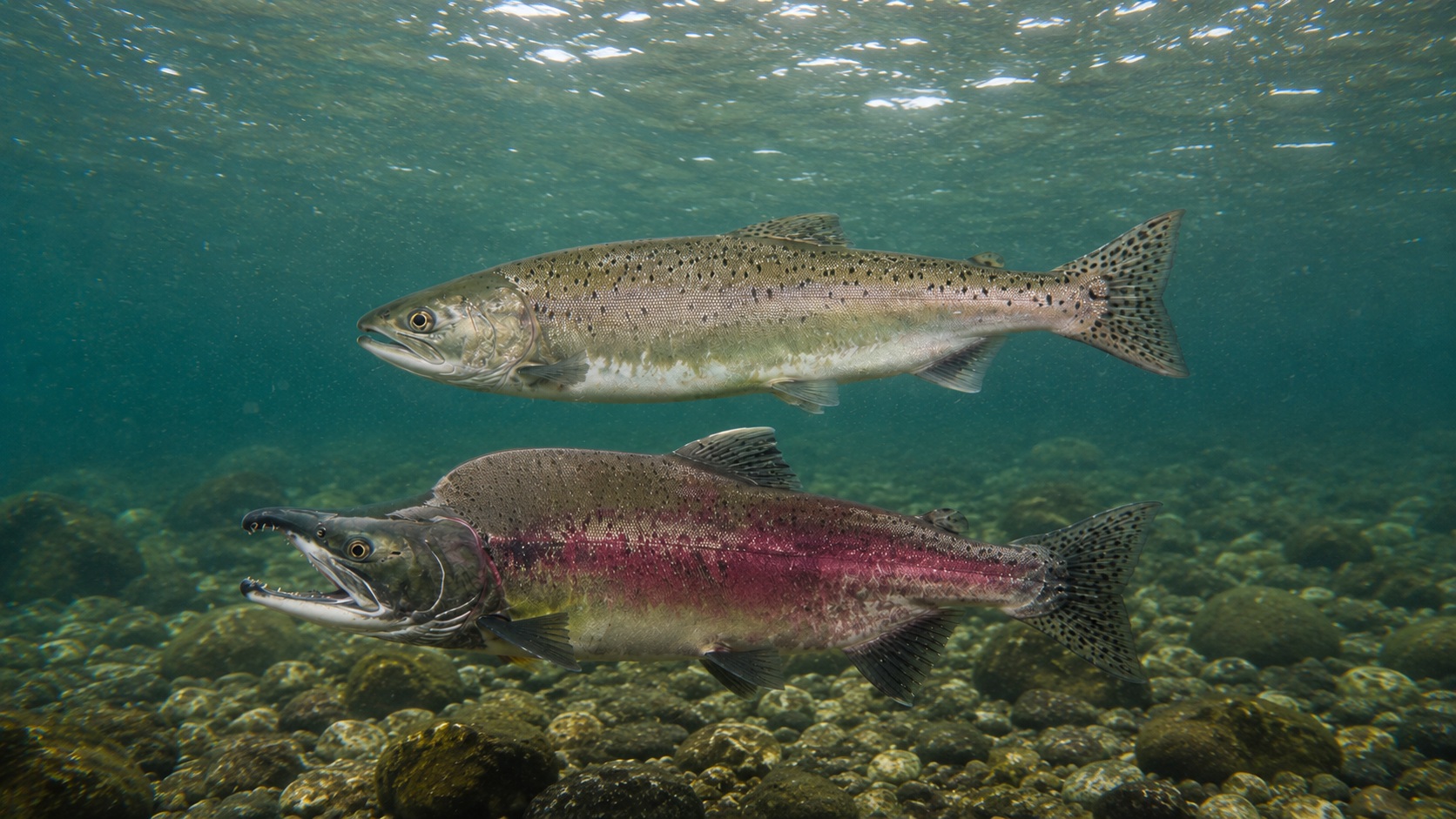
Ocean-fresh pink salmon are bright silver along the sides with a greenish-blue back and large, irregular oval black spots scattered across the back and across both lobes of the tail fin. That heavy spotting on the tail — larger and more numerous than on any other Pacific salmon — is the single most reliable field mark when fish are chrome. The body is compact relative to other salmon, averaging 3 to 6 pounds and 20 to 25 inches, though fish in the 8 to 10 pound range appear each season. The IGFA all-tackle world record stands at 14 lbs. 13 oz. (6.74 kg), caught in Monroe, Washington in 2001.
Once fish have been in freshwater for even a short time, the transformation in males is dramatic and hard to miss. A pronounced fleshy hump develops just behind the head, the jaw hooks into a pronounced kype, and the body shifts from silver to a blotchy gray-brown. Females change color but do not develop the hump, retaining a more streamlined profile. Both sexes develop pink or red blotching on the sides near spawning time. The flesh is pale pink compared to chinook or sockeye, and the flavor is mild, which is why they pack well for canning and why Alaska processes more pink salmon commercially than any other species.
The two-year life cycle is what defines the species ecologically. Every fish alive today hatched two years ago. Odd-year and even-year populations are genetically distinct and do not interbreed, meaning a river with a strong odd-year run may produce almost nothing in even years, and vice versa. Before you plan a trip, confirm which year your target watershed runs.
Where to find them
Pink salmon range from northern California through British Columbia, Southeast Alaska, and around the rim of the North Pacific, but the core sport fishery concentrates in three regions.
Southeast Alaska holds the broadest and most consistent fishery, with fish entering hundreds of streams from Ketchikan north through the Panhandle. Sitka, Juneau, and Ketchikan-area drainages are popular bases. Trolling and casting in saltwater near river mouths before fish fully commit to the run produces chrome fish in excellent condition.
British Columbia sees major runs in the Fraser River system and in coastal streams from Vancouver Island northward. The even-year vs. odd-year split matters sharply here; the Fraser odd-year runs are historically far larger.
Puget Sound and western Washington concentrate the most accessible sport fishery in the lower 48. During strong odd-year returns — the 2025 Puget Sound return was forecast near 7.8 million fish, about 70 percent above the 10-year average — rivers like the Snohomish, Skykomish, Puyallup, Nisqually, and Dungeness get crowded. Marine Areas 7, 8-1, 9, and 10 (Hood Canal, Admiralty Inlet, central and south Sound) all have dedicated seasons.
In saltwater, fish stage near river mouths and in protected bays and passages before making their freshwater push. In rivers, pinks run fast and typically hold in moderate-depth runs and tailouts rather than the deep slow pools that attract chinook. They rarely hold more than a few hundred yards above tidewater in smaller systems, though they push farther up major rivers.
When to go
Pink salmon have the tightest and most predictable seasonal window of any Pacific salmon. The first fish enter Southeast Alaska tidewater in late June and the wave builds through July. Washington and southern BC streams see peak freshwater entry from mid-July through late August, with the very best river fishing often concentrated in a two- to three-week window. Fish that pushed into freshwater early and have lost their silver color are worth releasing; the prime window is fish fresh from the salt with all their energy intact.
Because only one brood line uses most rivers in any given year, targeting a strong odd-year watershed in an odd-year season (2025, 2027) is far more productive than fishing the same water in an even year. Check the Washington Department of Fish and Wildlife pre-season forecasts or the Alaska Department of Fish and Game run-tracking reports before committing to a destination.
What to throw
Light gear is the right call. A 7- to 8-foot medium-light spinning rod rated for 6- to 12-pound test paired with a quality 2500 to 3000 series reel covers nearly every situation. Fluorocarbon leader in the 10- to 12-pound range holds up to rocks and teeth without limiting presentation.
Small spinners in sizes 2 through 4 are the most reliable freshwater lure. Blue Fox Vibrax, Mepps Aglia, and similar in-line spinners in pink, orange, chartreuse, and silver all work. Match color to water clarity: brighter colors in off-color or turbid water, more natural silver and blue in clear conditions.
Small spoons in the 1/4 to 3/8 ounce range cover the same presentations and are especially good when fish are in faster water. Little Cleo, Krocodile, and similar patterns in hammered silver or pink finish are proven producers.
Flies in saltwater and freshwater both draw strikes. Clouser Minnows, pink and chartreuse streamers, and even small Woolly Buggers will move fish that are actively holding. Pink salmon are more willing to chase than coho but less so than chum once in the river.
In saltwater, light jigs tipped with scampi tails or small bait fish imitations trolled or cast near the surface around river mouths account for chrome fish. Small anchovy or herring strips under a mooching weight also work from a boat.
Pink salmon rarely require any sophisticated presentation. A steady retrieve that keeps the lure at mid-column in moderate current or moves it across staging pods in saltwater is usually enough. The fish are aggressive; finesse matters far less than putting the lure in front of them.
Regulations
Always verify current regulations before fishing. Rules change frequently, emergency orders supersede printed regulations, and region-specific rules vary significantly. The information below summarizes the regulatory framework as of 2025-2026 season planning.
Alaska: Sport fishing regulations are managed by the Alaska Department of Fish and Game (ADFG) and vary by region and drainage. For most of Southeast Alaska and Southcentral during peak season, bag limits for pink salmon are generous — commonly 6 fish per day in many areas, with no size limit — but check the current regional regulation booklet for your specific drainage before fishing. ADFG publishes separate regulation booklets for Southeast, Southcentral, Interior, and Arctic-Yukon-Kuskokwim regions. Emergency orders are posted at adfg.alaska.gov and can change mid-season.
Washington: The Washington Department of Fish and Wildlife (WDFW) sets salmon seasons annually through the North of Falcon process in the spring. Seasons and limits are watershed-specific. In strong odd-year returns, inner Puget Sound marine areas often allow 2 additional pink salmon per day on top of the standard combined salmon daily limit. Freshwater regulations define season dates, daily limits, and release requirements by specific river reach. Consult the current WDFW fishing regulations pamphlet (effective July 1 through June 30) or the WDFW website for the river and marine area you plan to fish.
British Columbia: Fisheries and Oceans Canada (DFO) manages salmon seasons through annual regulation notices. Check the current BC Sport Fishing Regulations for tidal and non-tidal waters at dfo-mpo.gc.ca.
A valid fishing license for the state or province is required everywhere. Washington requires a salmon/steelhead catch record card that must be punched before the fish is retained and returned at year end.
Handling and release
Pink salmon are a sensitive species once in freshwater. Ocean-bright fish in salt or just inside tidewater recover well from catch-and-release if handled correctly. Fish that have been in the river long enough to develop significant color change or the male hump are in spawning condition and have limited time remaining regardless of release; keep any legal fish you intend to eat from that group and release bright fish gently.
Wet your hands before touching any salmon. Do not squeeze the body or hold the fish vertically by the lower jaw — that posture stresses the spine and internal organs. Support the fish horizontally, minimize air exposure, and hold it in moderate current facing upstream until it swims away under its own power. Barbless hooks — required on some Washington rivers and recommended everywhere — dramatically reduce handling time and injury.
For retained fish, bleed them immediately by cutting the gill arch on both sides and placing the fish in an ice slurry. Pink salmon flesh degrades faster than chinook or coho in warm conditions and is worth the effort to chill quickly if you plan to eat them fresh. Vacuum-sealed and frozen within a few hours of catch, they hold well for months.
On the Table
Pink salmon — also called humpback salmon or “humpies” — are solid table fare, though they sit a notch below their Chinook and sockeye cousins in reputation. Fresh, well-handled fish are genuinely good eating; neglected fish deteriorate quickly, which explains the mixed reviews this species often gets.
Taste and texture: Pink salmon have pale pink to orange-pink flesh with a mild, lightly sweet flavor and low fat content compared to other Pacific salmon. The texture is softer and more delicate than Chinook or coho, which makes timing in the kitchen important — overcooking turns the flesh mushy fast. The mild flavor is a plus for anglers who find stronger salmon too rich.
Best preparation methods:
- Smoking: The low fat content that makes pinks tricky to grill actually works in the smoker, where gentle heat and smoke complement the mild flesh without drying it out. Cold-smoked or hot-smoked, pink salmon takes smoke flavor well.
- Pan-searing or planking: High, quick heat locks in moisture before the soft flesh has time to fall apart. A skin-on fillet seared hard on the skin side and finished briefly on the flesh side gives good results.
- Canning: Pink salmon are the species most commonly sold canned commercially for a reason — the mild flavor and soft texture hold up well, and the bones soften enough to eat, adding calcium. Home canning is a popular way to preserve a large catch.
- Baking with a glaze: A miso, soy-ginger, or citrus glaze adds flavor that pairs well with the mild flesh and helps retain moisture during baking. Keep oven time short and use a thermometer; pull at 125-130 F internal for best texture.
Handling for table quality: Pink salmon are among the most perishable of the Pacific salmons. Bleed the fish immediately at the gill plate, then get it onto ice or into an ice slurry within minutes of landing. Field dressing promptly and keeping the body cavity cold preserves the flesh quality dramatically. Because they enter freshwater and die after spawning, river-caught fish in spawning condition (dark coloration, soft flesh, hooked jaw on males) are well past peak eating quality — focus on bright, ocean-fresh or early-run fish for the table.
Caveats: Pink salmon harvested from certain rivers or watersheds may be subject to harvest advisories related to contaminants; check local Fish and Wildlife or state health advisories before eating fish from urban or industrial watersheds. No significant worm parasite concern for table purposes when fish are cooked to proper internal temperature. Freezing to USDA guidelines (-4 F for 7 days) eliminates parasite risk if serving preparations like gravlax.