A note about links: If we include links to retail sites like Amazon or Bass Pro Shops, it's because they're relevant to the topic and, as anglers ourselves, we believe they're worth checking out. As an Amazon Associate we earn from qualifying purchases.
Fishing for white sturgeon is unlike anything else in freshwater angling. You drop a heavy rig to the bottom of a deep, slow-moving channel, the rod loads up, and then everything goes sideways — sometimes literally. A big sturgeon can strip line, bulldoze upstream, and surface in a cartwheel that reminds you just how prehistoric this animal is. There is a weight to the whole experience that matches the fish itself: hours of stillness punctuated by explosive runs from a creature that may well have been swimming this same river before your grandparents were born. The current conservation picture adds another dimension to the pursuit. In several key waters, these fish cannot be kept at all, and that reality sits with you when you finally tail one at the boat, look at its armored flanks and whiskered snout, and slide it back into the current.
How to identify one
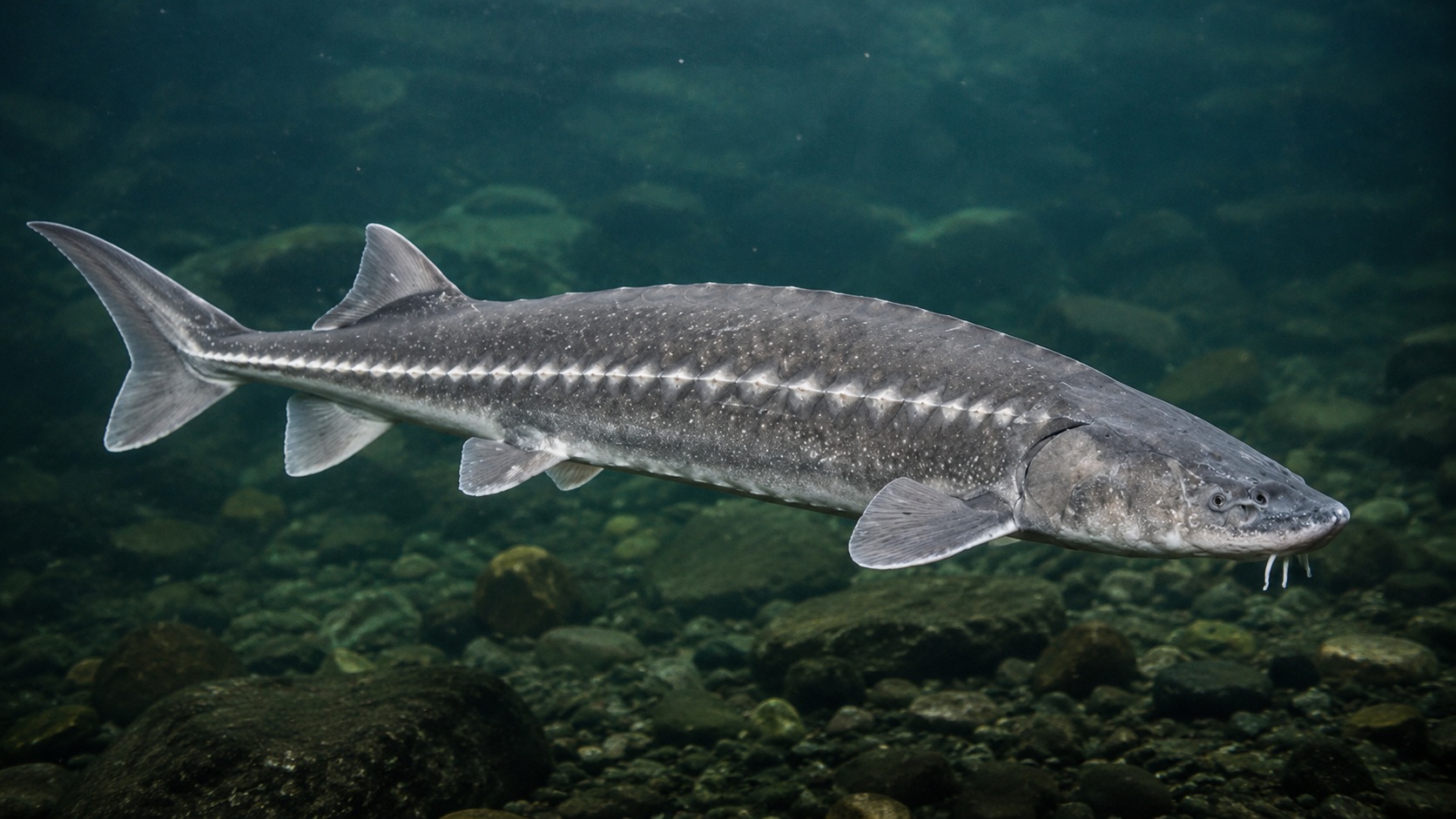
White sturgeon are the largest freshwater fish native to North America, and they look the part. The body is elongated and roughly cylindrical, covered in rows of bony scutes rather than true scales. Five rows of these plates run the length of the fish — one along the dorsal surface, one along each side, and one along each lower flank. The snout is broad and shovel-shaped compared to the narrower rostrum of the green sturgeon. Four barbels hang between the snout tip and the mouth, which is protrusible and set on the underside of the head.
Coloration ranges from pale gray to olive-brown on the back, fading to a lighter belly. The tail is heterocercal, meaning the upper lobe is longer than the lower, a feature shared with sharks. Adult white sturgeon in rivers average 4 to 7 feet in length, but fish exceeding 9 feet are documented, and historical accounts describe individuals approaching 20 feet and well over 1,000 pounds. The IGFA All-Tackle world record stands at 468 pounds (212.28 kg), caught by Joey Pallotta on July 9, 1983, in Benicia, California after a five-hour fight on 60-pound line.
The best field distinction from green sturgeon is the white sturgeon’s broader, blunter snout and generally paler coloration. Green sturgeon also display yellowish-green stripes along the body and belly, which white sturgeon lack.
Where to find them
White sturgeon are native to the Pacific slope of North America from the Aleutian Islands south to Monterey Bay in California. Their core populations concentrate in four major drainages: the Columbia River system (including the lower Snake and Willamette rivers), the Sacramento-San Joaquin river system, the Fraser River in British Columbia, and the Kootenai River in Idaho and Montana.
Within these systems, sturgeon hold in predictable habitat: deep holes adjacent to current breaks, below dams, at the confluence of tributary channels, and along submerged ledges where current deposits food. They are bottom oriented in all seasons, but they will move into shallower tidal flats and estuarine reaches during feeding periods, particularly on flood tides. In large reservoirs behind dams, they suspend at depth and are harder to target consistently.
On tidal rivers, structure your search around the tidal cycle. Incoming tides push baitfish and invertebrates into river channels, triggering feeding activity in staging fish. The Columbia River estuary, the Sacramento Delta, and the lower Fraser near Mission all fish better on moving water. Upriver sections hold fish that are less influenced by tide and more keyed to seasonal migrations tied to water temperature and flow.
When to go
Spring is the primary season. As water temperatures climb from the mid-40s into the low 60s Fahrenheit (roughly 7 to 16 Celsius) between March and June, sturgeon move upriver to spawn. Pre-spawn fish feed heavily and are concentrated in predictable reaches, making them the most accessible of the year. This is also when regulatory seasons in the Pacific Northwest are most likely to allow retention, when any retention is permitted at all.
Summer fishing is slower as fish scatter and water warms. Some excellent catch-and-release action continues through summer on the Columbia above Bonneville Dam, where cold reservoir releases keep temperatures in range. Fall brings another feeding surge as fish fatten before winter. Winter sturgeon fishing in tidal reaches can be surprisingly productive on mild days — fish are lethargic but present, and the crowds thin dramatically.
Peak feeding windows within a day align with tide changes on tidal rivers. On non-tidal sections, early morning and evening tend to be most productive, though sturgeon are caught throughout the day.
What to throw
White sturgeon are opportunistic bottom feeders with a diet that tracks whatever is seasonally abundant. The most consistently productive baits across systems and seasons include:
Shad and eulachon (smelt) — Cut shad, whole shad, or shad roe are arguably the top producers on the Columbia system. Eulachon (candlefish) are a traditional and effective bait where legal and available, particularly in tidal reaches when the smelt are running.
Lamprey — Pacific lamprey and cut lamprey sections produce well on the Columbia and Willamette. The oily scent holds in current effectively.
Nightcrawlers and worm cocktails — A cluster of nightcrawlers on a wide-gap hook catches sturgeon across all systems and is a reliable option when fish baits are unavailable.
Sand shrimp and ghost shrimp — Highly productive in tidal and brackish reaches, particularly the Sacramento Delta and lower Columbia. Often more effective during early season or in lower-clarity water.
Salmon eggs and roe — Cured roe bags or loose eggs are effective during salmon spawning seasons when eggs are naturally drifting through sturgeon habitat.
Tackle should be scaled to the water. A conventional rod rated for 20 to 60 pounds, paired with a level-wind reel holding 200-plus yards of 40 to 80-pound braid, is a workable general setup. Use a sliding sinker rig — a slider or fish-finder rig that lets line run freely through the weight — so a fish can pick up the bait without feeling resistance immediately. Sinkers range from 2 ounces in slow tidal water to 16 ounces or more in fast Columbia River current. Circle hooks in 7/0 to 10/0 sizes are increasingly preferred for sturgeon because they tend to hook fish in the corner of the mouth, reduce gut-hooking, and are mandatory in some jurisdictions.
Regulations
White sturgeon regulations are among the most complex and rapidly changing in freshwater fishing. The information below reflects the best available data as of June 2026, but conditions change — always confirm with the relevant state or provincial agency before your trip, because seasons open and close on short notice based on annual population assessments.
California: White sturgeon are currently a candidate species for listing as threatened under the California Endangered Species Act. The sport fishery is open on a catch-and-release only basis from October 1, 2025 through June 30, 2026 in designated waters including the ocean, San Francisco Bay, the Delta, and lower Sacramento and San Joaquin rivers. No retention is permitted. A Sturgeon Report Card is required. Anglers must use a single barbless hook. Any sturgeon exceeding 68 inches fork length must remain fully submerged and may not be removed from the water.
Oregon: In the Columbia River mainstem, retention of white sturgeon is closed by default as of 2026, with retention fisheries only opened by emergency rule when stock conditions allow. When open, slot limits and minimum sizes vary by river section (typically 38-inch minimum fork length below The Dalles Dam, 43-inch minimum above). No traditional New Year’s Day opener was held in 2026. Catch-and-release fishing is permitted in closed-retention reaches. Check ODFW regulation updates frequently.
Washington: Washington mirrors Oregon’s Columbia River management. Retention is closed by default and opened by emergency rule. When open, a 43 to 54-inch fork length slot applies in sections like The Dalles Pool, with a 38-inch minimum in lower-river sections. The annual limit is 2 fish combined across Oregon and Washington licenses. A Catch Record Card is required. Night fishing for sturgeon is prohibited.
British Columbia: The Fraser River sturgeon fishery is catch-and-release only. A White Sturgeon Conservation Licence is required in addition to a basic freshwater licence for fishing the Fraser River watershed from the CPR Bridge at Mission upstream. Fish over 150 cm (approximately 59 inches) in total length must remain fully submerged at all times during handling.
Regulations governing gear, methods, and open seasons apply in all jurisdictions. Always verify current rules through official agency sources before fishing.
Handling and release
White sturgeon are a species where handling technique directly affects survival, and the conservation context in 2026 makes proper release critical.
Keep fish in the water. For fish under roughly 1 meter (about 40 inches), a brief lift for a photograph is generally tolerated if the fish is supported horizontally with two hands. For larger fish, keep them submerged throughout. In British Columbia, fish over 150 cm must remain in the water by regulation; treating this as the standard everywhere is sound practice.
Use circle hooks and barbless hooks. Many jurisdictions require barbless hooks for sturgeon. Circle hooks tend to lodge in the corner of the jaw rather than deeper in the mouth or gullet, making removal faster and less traumatic.
Minimize fight time. Use gear heavy enough to land the fish efficiently. Prolonged fights in warm water exhaust fish to the point of physiological stress that can cause delayed mortality. In summer, when water temperatures exceed 68 degrees Fahrenheit (20 Celsius), consider not targeting sturgeon at all.
Revive before release. If a fish is exhausted, hold it upright and facing into the current until it kicks free under its own power. Never toss or drop a large sturgeon back in from above the water surface.
Use a sling or cradle for big fish. Lifting a large sturgeon — especially one over 50 pounds — by the tail or midsection can damage internal organs. A soft mesh landing cradle or sling that distributes weight along the body is the correct tool.
The white sturgeon is a species that connects today’s anglers to an animal that has existed largely unchanged for 200 million years. The populations alive in these rivers today are the product of long-lived individuals, many of them older than the anglers fishing for them. The care you take with each fish you touch is a direct contribution to whether this fishery exists for the next generation.
On the Table
White sturgeon is genuinely excellent table fare — firm, mild, and versatile — but its eatability rating stays at “fair” because retention is heavily restricted or outright prohibited across most of its range, making it a catch-and-release fish for the majority of anglers most of the time.
Taste and texture: The flesh is white to off-white, firm, and dense with large muscle flakes — closer in structure to veal or chicken breast than to a flaky fish fillet. The flavor is mild and slightly sweet, with a subtle richness that takes on buttery notes when prepared simply. Wild fish can run a touch bolder than farm-raised, but neither is strong or “fishy.” Because the flesh is so meaty and low in connective tissue, it holds up well to high heat without falling apart.
Best preparation methods:
- Grilling: The firm texture makes sturgeon ideal for the grill. Brush steaks or fillets with oil, season simply with salt, pepper, and lemon, and cook over medium-high heat 4-5 minutes per side. The mild flesh picks up grill char beautifully without being overwhelmed.
- Smoking: Sturgeon is one of the best candidates for hot-smoking in the freshwater world. Low and slow at 180-200 degrees F over alder or apple wood produces a silky, smoke-kissed result. Pat the surface dry before smoking to ensure good smoke adhesion.
- Pan-searing: A hard sear in a cast-iron skillet with butter, garlic, and fresh thyme works very well for steaks. Pull the fish at an internal temp of 135-140 degrees F and rest briefly — overcooking makes it rubbery.
- Baking: Thick fillets benefit from a covered bake at 350 degrees F for 20-25 minutes before finishing uncovered. This prevents the outside from seizing before the center comes up to temperature.
Handling for table quality: Ice fish immediately after a legal harvest. Sturgeon bleed well if bled at the gill plate right after dispatch. The skin is tough and covered in bony scutes (the armored ridge plates) — remove scutes before skinning by scoring alongside them. The lateral line and any dark red bloodline along the fillet should be trimmed away to keep flavor clean. Rinse, pat dry, and refrigerate on ice for no more than 1-2 days before cooking.
Legal status — critical note: White sturgeon retention is regulated by strict slot limits and annual quotas that vary by watershed and change year to year. In California, the fishery is currently catch-and-release only in all state waters. On the Columbia River (Oregon/Washington), short retention windows with tight slot limits (typically 43-54 inches fork length) apply to specific pools, and large portions of the river are closed to retention entirely. Always check current state regulations before retaining any sturgeon — the rules change frequently and penalties are significant.