A note about links: If we include links to retail sites like Amazon or Bass Pro Shops, it's because they're relevant to the topic and, as anglers ourselves, we believe they're worth checking out. As an Amazon Associate we earn from qualifying purchases.
Most fish sleep through the coldest nights of January. Burbot throw a spawning party. While walleye anglers are warming up by the heater and trout are hugging the thermocline, eelpout are stacked in 15 feet of water beneath the ice, aggressive, hungry, and completely ignored by the majority of anglers on the lake. That gap in attention is your advantage. Burbot are the cult fish of the hard-water crowd, built ugly on purpose and eating like cod because they are cod, the only member of that saltwater family to have made a permanent home in freshwater. Chase them at night on Lake of the Woods in Minnesota, the Tanana River in Alaska, Lake Diefenbaker in Saskatchewan, or the Snake River in Idaho, and you will come away with a cooler full of white, flaky, mild fillets and a story that sounds made up.
How to identify one
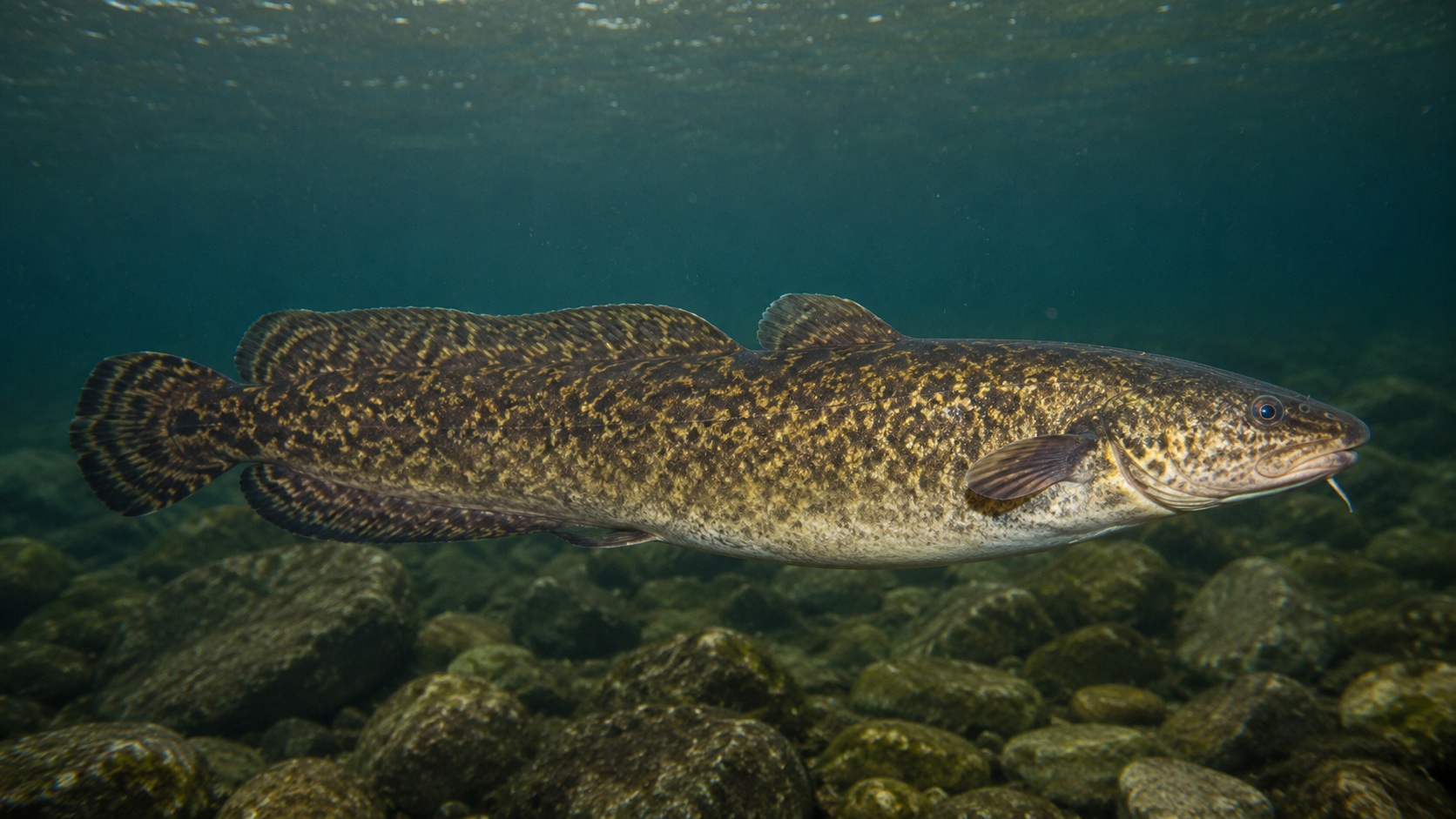
Burbot look like what happens when an eel and a catfish collide. The body is long, slender, and rounded toward the tail, covered in small smooth scales and a thick layer of protective slime. Coloration runs from olive-brown to yellowish-tan with a mottled, marbled pattern that helps them disappear on a rock or gravel bottom. The most reliable field mark is the single chin barbel, one fleshy whisker beneath the jaw, plus two dorsal fins running most of the length of the back. The pelvic fins sit unusually far forward, almost under the chin. Sizes range widely: a typical catch runs 16 to 24 inches and 1 to 4 pounds, but fish over 10 pounds are caught every winter season and the all-tackle world record from Lake Diefenbaker stands at 25 lb 2 oz.
Where to find them
Burbot need cold, clean, well-oxygenated water and they need depth. In lakes, summer finds them in the profundal zone, often 60 to 150 feet down where temperatures stay below 65 degrees. As water cools in fall and the ice forms, they move shallower, staging on rocky points, gravel shoals, and hard-bottom flats in 8 to 30 feet of water. River populations hold in deep pools and slow runs adjacent to gravel substrate, especially below dams and in tailwaters that stay cold year-round.
Prime destination waters in North America include Lake of the Woods and Rainy Lake on the Minnesota-Ontario border, Flathead Lake and Fort Peck Reservoir in Montana, the Tanana and Copper River drainages in interior Alaska, Lake Diefenbaker and Lac La Ronge in Saskatchewan, Great Slave Lake in the Northwest Territories, and the Snake River system in Idaho. Great Lakes populations persist in Lakes Superior, Michigan, and Huron. In New England, burbot appear in deep cold lakes across Maine, New Hampshire, and Vermont, where they are sometimes called freshwater cusk. Minnesota’s Leech Lake near Walker draws particular attention: the International Eelpout Festival, held on the ice in February since 1980, is one of the few major sporting events in North America organized entirely around a single species that most anglers have never targeted.
When to go
Winter is the whole answer. Burbot spawn under the ice from late December through March, congregating in shallow water to broadcast eggs in writhing communal masses. This spawning behavior makes them extraordinarily catchable during the coldest months of the year, precisely when most anglers have put their rods away. The best nights are the bitter ones: overcast skies, temperatures well below freezing, with snow on the ice. Activity peaks from an hour after sunset until around 2 a.m., though they will feed through the entire night. Open-water catches are possible in deep cold lakes during summer, mostly as incidental catches by anglers bottom-fishing for walleye or lake trout, but ice is where the real fishery lives.
What to throw
Cut bait and live minnows are the standard. Burbot locate food primarily by smell and lateral-line vibration in complete darkness, so scent matters. Cut sucker, chub, cisco, or frozen smelt all work well. Anchovies from the grocery store produce fish. For lures, phosphorescent or glow-in-the-dark jigging spoons in the 1 to 2 ounce range are effective because they reflect any available light and create noise on the bottom. The retrieve style that consistently outperforms subtle jigging is aggressive pounding: lift the jig hard, let it crash to the bottom, and stir up a cloud of sediment. That thump registers on the lateral line and triggers strikes from fish that may not have been close enough to smell the bait.
Tip-ups rigged with a large minnow or cut bait suspended two inches off the bottom produce fish for anglers who want to set multiple holes. After dark in a hard-water season, a spread of tip-ups with one or two active jigging rods covers water and keeps options open. For open-water river fishing, a simple bottom rig with a 1 to 2 ounce sinker and a hook baited with cut sucker fished in the slowest part of a deep pool will find fish. No need for finesse gear. A medium-heavy rod and 15-pound monofilament handles anything you will encounter.
Regulations
Burbot regulations vary significantly by state and province, and the patchwork reflects the species’ transition from largely unregulated rough fish to managed game fish in many jurisdictions. Always verify with your specific state or provincial agency before your trip.
Minnesota: Burbot were reclassified from rough fish to game fish in 2020. As of 2026, there is no statewide daily bag limit, though limits have been proposed and may be adopted in coming seasons. Check the Minnesota DNR (dnr.state.mn.us) for updates before heading to Lake of the Woods or Rainy Lake.
Michigan: As of April 1, 2026, Michigan established a daily possession limit of five burbot per angler statewide. This is a new regulation and represents a significant shift from the previous unregulated status. Michigan DNR manages this fishery at michigan.gov/dnr.
Montana: No specific statewide bag limit was listed for burbot in the 2026 Montana FWP regulations for most general waters, though some specific water bodies such as Tiber Reservoir have special rules. Confirm current limits with Montana Fish, Wildlife and Parks at fwp.mt.gov before fishing Flathead Lake or the Missouri River system.
Idaho: The bag limit is 6 burbot per day in the Panhandle region. Burbot are open year-round where present. Idaho Fish and Game at idfg.idaho.gov is the authoritative source.
Alaska: The general statewide limit is 15 burbot per day, but this drops sharply on many specific waters. Lake Louise allows only 1 per day. The Tyone River system allows 2. Because the variation is so extreme, checking ADF&G regulations for your specific drainage (adfg.alaska.gov) before any Alaska burbot trip is not optional.
Canada: Limits vary by province. Saskatchewan allows 8 per day; Alberta allows 10. Consult your provincial fisheries agency for current rules.
For ice fishing specifically, most states that regulate burbot do not distinguish between open-water and ice seasons, but check for any special winter-only closures or sanctuary areas on the lakes you plan to fish.
Handling and release
Burbot are slippery. The heavy mucus coat that makes them so effective at navigating cold rocky bottoms is the same coating that makes them nearly impossible to hold with dry hands. Wet your hands before handling, grip firmly around the body just behind the pectoral fins, and keep the fish low over the ice or water. Burbot are hardy and recover well from brief air exposure in cold weather. The cold itself is not the problem for them. If you plan to release the fish, remove the hook quickly and return the burbot to the water headfirst. For a keeper fish destined for the table, burbot hold exceptionally well on a stringer or in a live well in cold water. The flesh is dense, white, and mild, and the liver is considered a delicacy by those who know the fishery. A burbot kept in ice and cleaned the same day is one of the better eating fish in any cold freshwater system.
On the Table
Burbot is one of the most underrated table fish in fresh water, and anglers who discover its eating quality rarely throw one back. The only freshwater member of the cod family (Gadidae), it delivers mild, sweet, white flesh that has earned it the nickname “poor man’s lobster” among ice-fishing communities from Alaska to the Great Lakes.
Taste and texture: The flesh is bright white, fine-grained, and firm with a delicate, slightly sweet flavor that most anglers compare directly to cod or haddock — and, when boiled in butter, to lobster tail. There is no oiliness and virtually no “fishy” aftertaste. Texture holds up well to heat but turns rubbery if overcooked or improperly frozen.
Best preparation methods:
- Boiled in seasoned water with butter: The classic technique. Simmer chunks in lightly salted water (some cooks add a tablespoon of sugar) just until the flesh turns opaque, then serve immediately with drawn garlic butter. The cod-like density of the flesh holds together without falling apart, and the result genuinely mimics the texture of boiled lobster.
- Battered and fried: Thick loin sections cut into nuggets, coated in a light beer batter or seasoned cornmeal, and fried at 350-375 F produce a clean, flaky result comparable to cod fish-and-chips. The firm flesh does not become mushy inside the batter the way softer fish can.
- Pan-fried in butter: Skin-off fillets dusted with seasoned flour and cooked in a hot cast-iron pan stay together well. The mild flavor pairs cleanly with lemon, capers, or fresh herbs without needing heavy seasoning to cover off-flavors.
- Baked: Thick loin portions hold moisture well in a 400 F oven with olive oil and aromatics. Avoid baking the thin tail-end fillets, which desiccate and curl quickly — save those for chowder or frying.
Handling for table quality: Burbot deteriorate faster than many freshwater species once out of cold water. Keep them alive or on ice immediately after landing. The skin is slick and tough; the most reliable skinning method is to score around the base of the head, hang the fish by the lower jaw, and pull the skin off with pliers in one strip toward the tail. Rib bones sit perpendicular to the body cavity — fillet around them on larger fish or snip them cleanly with kitchen shears. The thick back-loin section is the prime cut; process that section first. Do not refreeze thawed burbot; the texture degrades to rubbery in a second freeze cycle.
Eating caveats: No significant parasite concerns specific to burbot beyond the standard rule of fully cooking all freshwater fish to an internal temperature of 145 F. No ciguatera risk (strictly freshwater). No elevated mercury concerns at typical keeper sizes. Check local regulations, as some interior Alaska and Canadian waters have specific bag limits during winter ice-fishing seasons when burbot are most actively targeted.