A note about links: If we include links to retail sites like Amazon or Bass Pro Shops, it's because they're relevant to the topic and, as anglers ourselves, we believe they're worth checking out. As an Amazon Associate we earn from qualifying purchases.
You feel the hit before you understand what happened. One second your bait is on the bottom next to a wreck piling, and the next something the size of a refrigerator is trying to drag your entire rig into a pile of barnacled steel. Goliath Grouper do not run — they turn and bore straight back into cover, and if your tackle is not up to the task, they win every time. These encounters are not about finesse. They are about horsepower, heavy gear, and the surreal experience of staring into the water as a fish that outweighs three adult men rises from the structure to investigate your offering. Along the southeastern Atlantic coast, in the Gulf of Mexico, and throughout the Caribbean, anglers lucky enough to be on the right structure get a shot at these giants — and even a catch-and-release encounter is the kind of story you tell for years.
How to identify one
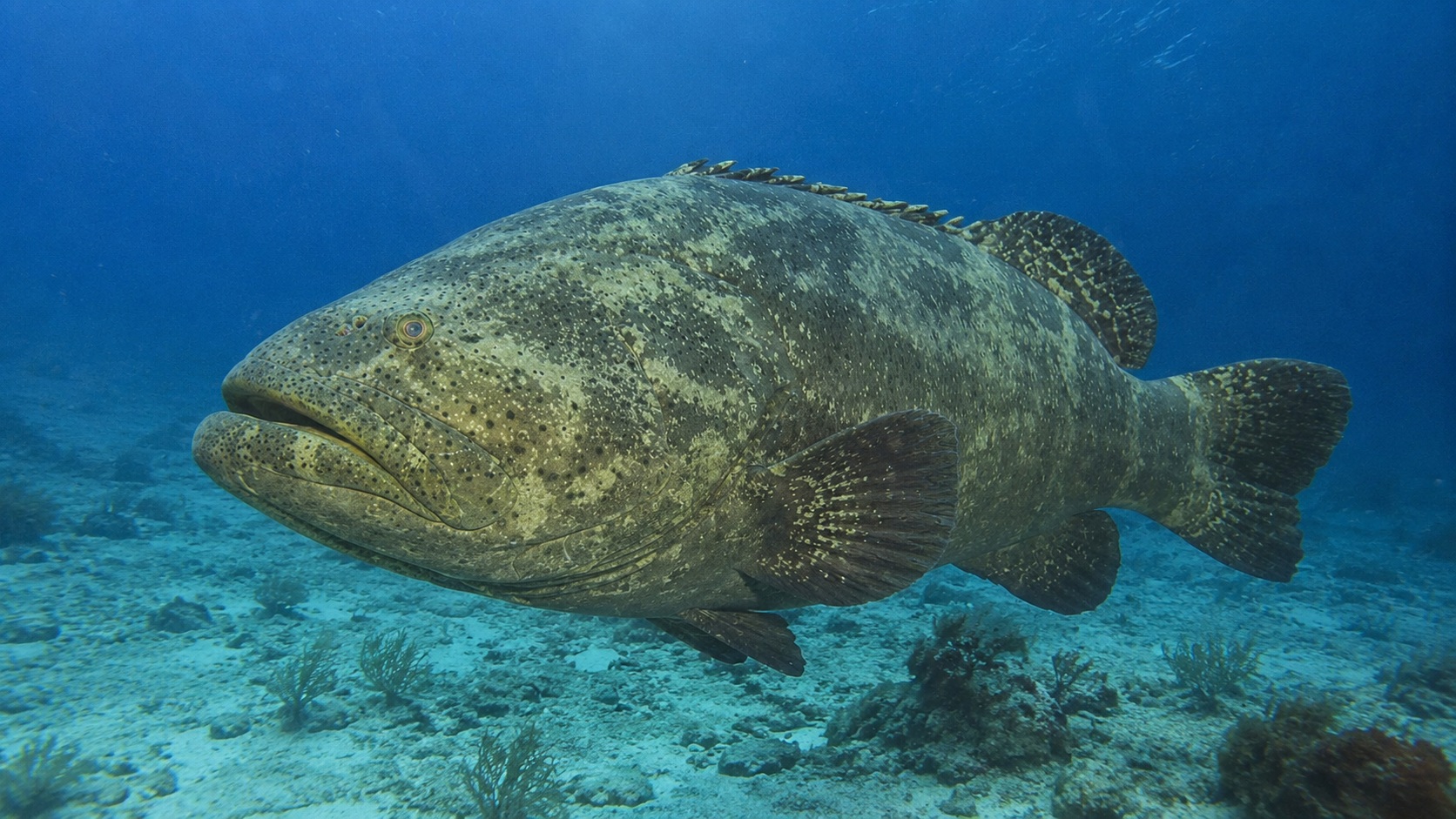
Goliath Grouper are nearly impossible to confuse with anything else once you have seen a large one. The body is thick-set and elongate, with a broad, flat head and a notably small eye relative to body size. Coloration runs from brownish yellow to grey to greenish, and the fish is covered in small, scattered black dots across the head, body, and fins. Juveniles show irregular dark brown blotches and pale yellowish mottling that serves as camouflage in mangrove roots. The mouth is enormous, built for engulfing prey whole rather than biting. Adults can exceed 8 feet in total length. The pectoral and caudal fins are rounded. No other Atlantic grouper species approaches this size; the nearest lookalike in US waters is the Black Grouper, which tops out well under 200 pounds and lacks the characteristic dotted patterning at large sizes.
Where to find them
Goliath Grouper are hard-structure fish. Adults claim a piece of structure and defend it, sometimes for years. That structure is wrecks, bridge pilings, jetties, dock structures, and natural rock ledges. The highest concentrations accessible to US anglers are along the Florida Gulf and Atlantic coasts, where nearshore wrecks, bay bridges, passes, and offshore reef systems hold resident fish throughout the year. Outside Florida, the species ranges north along the Atlantic coast to the Carolinas — largely juveniles and sub-adults pushing north in summer — and west along the Gulf Coast through Alabama, Mississippi, Louisiana, and Texas, where offshore platform structures and nearshore artificial reefs provide similar hard-bottom habitat.
Juveniles spend their first years in the tangle of mangrove prop roots in estuaries and tidal creeks, which is why mangrove health is directly tied to this species’ long-term recovery. In the Caribbean, adult fish hold on coral reef structure, wreck sites, and rock ledges throughout the Bahamas, Cuba, Belize, and the broader region. Adults range from the shallows down to about 300 feet, but the most fishable concentrations are in 20 to 80 feet of water on nearshore and inshore structure. Spawning aggregations form at predictable sites during the late summer and fall season, when dozens of large fish gather on specific wrecks and reefs in predictable numbers.
When to go
Water temperature drives Goliath Grouper activity. Fish are most active when water temperatures are in the upper 70s to mid-80s Fahrenheit, which corresponds to summer and early fall through most of their US range. Along the Gulf Coast and South Atlantic, this window runs roughly June through October. Further north toward the Carolinas, summer encounters are briefer and largely limited to the warmest months of July and August, when sub-adults push inshore. Spawning aggregations from late August into October concentrate fish on known structure in predictable numbers, making this the most productive period for a genuine giant encounter.
Fish are resident on structure year-round in warmer waters, so off-peak months still produce, but the summer bite is when you have the best chance at a truly large fish. Tidal movement matters less than it does for many inshore species, but slack water and the beginning of an incoming tide tend to produce more active feeding. Early morning and late afternoon are productive, but Goliath Grouper will eat throughout the day on the right structure.
What to throw
Live bait is the gold standard. A large live jack, mullet, pinfish, or grunt dropped straight to the bottom beside the structure will draw strikes from fish that ignore everything else. Anything in the 1 to 3 pound range is appropriate for a big fish. Dead bait works well too, especially oily fish like bonito, mackerel, or false albacore — cut or whole. The scent trail matters. Large cut stingray is a traditional bait and a producer on trophy-class fish.
For tackle, do not underestimate what is required. Use a heavy conventional setup in the 50-to-80-class range with a two-speed reel and maximum drag capability. 200 to 400 lb test monofilament leader on a cable or heavy mono rig is standard, with 16/0 to 20/0 circle hooks crimped solidly to the leader. Mono leaders are preferred over fluorocarbon in this application because the stretch helps absorb the initial surge. Position your anchor upcurrent of the wreck so your bait drifts into the strike zone — you need room to fight the fish away from structure before it wraps you around a beam. For juveniles on inshore structure and bridges, paddletail swimbaits on heavy jigheads in the 1 to 2 oz range will draw strikes on lighter gear and are an exciting way to target the smaller fish.
Regulations
Harvest is prohibited in all U.S. federal waters under NOAA Fisheries management through the Magnuson-Stevens Act. The federal moratorium has been in place since 1990, when the population had collapsed from decades of spearfishing and hook-and-line harvest. The species is managed as a federal stock across the South Atlantic and Gulf of Mexico Fishery Management Councils’ jurisdictions.
State waters follow the same prohibition in most cases, though management details can change as the population is periodically reassessed. Some state agencies have piloted limited, lottery-based research harvest programs in recent years, but for the vast majority of anglers this fish is strictly catch-and-release in all waters. Always check with your state fish and wildlife agency and NOAA Fisheries for current rules before targeting this species, as regulations are subject to change and vary between states and between state and federal waters.
Caribbean: Harvest has been prohibited in US Caribbean waters since 1993.
Goliath Grouper were once so abundant along the southeastern coast that early accounts describe them as a nuisance. Commercial and recreational overharvest through the mid-20th century pushed the species to near-collapse by the 1980s. The US harvest moratorium in 1990 was the direct response to that population crash. Since then, the species has shown meaningful recovery in US waters. The conservation story is part of what makes catching one meaningful.
Handling and release
Goliath Grouper are catch-and-release only for nearly all anglers, and proper handling is not optional — it is part of your legal obligation and the fish’s survival. Large specimens must be kept in the water. Their skeletal structure cannot support their own body weight in air, and removing a 200-pound or larger fish from the water causes internal injury that can be fatal. Keep the fish beside the boat, remove the hook with long-handled dehooking pliers, and allow the fish to swim away on its own. Do not attempt to pull a large fish across the gunwale for a photo. If you need a photo, lean over the side of the boat.
For fish caught in deeper water showing signs of barotrauma — a distended stomach, a fish that cannot stay down — use a descending device or release weight to return it to depth quickly. Circle hooks make dehooking faster and less traumatic; barbless hooks are worth considering in this fishery. These fish are long-lived and slow-maturing, with individuals documented at 37 years. Every released fish represents decades of future encounters for the next angler. Treat them accordingly.
On the Table
Goliath grouper are not a table fish — not because the flesh is poor quality, but because possessing one in the United States is illegal under federal and state protections, and has been since 1990. Any angler who catches a goliath grouper must release it immediately and unharmed.
Legal status: The goliath grouper (Epinephelus itajara) has been under a complete harvest and possession moratorium in U.S. Atlantic and Gulf of Mexico federal waters since 1990, managed by NOAA Fisheries under the Magnuson-Stevens Act. State waters across the species’ US range follow the same prohibition. The species was severely depleted by spearfishing and hook-and-line harvest through the 1970s and 1980s. A limited, highly regulated harvest was briefly piloted in Florida in 2023 as a research program (a small number of tags issued by lottery), but for the vast majority of anglers this fish is strictly catch-and-release. Possessing a goliath grouper outside of a specific permitted program constitutes a federal violation.
Taste and texture (historical and reference only): Historically, goliath grouper was considered good-to-excellent eating — consistent with other large grouper species. The flesh is white, firm, and mild with a slightly sweet flavor, similar to black grouper or Warsaw grouper. The dense, meaty texture holds up well to high-heat cooking methods. Older accounts describe it as one of the more flavorful of the large Atlantic grouper, though the sheer size of the fish (commonly 200-400+ lbs) means the fillets from large adults are very thick.
Ciguatera risk (reference only): As a large apex reef predator in tropical and subtropical Atlantic waters, goliath grouper carry a meaningful ciguatoxin bioaccumulation risk — higher in larger, older fish from reef systems in South Florida, the Caribbean, and the Gulf. This is a secondary concern given the legal prohibition, but worth noting for context.
For anglers: Handle goliath grouper with care during the fight and at boatside. These fish are powerful and large; keep them in the water as much as possible, use a dehooking tool, and minimize air exposure. Vertical release (head-up) helps the fish recover and descend. Document with an in-water photo if you like — they are genuinely impressive fish — then release promptly.